

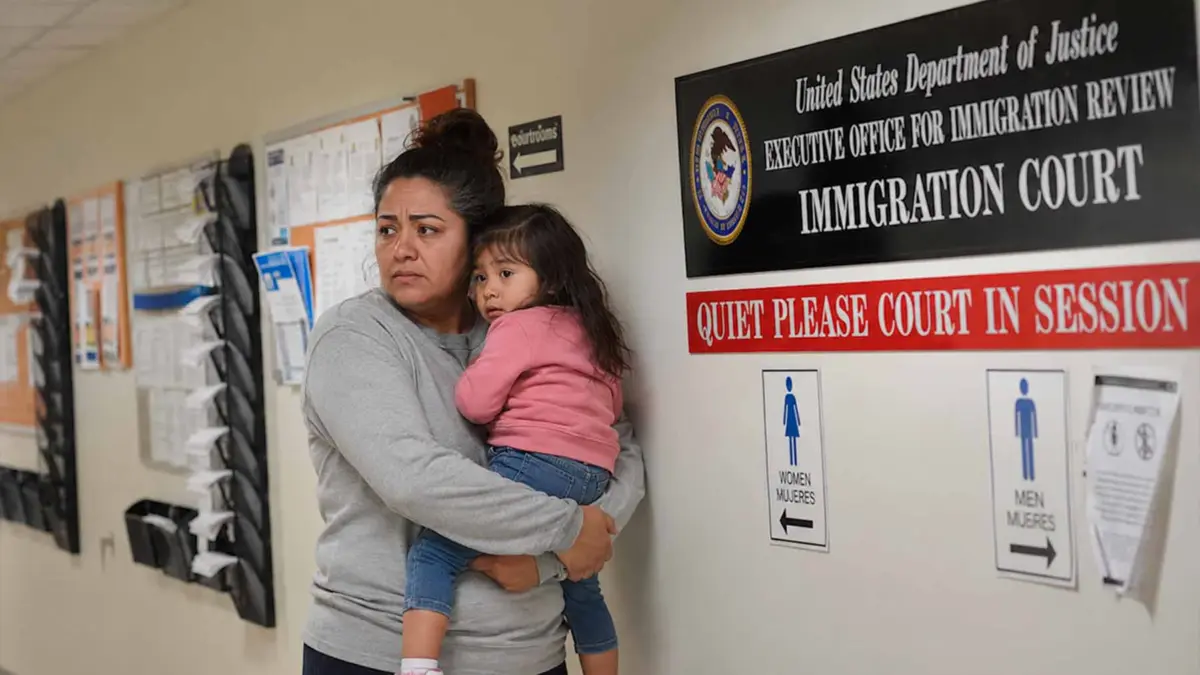
WASHINGTON — In a sweeping regulatory change that fundamentally alters the landscape of the United States asylum system, federal immigration authorities have enacted a controversial new procedure designed to drastically reduce administrative backlogs. Under the updated rules, the U.S. Citizenship and Immigration Services (USCIS) is authorized to bypass mandatory in-person asylum interviews for specific applicants, diverting their cases immediately into the adversarial environment of the nation’s immigration courts.
While the administration champions the policy as an essential bureaucratic efficiency measure intended to clear millions of pending cases, human rights advocates, legal experts, and affected migrants warn of severe repercussions. By removing the initial screening interview—traditionally a non-adversarial setting where individuals could explain their fears of persecution—the policy forces vulnerable asylum seekers directly into high-stakes judicial proceedings, sparking intense debate over due process and the future of humanitarian protection in the United States.
Main Facts
The core of the new regulatory framework centers on procedural acceleration and document-based decision-making.
- Elimination of Initial Interviews: USCIS officials are no longer legally required to conduct an in-person interview with every asylum seeker. Instead, officers can review existing case files purely on paper and render a determination to bypass the agency level altogether.
- Direct Referral to Courts: Applicants whose cases are selected under this new framework receive a Notice to Appear (NTA) before an immigration judge within the Executive Office for Immigration Review (EOIR), effectively skipping the USCIS administrative adjudication phase.
- Targeted Demographics: The policy heavily impacts specific categories of applicants, most notably those who filed their asylum applications past the traditional one-year statutory deadline or those whom USCIS officers determine fail to meet specific preliminary administrative criteria.
- Massive Scale: According to government estimates, approximately 444,724 pending asylum cases—roughly one-third of the entire current backlog—could be funneled directly into the court system under this initiative. Annually, an estimated 132,000 files are projected to bypass USCIS and head straight to judicial dockets.
- Shifting Legal Environment: Moving a case from USCIS to an immigration court transitions the process from a non-adversarial review into a formal litigation process. Asylum seekers must now face government attorneys representing the Department of Homeland Security (DHS), who actively cross-examine applicants and contest their claims.
Chronology: The Evolution of the Asylum Backlog and Policy Shift
To understand how the U.S. immigration system arrived at this critical juncture, it is necessary to examine the historical trajectory of administrative reforms, executive actions, and systemic pressures that culminated in the current regulation.
1. The Growing Humanitarian Crisis and Administrative Strain (2015–2020)
For over a decade, the U.S. immigration system has faced unprecedented pressures. Political instability, economic collapse, violence, and climate displacement across Latin America and other regions drove millions of individuals to seek refuge at the U.S. southern border and internal ports of entry. As filings surged into the hundreds of thousands annually, both USCIS offices and the immigration court system (EOIR) experienced crippling bottlenecks.
2. The Era of Regulatory Overhauls (2020–2024)
Successive administrations attempted various containment strategies, ranging from Title 42 public health restrictions to expedited removal protocols. During this period, the backlog at USCIS alone ballooned past one million cases. Internal memos and federal proposals began exploring mechanisms to streamline adjudications. The primary focus shifted toward "fast-tracking" decisions, raising the evidentiary burden at early stages, and identifying pathways to weed out applications deemed legally deficient before they consumed valuable agency resources.
3. Publication in the Federal Register and Implementation (Late 2024–2026)
The definitive shift materialized with the formal publication of the new interim rule in the Federal Register. By granting USCIS officers the unilateral authority to evaluate files strictly on paper and issue direct court referrals, the agency effectively redefined the first line of defense for asylum seekers. Rather than investing time and manpower into conducting lengthy personal interviews for applicants deemed unlikely to succeed under standard administrative thresholds, the agency elected to transfer the burden entirely onto the immigration courts.
Supporting Data and Statistical Breakdown
The quantitative reality behind the new regulation highlights the sheer scale of the U.S. immigration backlog and the immense pressure placed on judicial resources.
- 444,724 Pending Cases at Risk: Government impact assessments indicate that nearly half a million active asylum applications currently sitting in administrative limbo are eligible for direct routing to immigration judges.
- 132,000 Annual Direct Referrals: Projections show that the new policy will continuously pump more than 130,000 new adversarial cases into the judicial system every year, drastically accelerating the inflow of files.
- Comparative Rejection Rates: Historical data underscores the structural danger of this transition for migrants. Historically, immigration courts maintain significantly higher asylum denial rates compared to USCIS asylum offices. While USCIS officers operate under guidelines geared toward evaluating protection claims in a protective, non-adversarial context, immigration judges function within a punitive judicial framework where legal representation heavily dictates outcomes.
- The Representation Gap: Unlike criminal court proceedings, the U.S. immigration system does not guarantee court-appointed public defenders for indigent defendants. Consequently, hundreds of thousands of migrants—many of whom speak English as a second language, suffer from trauma, and possess zero legal training—will be forced to navigate complex federal litigation entirely on their own against experienced DHS trial attorneys.
Official Responses and Stakeholder Perspectives
The implementation of the rule has triggered sharp polarization between federal policymakers, immigration officials, and legal advocacy organizations.
The Administration’s Stance
Defenders of the policy argue that drastic times require drastic administrative measures. From the perspective of USCIS leadership, the agency is chronically underfunded and overwhelmed by mountains of paperwork that delay legitimate cases for years.
By filtering out cases that lack initial administrative viability or fail basic timeliness criteria (such as the one-year filing deadline), the agency claims it can reallocate vital personnel to process other urgent humanitarian claims more efficiently. Proponents maintain that sending a case to an immigration court is not a denial of rights, but rather a direct routing to the proper judicial venue where a final, legally binding determination can be made by a trained immigration judge.
The Legal and Humanitarian Outcry
Conversely, civil rights groups, legal associations, and immigrant advocacy coalitions have condemned the rule as an assault on due process and human rights.
- Undermining the Right to Seek Asylum: Critics emphasize that the affirmative asylum interview at USCIS was intentionally designed as a safe space where persecuted individuals could articulate complex, often traumatic narratives of fear without facing aggressive cross-examination. Removing this step strips away a critical safety net.
- Overburdening the Courts: Legal scholars point out the deep irony of the policy: while it successfully reduces the administrative burden on USCIS, it dumps hundreds of thousands of complex litigation files onto an already paralyzed immigration court system that is already struggling with a multi-million-case backlog.
- Due Process Violations: Organizations providing pro bono legal services argue that forcing traumatized individuals—many of whom cannot afford private counsel—to defend themselves in a complex courtroom trial against government lawyers creates an inherently unjust legal process, effectively guaranteeing higher rates of deportation regardless of the merits of the underlying persecution claims.
Implications for the Future of U.S. Immigration
As this new procedural reality takes hold, its long-term ramifications will shape the trajectory of American immigration policy and humanitarian law for years to come.
1. Accelerated Deportation Pipelines
Because immigration courts possess higher denial rates and move swiftly through dockets under targeted enforcement priorities, the mass routing of cases from administrative offices to judicial tribunals will likely result in an exponential surge in final orders of removal. Families and individuals who once spent years waiting for a bureaucratic interview will now find themselves facing expedited deportation orders within months.
2. Strain on Community Legal Networks
Nonprofit legal clinics, community organizations, and volunteer attorneys are bracing for an unprecedented wave of emergency requests for representation. With federal funding for immigration legal aid remaining scarce, the gap between the number of migrants facing deportation in court and those with access to legal counsel will widen catastrophically.
3. A Fundamental Redefinition of Sanctuary
Ultimately, the decision by USCIS to abandon universal interviews signals a profound ideological shift in how the United States approaches humanitarian protection. What was once structured as an investigative, protective administrative process is rapidly morphing into an enforcement-driven mechanism.
For hundreds of thousands of families currently navigating the system, the path to safety has grown drastically narrower, more adversarial, and infinitely more precarious. The speed and efficiency with which these transferred cases are handled in the coming months will not only determine the personal fates of countless individuals, but will also stand as a defining test of the integrity of the American legal system.




Leave a Reply