

By Christian Pérez
Specialized Science and Historical Outreach Journalist
Main Facts: Unlocking the Secrets of the Cretaceous
In the dense, humid rainforests of what is now northern Myanmar, approximately 100 million years ago, a microscopic tragedy unfolded. As colossal dinosaurs roamed the prehistoric terrain, a tiny, unassuming beetle became ensnared in the sticky, golden resin of an ancient conifer. That catastrophic moment—which sealed the insect’s immediate fate—ultimately preserved it in exquisite, three-dimensional detail for an epoch unimaginable to its contemporaries.
Now, an international team of paleontologists and evolutionary biologists has unveiled this remarkable specimen, introducing to science an entirely unknown genus and species: Icaroramus perisi. Published in the prestigious journal Proceedings of the Royal Society B: Biological Sciences, this discovery fundamentally challenges long-held assumptions about how the ancestors of modern fireflies and their relatives communicated.
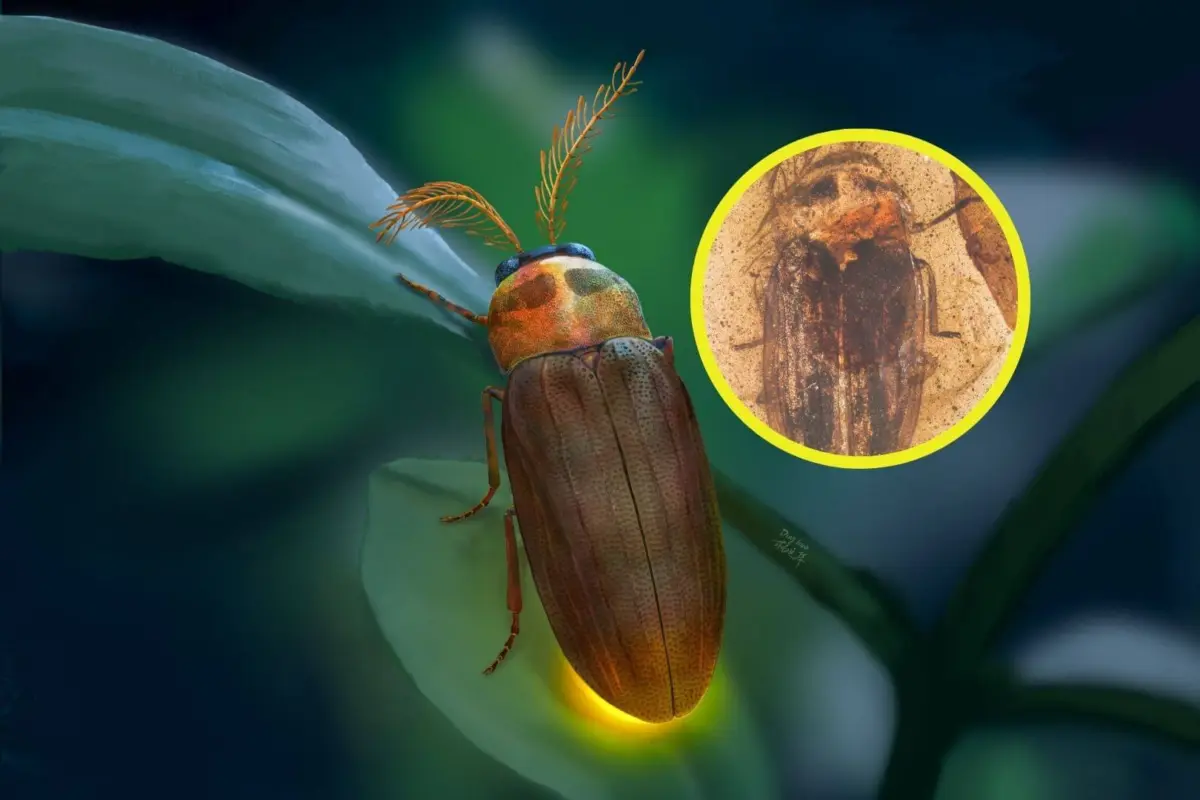
The fossil’s significance lies in a paradoxical combination of anatomical traits never before seen in a single insect. Icaroramus perisi boasts an extraordinarily complex, hyper-specialized radar-like array of antennae alongside a fully developed light-producing abdominal organ. This unique morphological cocktail strongly indicates that the evolutionary path toward bioluminescence was far more intricate, multifaceted, and experimental than science previously dared to imagine. Rather than relying solely on the mesmerizing light flashes characteristic of modern fireflies, these Cretaceous ancestors likely operated in a sensory world that merged chemical cues (pheromones) with brilliant bioluminescent displays.

Chronology: From Burmese Amber Mines to Evolutionary Breakthroughs
To understand the journey of Icaroramus perisi, one must trace a timeline spanning over a hundred million years of geological upheaval, microscopic preservation, and modern laboratory analysis:
- c. 100 Million Years Ago (Cretaceous Period): Mid-Cretaceous ecosystems flourish. Coniferous trees in Southeast Asia produce copious amounts of resin, accidentally trapping diverse insect life, including ancestral beetles that are actively experimenting with chemical and light-based communication.
- The Intervening Millennia: The resin hardens into amber, protecting the fragile biological structures from bacterial decay, scavenging, and crushing geological pressure while tectonic plates slowly shift the landmasses of modern-day Myanmar.
- Recent Years: The amber specimen is unearthed by miners in the Kachin state of Myanmar—a region globally renowned for yielding exceptionally preserved Cretaceous fossils—and eventually makes its way into scientific hands for formal description.
- August 2026: Following exhaustive microscopic analysis, digital 3D reconstruction, and comparative anatomical studies, an international research team officially classifies the specimen, naming it Icaroramus perisi, and publishes their paradigm-shifting findings in Proceedings of the Royal Society B.
Supporting Data: The Anatomy of an Evolutionary Anomaly
The scientific weight of Icaroramus perisi rests on hard, verifiable anatomical data that push the boundaries of insect morphology. Researchers analyzing the fossil focused on two primary features: the unprecedented structure of the antennae and the surprising placement of the abdominal luminous organ.
1. The Quadruple-Branched Antennae
In the insect world, antennae serve as sophisticated chemical laboratories, densely populated with sensilla (sensory receptors) designed to detect airborne molecules, notably sex pheromones. Many insect lineages develop branched (pectinate or bipectinate) antennae to maximize surface area and improve detection ranges.
However, Icaroramus perisi took this evolutionary adaptation to a bewildering extreme:

- Segment Architecture: Each antenna consists of 12 distinct segments.
- Unprecedented Branching: Segments four through eleven feature a completely unprecedented configuration—two distinct pairs of branches per segment.
- Functional Division: One pair of branches originates basally, growing relatively long and thick with coarse hairs, while the second pair arises more centrally, presenting a finer structure covered in delicate micro-hairs.
- Symmetry and Validity: Confirmed to be perfectly symmetrical on both sides of the head, this complex architecture ruled out any possibility of developmental anomaly or accidental deformation. No known living or extinct beetle possesses a comparable antennal framework.
2. The Abdominal Luminous Organ
At the terminal end of the abdomen, the fossil clearly preserves a distinct, lighter-colored region corresponding precisely to the light-producing organs (photocytes) found in modern lampyrids (fireflies) and elateroids (click beetles). However, in modern species that rely heavily on visual flashing for courtship, visual systems (large eyes) dominate, while antennae tend to be relatively simple. Icaroramus flips this ecological blueprint on its head by coupling a rudimentary or secondary light organ with what is arguably the most complex olfactory apparatus ever discovered in a beetle.
Official Responses and Expert Insights
The publication of the Icaroramus perisi study has sent ripples through the global paleoentomology community, sparking intense discussion regarding sensory evolution.
Lead researchers involved in the Proceedings of the Royal Society B paper emphasize the sheer rarity of finding such contrasting sensory extremes preserved simultaneously. "Encountering such highly specialized antennae coupled with a luminous organ in a single fossil offers an unprecedented window into how ancestral firefly relatives navigated their mating and survival strategies," notes the research team in their official findings.
Paleoentomologists not directly affiliated with the study have similarly lauded the discovery as a masterclass in the complexities of insect evolution. Experts point out that the amber from Kachin, Myanmar, continues to act as a scientific time machine, unearthing "failed evolutionary experiments"—adaptations that thrived under specific Cretaceous pressures but ultimately vanished from the gene pool. The discovery forces modern biologists to reconsider the timeline of sensory integration, proving that multi-modal communication (using both scent and light simultaneously) was already taking place during the age of the dinosaurs.

Implications: A Multi-Sensory Cretaceous World and Evolutionary Dead Ends
The implications of the Icaroramus perisi discovery extend far beyond the taxonomy of a single ancient beetle. They reshape our understanding of ancient ecosystems, evolutionary pathways, and the impermanence of biological innovation.
Rethinking Cretaceous Courtship and Defense
In the dense, shadowed understory of Cretaceous forests, relying on a single sensory channel could be a liability. The researchers hypothesize that Icaroramus utilized its "super-olfato" (hyper-olfaction) via its multi-branched antennae to track faint female pheromone trails across vast distances in a cluttered environment.
Meanwhile, what purpose did the light organ serve if not for dazzling mates? The scientific consensus points toward aposematic signaling—a warning to nocturnal predators (such as early mammals, amphibians, and predatory insects) that the beetle was chemically defended, unpalatable, or toxic. Over millions of years, as ecological pressures shifted, these pathways likely bifurcated: some lineages leaned heavily into visual flashing (leading to modern fireflies), while others abandoned complex light signals or lost these hyper-specialized antennal arrays altogether.
Evolution as a Non-Linear Experiment
Perhaps the most profound philosophical and biological takeaway from Icaroramus is the reminder that evolution does not march in a straight, progressive line toward modern forms. Nature is an incessant tinkerer, running complex, high-risk biological experiments.

The extraordinary, four-branched antennae of Icaroramus represent an evolutionary dead end—a brilliant, highly adapted solution to a Cretaceous problem that left no descendants in the modern world. Environmental shifts, changing predator-prey dynamics, or the energetic costs of maintaining such complex tissues likely drove this specific anatomical design to extinction.
Ultimately, thanks to the miraculous preservation of Kachin amber, Icaroramus perisi stands as a testament to the staggering diversity of life that once inhabited our planet. It proves that 100 million years ago, the microscopic inhabitants of Earth were already orchestrating complex symphonies of light and scent, long before the first human ever looked up into a summer night and marveled at the glow of a firefly.



Leave a Reply