

By Investigative Desk
Published in Exclusive Partnership
Main Facts: A Seven-Day Tenancy and a Direct Order from the Casa de Nariño
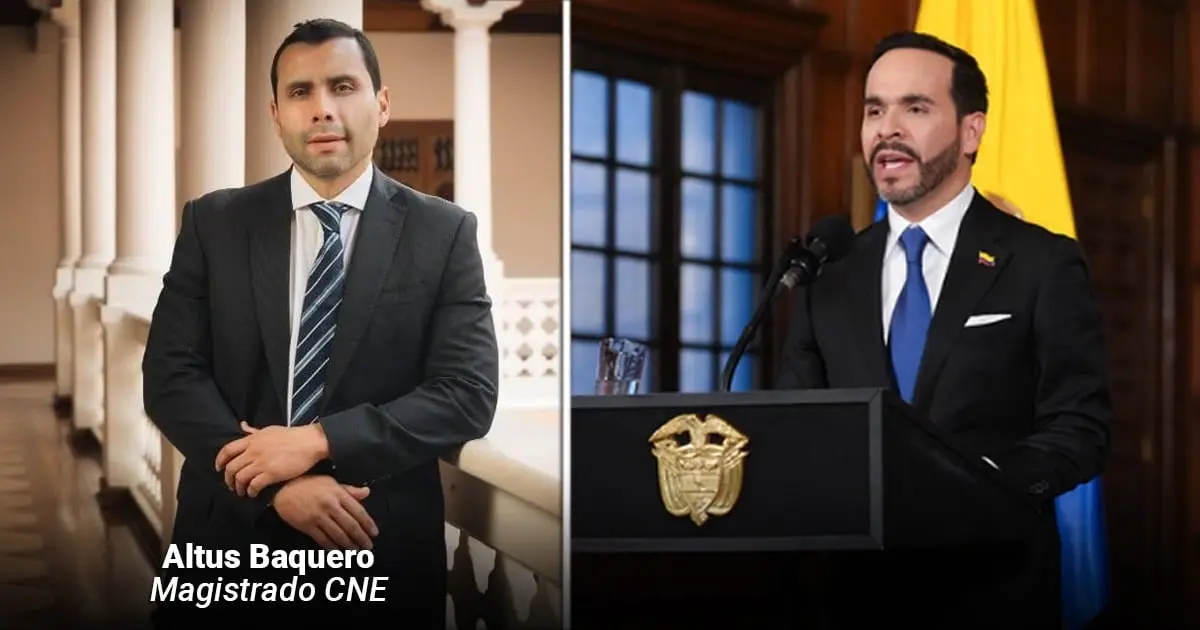
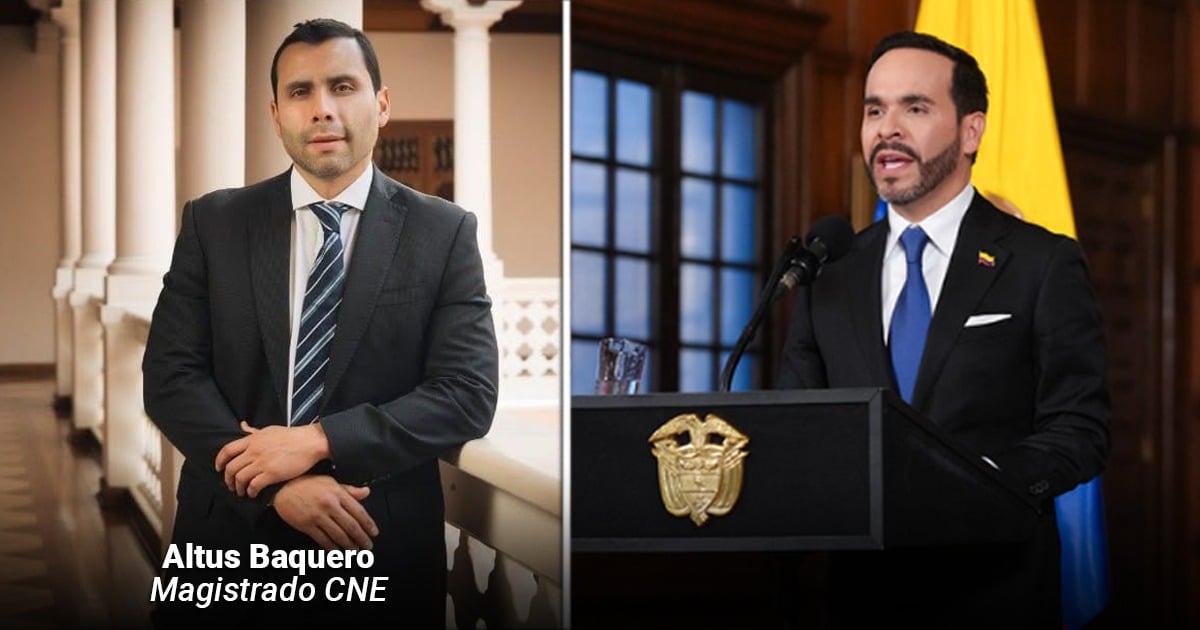
In contemporary Colombian politics, the line separating electoral independence from executive retribution is razor-thin, and few cases illustrate this volatile intersection better than the abrupt dismissal of attorney Altus Baquero.
Graduated with honors from the prestigious Universidad del Rosario and having recently completed a high-stakes tenure as a magistrate on the National Electoral Council (CNE), Baquero thought he had secured a stable footing in the executive branch. On September 29, 2026, he signed a direct-hiring contract (Agreement CD-2071-2026) valued at 60 million pesos (approximately USD $15,000) to serve as a high-level legal advisor to the Ministry of the Interior, specifically supporting Minister Rodrigo Lara’s Directorate of Security, Citizen Coexistence, and Government.
The contractual timeline was straightforward: a 91-day engagement registered through the official SECOP II procurement platform, slated to run until December 31, 2026. Official execution commenced on September 30.
Yet, exactly seven days later, on October 7, the arrangement was brought to an abrupt and unceremonious halt. By an inescapable, direct order issued from the highest office in the nation—the desk of President Abelardo De la Espriella—the Ministry of the Interior was instructed to cancel Baquero’s contract immediately.
While executive appointments and contracts are legally subject to ministerial discretion, instances where the Presidency directly intervenes to overturn a portfolio’s hiring decisions are exceptionally rare. Sources inside the Casa de Nariño have confirmed that the cancellation was not a routine administrative adjustment. Rather, it was a clear political reckoning.
The administration’s dissatisfaction with Baquero stems directly from contentious decisions he authored or supported during his time as an electoral magistrate. Specifically, government insiders point to two controversial rulings: his vote favoring the internal party consultation rights of former presidential candidate Iván Cepeda, and his dissenting vote regarding the sanctions imposed on the Petro Presidente campaign for violating electoral spending caps—a case that has since opened pathways for potential criminal investigations against key political actors.
Chronology: From Electoral Tribunal Battles to a Flash-in-the-Pan Executive Advisory
The trajectory of Altus Baquero’s professional life over the past three years reads like a legal thriller, defined by narrow margins, intense institutional friction, and sudden reversals of fortune.
2023–2025: The Five-Day Disciplinary Odyssey
Baquero’s administrative trials began in August 2023, shortly after his designation as a Liberal Party quota on the CNE, supported by former Registrar Carlos Ariel Sánchez and former Ombudsman Carlos Camargo. A citizen complaint filed by Walter Orgagón Bolívar alleged that Baquero lacked the statutory 15 years of professional experience required to hold a magistracy.
According to initial calculations by the Inspector General’s Office (Procuraduría General de la Nación), Baquero’s timeline fell short by a mere five days. Counted from his law school graduation on August 23, 2007, the disciplinary organ asserted he possessed 14 years, 11 months, and 25 days of experience at the exact close of the application window.

A secondary charge accused him of failing to declare a conflict of interest regarding a contract between Fortaleza Legal S.A.S. and the Office of the Ombudsman between 2020 and 2022, during Baquero’s tenure as the entity’s General Secretary. The Procuraduría claimed that the mandatory one-year cooling-off period between private contracting and public service had been breached, with only six months having elapsed.
This triggered a grueling three-year legal battle:
- Initial Anulment: The Council of State initially struck down his election.
- Constitutional Intervention: The Constitutional Court intervened, protecting Baquero’s fundamental rights, overturning the annulment, and reinstating him provisionally on the grounds that experience should be calculated up to the date of actual election rather than the application deadline.
- Vindication: On August 22, 2025, the Procuraduría issued a first-instance absolute acquittal (expediente IUS-E-2021-437952), formally executed on September 18, 2025. The body accepted the Constitutional Court’s reasoning, confirming he met all qualifications and finding no real conflict of interest.
- Final Cleansing: On June 22, 2026, the acquittal was fully ratified. Shortly thereafter, the Council of State definitively closed all remaining nullity lawsuits, officially certifying that Baquero held 15 years and 7 months of valid professional experience.
August 31, 2026: Departure from the CNE
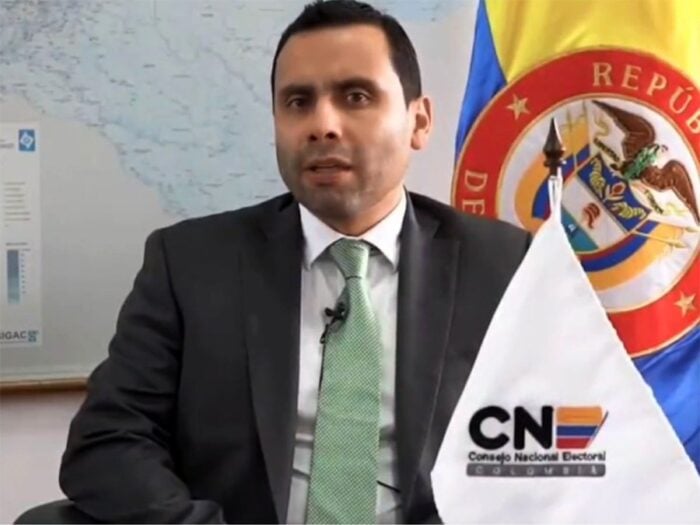
Having survived the existential threats to his magistracy, Baquero completed his constitutional term on the CNE on August 31, 2026. During his final months, he participated in landmark rulings, including the high-profile disciplinary measures directed at the 2022 presidential campaign financing files.
September 29 – October 7, 2026: The Executive Experiment and Termination
- September 29: Agreement CD-2071-2026 is signed via direct contracting, backed by formal Ministry certifications confirming that internal staffing was insufficient and that the role demanded a minimum of 66 months of specialized experience (Baquero formally accredited 106 months, supplemented by a Master’s and a Doctorate in Law from Universidad Sergio Arboleda).
- September 30: Contract execution officially begins.
- October 7: Following direct instructions from President Abelardo De la Espriella, the Ministry of the Interior terminates the advisory agreement. In accordance with Colombian administrative law, Baquero’s compensation is restricted to a strictly proportional payout covering the exact days services were rendered.
Supporting Data and Institutional Framework
The mechanics of public contracting in Colombia dictate specific protocols for early termination, yet the political architecture surrounding Baquero’s case exposes systemic vulnerabilities in how bureaucratic appointments interact with shifting political tides.
| Contractual Parameter | Details |
|---|---|
| Agreement Number | CD-2071-2026 |
| Platform Registry | SECOP II Official Procurement Portal |
| Modality | Direct Contracting (Contratación Directa) |
| Original Duration | 91 Days (Scheduled: Sept 30 – Dec 31, 2026) |
| Actual Execution Period | 7 Days (Sept 30 – Oct 7, 2026) |
| Total Contract Value | $60,000,000 COP |
| Required Experience | 66 Months (Baquero accredited 106 Months) |
| Academic Credentials | Abogado (U. del Rosario), Magíster y Doctor en Derecho (U. Sergio Arboleda) |
Under standard public procurement guidelines, when an executive agency terminates a service contract ahead of schedule without fault of the contractor, compensation must correspond precisely to the work executed up to the date of notice. Consequently, Baquero walks away with remuneration for only one week of work, leaving the legal utility of the preliminary administrative concepts he drafted during those seven days entirely unresolved.
Official Responses and Administrative Silence
The abruptness of the presidential veto has placed the Ministry of the Interior in a difficult communicative posture. Neither Minister Rodrigo Lara nor the administrative divisions responsible for human talent and legal contracting have issued a formal public statement detailing the operational mechanics of the cancellation.
When pressed by investigative journalists, internal ministry sources confirmed that the decision bypassed standard bureaucratic reviews. While portfolio heads traditionally retain full autonomy over the selection of their direct advisory teams, the override from the Casa de Nariño reflects an extraordinary assertion of presidential authority.
Furthermore, the Ministry has remained silent on two critical operational questions:
- Will the portfolio launch a new public or direct-hiring process to secure a replacement advisor for the Directorate of Security, Citizen Coexistence, and Government?
- What will happen to the administrative concepts, legal viability reviews, and jurisprudential analyses that Baquero managed to produce during his brief seven-day window in office?
Observers note that while the incoming documents may possess technical merit, the political stigma attached to their author makes it unlikely they will be openly integrated into active ministerial policy.
Implications: The Fragile Boundary Between Electoral Justice and the Executive Branch
The rapid transition of Altus Baquero—moving from an electoral magistrate rendering politically explosive verdicts, to a high-level executive contractor, and back to an ex-contractor within the span of a single week—serves as a cautionary case study for Colombia’s institutional stability.

1. The Politicization of Technical Advisories
The intervention by President De la Espriella demonstrates that technical competence and statutory qualification—such as Baquero’s certified doctorate, extensive postgraduate credentials, and 106 months of verified experience—can be entirely superseded by political grievances stemming from past judicial votes. This sets a chilling precedent for jurists and technocrats who cycle between independent regulatory bodies and executive policy roles. If past rulings are retroactively “punished” through employment blacklists or sudden contract cancellations, the independence of electoral and judicial tribunals faces an insidious psychological deterrent.
2. The Blurring of Separation of Powers
When the executive branch exercises micro-level oversight over ministerial contracts to settle scores related to CNE decisions, the functional separation between administrative governance and electoral oversight is compromised. The CNE is constitutionally designed as an autonomous body insulated from executive pressure. When former members of such tribunals find themselves personally targeted or rewarded based on how their past votes align with the sitting administration’s agenda, the perceived impartiality of the entire electoral system is damaged.
3. Institutional Fallout for the Legal Community
Baquero’s ordeal—surviving a grueling three-year disciplinary crusade by the Procuraduría only to be neutralized by a stroke of presidential pen days after entering the government—highlights the precarious nature of public service careers in high-polarization environments. As the legal community processes the fallout of Agreement CD-2071-2026, the message from the Casa de Nariño is unmistakably clear: in the current political landscape, past judicial independence carries a heavy price, and the executive branch maintains a long and unforgiving memory.