

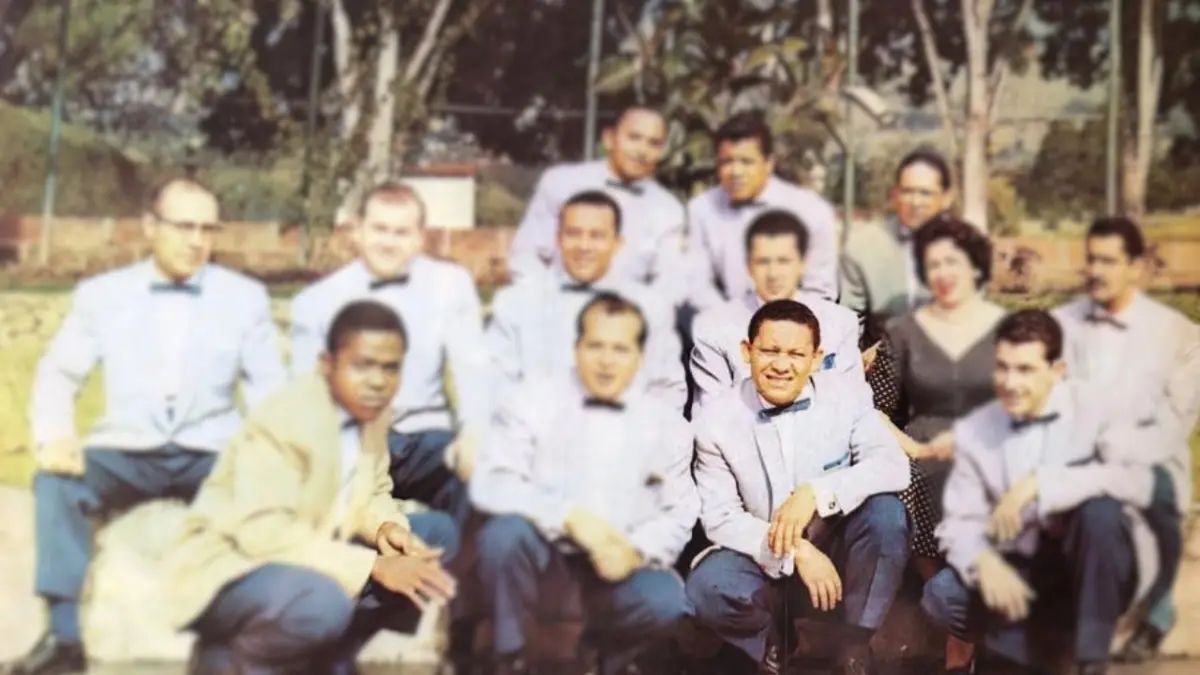
As music lovers across the Caribbean and the global diaspora look back at the golden era of Colombian big bands, the conversation almost invariably begins and ends with the legendary maestro Lucho Bermúdez and his iconic songstress, Matilde Díaz. Yet, just beside them in the historical pantheon stands a figure of unmatched vibrancy, comedic timing, and vocal magnetism: Rafael Enrique Ruiz Romero, universally celebrated as Bobby Ruiz.
Born in the historic port city of Cartagena on July 6, 1926, Bobby Ruiz was far more than a secondary crooner. He was the comedic spark, the rhythmic heartbeat, and the theatrical engine that propelled the Lucho Bermúdez Orchestra to international renown. As the music world approaches the centenary of his birth, his legacy shines brighter than ever, reminding us of a time when Caribbean soundscapes, sophisticated arrangements, and unbridled joy captured the soul of a nation.
Main Facts: The Eternal Legacy of a Tropical Pioneer
The impact of Bobby Ruiz on Colombian tropical music is deeply etched into the grooves of mid-century shellac and vinyl records. While Matilde Díaz commanded the stage with her sweet, resonant delivery, the vocal interplay between Díaz and Ruiz formed the structural backbone of Bermúdez’s most celebrated recordings.
Biographer José Portaccio Fontalvo, author of the definitive texts “Lucho Bermúdez. Cumbias, porros y viajes” and “Carmen tierra mía – Lucho Bermúdez,” captures this synergy perfectly:
“The duo of Bobby Ruiz and Matilde Díaz was fundamental to the success of the orchestra. Their voices intertwined and brought luster to the songs. The highest testimony of this remains captured in the long-play record ‘Lucho en el Tequendama’.”
That landmark album featured nearly all its tracks—such as "Lina", "Baila negra", "Tumbasón en Bogotá", and "Mono Fabio"—executed by this brilliant vocal pairing. Together with labels like Tropical, Philips, and Sonolux, Ruiz and Díaz established a natural vocal symbiosis that defined the sound of Colombia’s Caribbean coast for generations.
Beyond his vocal talents, Ruiz was a supreme showman. Matilde Díaz herself fondly recalled his irresistible stage presence:
“He was the grace of the orchestra. He would move, he would invent words, he would sing in French, he would sing in Italian, but he wasn’t saying anything. And everyone loved him for it, too.”
Whether he was scatting in made-up European languages or cutting loose with dynamic choreography, Ruiz brought an infectious theatricality that transformed formal ballroom dances into vibrant cultural celebrations.
Chronology: From Cartagena’s Underage Cabarets to the Stages of Los Angeles
The trajectory of Bobby Ruiz reads like a cinematic journey through the Golden Age of Latin American popular music, marked by early rebellion, relentless touring, and eventual international acclaim.
1. The Adolescent Beginnings in Cartagena (circa 1944)
Long before he was sharing stages with musical titans, Ruiz was a teenager captivated by the nightlife and vibrant melodies pulsing through Cartagena. Around 1944, driven by an irrepressible passion for singing, he began sneaking into local nightspots to perform. His youthful ambition frequently clashed with the law; local police routinely escorted the underage singer out of venues, unable to curb an artistic drive that refused to be silenced.
2. The Barranquilla Debut and Early Recordings
Following a formative season building his reputation in Cartagena, Ruiz expanded his horizons northward to Barranquilla. There, he made his professional debut with Rumbavana, a Cuban orchestra whose director, Armando Cartaya, had recently relocated to Cartagena to helm the Orquesta Emisoras Fuentes (the radio network that later evolved into the iconic record label).
It was with this ensemble that Ruiz made his foundational studio recordings, immortalizing tracks such as:
- "El clarinete de Simón"
- "El currimbiá"
- "La mano descompuesta"
3. The Medellín Circuit: Sonora Cabecenido, Pacho Galán, and Lucho Bermúdez
As his reputation as a versatile and charismatic interpreter grew, Ruiz migrated to Medellín, Colombia’s burgeoning commercial music hub. There, he lent his voice to some of the most prestigious aggregations of the era:
- Sonora Cabecenido (led by Edmundo Arias)
- The Orchestra of Pacho Galán (the king of the merecumbé)
- The Lucho Bermúdez Orchestra, which he joined in the mid-1950s, marking the definitive zenith of his career.
During his tenure with Bermúdez, Ruiz recorded an astonishing catalog of solo numbers and duets. His solo cuts included crowd-pleasers like:
- "Los primos Sánchez"
- "La buchaca"
- "El marañón"
- "La gaita de las flores"
- "Carnaval"
- "El gallito"
- "Molongo"
- "El pájaro macuá"
- "El pitirre"
- "María tumbasón"
- "La boquillera"
Concurrently, his duets with Matilde Díaz became instant classics, featuring unforgettable performances on:
- "Diana María"
- "Manizaleña"
- "El helado de leche"
- "Hasta luego Medellín"
- "Arepa de pilón"
- "Julián el solterón"
4. Collaborations Beyond the Bermúdez Orchestra
Ruiz’s vocal versatility also found a home in several other legendary ensembles. With Sonora Cabecenido, he recorded:
- "Qué ladrón"
- "La flaca"
- "Que le den"
- "Juan Torero"
- "Qué campanera"
Other notable collaborations included:
- Italian Jazz: "Chachita bonita"
- Edmundo Arias: "Solo estoy", "Qué dichoso es", and "Cumbia candelosa"
- Sonora Dinamita: "Marañón" and "Pedazo de cariño"
- Pedro Laza y sus Pelayeros: "El pescador"
5. International Expansion and Later Years
As the 1970s dawned, the landscape of Colombian music began to shift. Deciding to open a new chapter in his life, Ruiz left the Lucho Bermúdez Orchestra and emigrated to the United States alongside his wife, Dioselina.
Settling in Southern California, Ruiz founded Los Internacionales, an orchestra dedicated to performing salsa and traditional Colombian tropical music for the growing Latino diaspora in Los Angeles. Though deeply rooted abroad, Ruiz never severed ties with his homeland. He frequently returned to Colombia—especially his beloved Cartagena—to vacation, reconnect with old friends, and attend to his health.
In a quiet testament to a life fully lived, Bobby Ruiz passed away in Atlanta, Georgia, at the remarkable age of 91, leaving behind a legacy that spans generations.
Supporting Data: The Discographic Footprint
To understand the magnitude of Bobby Ruiz’s contribution, one must look at the sheer volume and stylistic breadth of his recorded output. Working across the most influential record labels of the 20th century—including Tropical, Philips, and Sonolux—Ruiz helped shape the commercial viability of Colombian export music.
| Category / Ensemble | Key Recordings & Songs |
|---|---|
| With Lucho Bermúdez (Solo) | "Los primos Sánchez", "La buchaca", "El marañón", "Carnaval", "El gallito", "Molongo", "La boquillera" |
| Díaz-Ruiz Duets (Bermúdez) | "Lina", "Baila negra", "Tumbasón en Bogotá", "Mono Fabio", "Diana María", "Manizaleña", "Arepa de pilón" |
| Early Works (Emisoras Fuentes / Rumbavana) | "El clarinete de Simón", "El currimbiá", "La mano descompuesta" |
| With Edmundo Arias & Sonora Cabecenido | "Quiero ladrón", "Juan Torero", "Cumbia candelosa", "Solo estoy" |
| With Sonora Dinamita & Pedro Laza | "Marañón", "Pedazo de cariño", "El pescador" |
This extensive discography proves that Ruiz was far more than a stylistic footnote; he was a prolific, adaptable artist capable of navigating cumbia, porro, gaita, and tropical jazz with equal technical mastery and emotional authenticity.
Official Responses and Cultural Appraisals
Music historians, biographers, and cultural institutions have long championed the preservation of Ruiz’s artistic narrative. In his comprehensive biographical work, José Portaccio Fontalvo emphasizes that the golden era of Colombian orchestral music cannot be accurately understood without acknowledging the egalitarian brilliance of its front-line performers.
"The brilliance of Lucho Bermúdez’s arrangements required interpreters who understood not just the time signature, but the soul of the Caribbean. Bobby Ruiz possessed that rare intuition. He could make an audience laugh, weep, and dance within the span of a single three-minute 78 RPM record," notes Portaccio Fontalvo in Lucho Bermúdez. Cumbias, porros y viajes.
Furthermore, cultural foundations across the Caribbean coast of Colombia continue to advocate for educational curricula that highlight the contributions of mid-century artists like Ruiz. These institutions argue that figures who carried Colombian culture to international stages—from Barranquilla to Medellín, and eventually to Los Angeles and Atlanta—deserve permanent civic recognition.
Implications: Preserving a Centenary Heritage
As cultural programmers, radio broadcasters, and musicologists look ahead to July 6, 2026—the official centenary of Bobby Ruiz’s birth—the discussions surrounding his legacy carry profound implications for the preservation of Colombia’s intangible cultural heritage.
1. Archival Digitization and Accessibility
Much of Ruiz’s early work with regional radio orchestras and transient ensembles remains locked away in analog formats, vulnerable to physical degradation. The upcoming centenary serves as an urgent call to action for national archives, private collectors, and major record labels to comprehensively digitize, remaster, and make accessible his complete catalog on modern streaming platforms.
2. Re-evaluating the Ensemble Dynamic
Contemporary tropical music scholarship often focuses disproportionately on bandleaders and principal composers, occasionally sidelining the vocalists and instrumentalists who brought those compositions to life. Re-centering figures like Bobby Ruiz challenges this top-down historical model, offering a more democratic and accurate portrait of how collective creativity functioned in the mid-20th-century Colombian big band.
3. Inspiring the Next Generation of Caribbean Artists
For young musicians in Cartagena, Barranquilla, and across the Caribbean basin, the story of Bobby Ruiz—a teenager sneaking into cabarets out of sheer love for song, rising to international acclaim—offers a powerful narrative of artistic perseverance. By honoring his centenary, cultural leaders reinforce the value of local idioms, traditional rhythms, and uninhibited stage performance in an increasingly globalized musical landscape.
As we celebrate him as our Artist of the Week, we recognize that Bobby Ruiz’s voice was never merely a sound of the past; it remains an enduring invitation to celebrate the exuberant, multifaceted spirit of Colombian culture.



Leave a Reply