

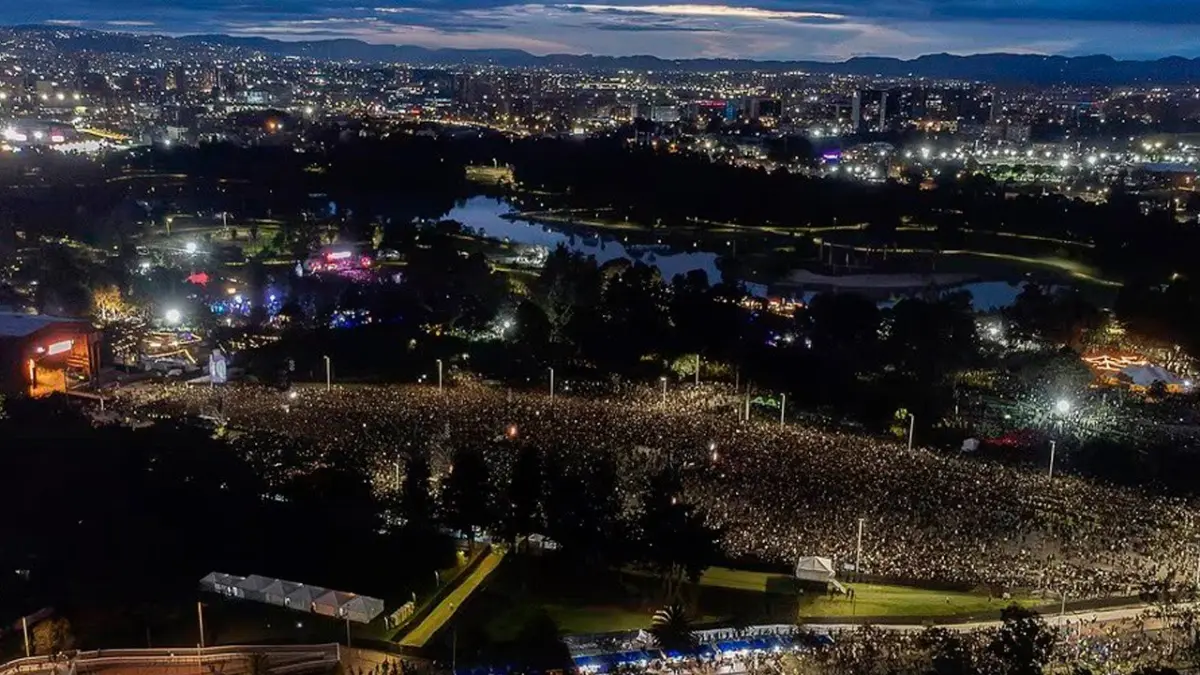
BOGOTÁ, COLOMBIA — The vibrant heart of Bogotá has once again proven to be the undisputed rock capital of Latin America. The 30th-anniversary milestone edition of Rock al Parque has officially etched its name into the history books. Before even opening the gates for its grand finale, the festival achieved a staggering, unprecedented attendance milestone, welcoming more than 465,500 cumulative attendees across its first two days at the sprawling Metropolitan Simón Bolívar Park.
Surpassing the total cumulative counts of several legendary prior editions, this year’s festival highlights not only the enduring cultural resilience of rock and alternative music in Colombia, but also the unmatched drawing power of a free, open-air cultural institution that has defined generations.
Main Facts: A Massive Turnout That Defines a Generation
The numbers coming out of the District Secretariat of Culture, Recreation, and Sports paint a picture of an unprecedented cultural phenomenon. During Saturday, October 10, and Sunday, October 11, the Parque Metropolitano Simón Bolívar turned into a sea of black leather, band tees, and vibrant countercultural energy.
- The Two-Day Total: Before the final chords of Monday’s festival were even struck, Rock al Parque 2026 registered 465,500 cumulative visits.
- Saturday’s Inaugural Record: Opening day drew over 191,000 people, shattering all previous benchmarks for a festival’s opening day.
- Sunday’s Surge: The crowd swelled further on the second day, with 274,500 music lovers circulating through the park under a lineup spearheaded by heavyweights such as Mon Laferte, Esteman, Tokyo Ska Paradise Orchestra, Gondwana, Bándalos Chinos, and Claudio Narea.
This monumental turnout cements the festival’s ruby anniversary as its most successful staging in modern history, outperforming multi-day totals from historic years that previously stood as high-water marks for Colombian live entertainment.
Chronology of the Weekend: Day-by-Day Breakdown
Day One (Saturday, October 10): A Record-Breaking Kickoff
From the early hours of Saturday morning, lines stretched for blocks around the perimeter of the Simón Bolívar Park. Fans eagerly awaited the opening of the gates for the 30th-anniversary celebration. By mid-afternoon, the fields were packed.
According to official figures released by the District Secretariat of Culture, the opening day mobilized more than 191,000 attendees. The sheer volume of people caught even seasoned festival organizers by surprise, setting an absolute all-time high for a Saturday opening session in the three-decade history of the event. The energy was electric, driven by local and international acts that set a high bar for the remainder of the weekend.
Day Two (Sunday, October 11): The Mid-Festival Surge
If Saturday proved that the appetite for rock was as fierce as ever, Sunday confirmed that Rock al Parque 2026 was on track to shatter every benchmark in the book. A staggering 274,500 individuals flowed through the park grounds.
The day’s musical curation was a masterclass in cross-genre and international appeal. Festival-goers experienced the soaring vocals and emotional intensity of Mon Laferte, the vibrant indie pop-rock of Esteman and Bándalos Chinos, the infectious, brass-heavy rhythms of the Tokyo Ska Paradise Orchestra, the timeless reggae vibrations of Gondwana, and the nostalgic rock resonance of Claudio Narea. The massive crowds moved fluidly across the park’s multiple stages, creating an atmosphere of shared joy, moshing, and community.
Day Three (Monday, October 12): The Grand Finale and Final Stretch
Entering the third and final day—a holiday Monday in Colombia—the festival was already positioned as the most attended in recent memory. The final day’s lineup was designed to leave no stone unturned, offering a heavy-hitting mix of metal, punk, industrial rock, and ska.
The closing marathon featured legendary performances by industrial pioneers Ministry, Argentine metal titans Rata Blanca, British alternative rockers Editors, Chilean rock icons Los Bunkers, alongside Ratones Paranoicos, División Minúscula, Ghetto Kumbé, Los Elefantes, and La Severa Matacera. Running from 2:00 p.m. to 10:00 p.m. across the park’s four main stages, the final day pushed the cumulative attendance figure even higher, guaranteeing a historic closing chapter for the 30-year legacy.
Supporting Data: Historical Attendance Comparison
To truly grasp the magnitude of the 2026 numbers, one must look back at the historical milestones of Rock al Parque since its inception in 1996. While methodology and crowd-estimation techniques have evolved over the decades—making direct point-to-point comparisons a matter of relative reference—the official data published across major historical milestones highlights just how massive this year’s gathering has been.
Major Attendances in Rock al Parque History (1996–2026)
| Rank | Edition | Cumulative Attendance | Notes |
|---|---|---|---|
| 1 | 2026 | More than 465,500 | Count recorded across the first 2 days only. |
| 2 | 2004 | More than 400,000 | Celebration of the festival’s first 10 years (3 days). |
| 2 | 2014 | Around 400,000 | 20th-anniversary milestone edition (3 days). |
| 4 | 2023 | More than 390,000 | Post-pandemic resurgence edition (3 days). |
| 5 | 2015 | More than 350,000 | Standard multi-day festival run. |
*(Note: The 2026 figure reflects partial data recorded prior to the conclusion of the final day on October 12, easily surpassing the three-day totals of prior landmark editions like 2004 and 2014, which hovered around the 400,000 mark.)
Official Responses and Institutional Perspective
The overwhelming success of Rock al Parque 2026 did not happen by accident. It is the result of months of meticulous inter-institutional planning led by the Mayor’s Office of Bogotá, the District Secretariat of Culture, Recreation, and Sports, and Idartes (Instituto de Artes de Bogotá).
Speaking on the historic turnouts, municipal cultural representatives emphasized that the festival’s ability to draw nearly half a million people safely within its first 48 hours is a testament to the maturity of Bogotá’s cultural infrastructure.
"Rock al Parque is no longer just a music festival; it is a profound social compact," noted a spokesperson for the district administration. "It demonstrates that citizens of all backgrounds can gather in the hundreds of thousands to celebrate art, dissent, poetry, and heavy guitars in an environment of collective joy and mutual respect."
Security, mobility, and logistical teams worked in tandem to manage the massive influx of people. Specialized transport plans, including extended hours and strategic route adjustments for the city’s TransMilenio mass transit system, were deployed to safely shuttle hundreds of thousands of fans to and from the Simón Bolívar Park across the three-day holiday weekend.
Implications: What This Means for the Future of Live Music in Latin America
The historic turnout of Rock al Parque 2026 carries deep implications for the future of the festival, the city of Bogotá, and the wider Latin American live music industry.
1. The Undisputed King of Free Festivals
While massive music festivals have proliferated globally, almost all rely on high-tier ticketing models that price out substantial portions of the population. Rock al Parque remains a rare, defiant anomaly: a world-class, multi-stage mega-festival completely free and open to the public. The 2026 attendance proves that public funding for culture yields massive dividends in social cohesion, tourism, and civic pride.
2. Generational Renewal
One of the most striking observations from the 2026 edition was the demographic diversity within the crowds. Alongside veterans who attended the inaugural 1996 concerts, a vast wave of Gen Z and younger millennial fans filled the mosh pits. This proves that rock, metal, ska, and alternative genres continue to find passionate new blood in Colombia, securing the festival’s relevance for decades to come.
3. Economic and Tourism Impact
Bringing over half a million bodies into the heart of Bogotá over a single holiday weekend stimulates local commerce exponentially. Hotels, restaurants, transport sectors, and informal vendors experienced a massive economic boost. The international media attention garnered by acts like Mon Laferte, Ministry, and Rata Blanca further solidifies Bogotá’s reputation as the premier cultural tourism destination in the Andean region.
As the lights dim on the Simón Bolívar Park and the final feedback echoes into the Bogotá night, Rock al Parque 2026 closes its books not just as a successful concert series, but as a historic cultural milestone that has redefined the limits of what a free public music festival can achieve.
Stay tuned for ongoing coverage, photo galleries, and artist interviews via Radio Nacional de Colombia and follow the continuing digital broadcast using the official hashtag #RadiónicaEnRockAlParque.

Leave a Reply