

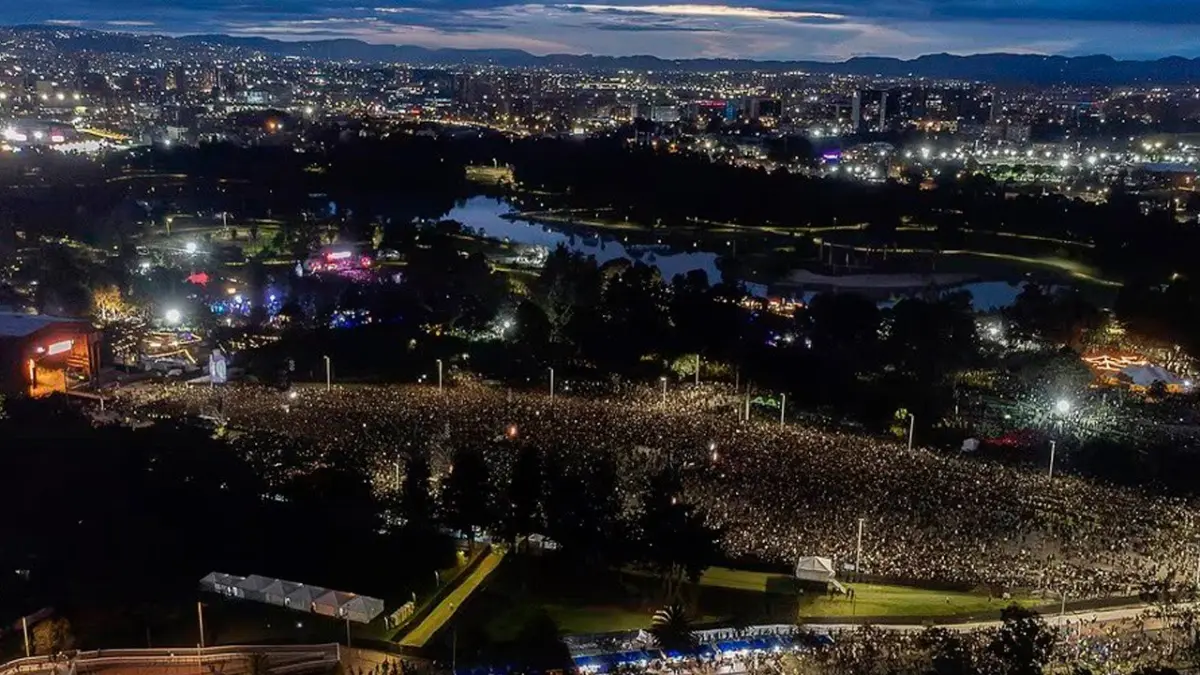
BOGOTÁ, COLOMBIA — The iconic Parque Metropolitano Simón Bolívar has once again transformed into the beating heart of Latin American rock culture. Celebrating its landmark 30th anniversary, the Rock al Parque festival has transcended its own storied legacy, pulverizing historical attendance records before the final amplifier even fell silent.
Driven by an eclectic line-up, flawless organization, and an insatiable public appetite for live music, the festival achieved an unprecedented milestone during its first two days alone. As Bogotá plays host to one of the planet’s largest free-admission rock festivals, the cultural impact of this milestone resonates far beyond the capital city’s verdant parks, cementing the event’s status as a crown jewel of global alternative music gatherings.
Main Facts: A Historic Milestone in Numbers
Before the grand finale on Monday, October 12, the cumulative attendance for Saturday, October 10, and Sunday, October 11, reached a staggering 465,500 people. This metric not only represents the highest mid-festival tally in the history of the event but already surpasses the total three-day attendance of several of the most heavily attended editions in the festival’s three-decade lifespan.
The breakdown provided by the District Secretariat of Culture, Recreation, and Sport highlights a meteoric rise in public engagement:
- Saturday, October 10: Drew an unprecedented opening-day crowd of over 191,000 attendees, setting a brand-new benchmark for the launch of the festival.
- Sunday, October 11: Saw participation swell dramatically, with 274,500 people circulating through the sprawling grounds of the Parque Simón Bolívar to catch powerhouse performances from regional and international heavyweights.
With these jaw-dropping figures locked in prior to the third and final holiday Monday, Rock al Parque 2026 has unequivocally redefined the boundaries of scale for free public cultural initiatives in the region.
Chronology of the Weekend: From Record-Breaking Opening to Massive Sunday
Saturday: A Record-Breaking Inauguration
The 30th-anniversary celebrations kicked off under crisp Bogotá skies on Saturday morning. Anticipation had reached a fever pitch weeks in advance, but the sheer volume of attendees caught even seasoned logistics teams by surprise. By early afternoon, the gates of Parque Simón Bolívar were inundated with multigenerational waves of rock fans clad in black leather, band T-shirts, and sneakers worn down by decades of slam dancing and festival-going.
According to official figures released by the District Secretariat of Culture, Recreation, and Sport, the opening day drew over 191,000 music lovers. This massive turnout shattered all previous records for a Day 1 inauguration in the history of Rock al Parque. The energy was palpable as local emerging bands shared space with legendary acts, setting a high bar for the rest of the weekend and signaling to the world that rock and alternative music in Colombia are not merely surviving—they are experiencing a roaring renaissance.
Sunday: The Mid-Weekend Surge
If Saturday proved that the appetite for the festival was intact, Sunday demonstrated its overwhelming drawing power. An astonishing 274,500 individuals streamed through the security checkpoints throughout the day, creating a vibrant sea of humanity that stretched across the park’s multiple stages.
The curatorial brilliance of the 30th-anniversary programming was on full display Sunday. The grounds vibrated to the eclectic, genre-bending sounds of Chilean songstress Mon Laferte, whose emotional resonance captivated the massive audience. The crowd also swayed and skanked to the infectious beats of Esteman, the joyous, horn-driven energy of the Tokyo Ska Paradise Orchestra, the timeless reggae rhythms of Gondwana, the indie-pop sensibilities of Bándalos Chinos, and the historic guitar work of Claudio Narea.
By the time Sunday night drew to a close, the cumulative tally stood at 465,500—a number that guaranteed the 2026 edition a permanent place in the history books.
Supporting Data: Contextualizing the 2026 Phenomenon
To truly understand the magnitude of the 465,500 attendance figure achieved in just two days, one must look back at the historical milestones of Rock al Parque since its inception in 1996 by Julio Correal and Idartes. For years, the festival has vied with European and North American free festivals for sheer volume, but 2026 has elevated the benchmark to an entirely different stratosphere.
Comparative Table: Highest Attendances in Rock al Parque History (1996–2026)
| Rank | Edition | Attendance Metric |
|---|---|---|
| 1 | 2026* | More than 465,500 (First 2 days only) |
| 2 | 2004 | More than 400,000 (Full 3-day total) |
| 2 | 2014 | Around 400,000 (Full 3-day total) |
| 4 | 2023 | More than 390,000 (Full 3-day total) |
| 5 | 2015 | More than 350,000 (Full 3-day total) |
*Note: Figures for 2026 are partial, recorded prior to the final holiday Monday session on October 12.
Historical Benchmarks
- The 10th Anniversary (2004): Celebrated as a golden era for the festival, the milestone tenth edition famously drew upwards of 400,000 people across three days, cementing the event as a cultural lifeline for Colombian youth.
- The 20th Anniversary (2014): Mirroring its predecessor a decade prior, the 2014 edition once again flirted with the 400,000-attendee mark, showcasing the enduring resilience of the festival despite changing musical landscapes.
- The Post-Pandemic Resurgence (2023): After years of disruption, Idartes reported a robust return to form with over 390,000 attendees over three days, proving that the live music ecosystem in Bogotá remained fiercely loyal.
Methodological Note: Cultural analysts and festival organizers point out that while these numbers serve as definitive markers of popularity, crowd-counting methodologies have evolved significantly over the 30-year history of Rock al Parque—moving from manual estimates and perimeter approximations to sophisticated, data-driven entry metrics managed by municipal authorities. Consequently, the 2026 figures represent the most accurate and reliable high-density tracking in the festival’s history.
Official Responses and Stakeholder Insights
The historic turnout prompted swift reactions from municipal leaders, cultural administrators, and the artists themselves, all of whom praised the peaceful behavior of the crowds and the organizational prowess required to manage nearly half a million people safely.
Municipal Leadership
Representatives from the Mayor’s Office of Bogotá and the District Secretariat of Culture, Recreation, and Sport issued joint statements highlighting the festival not merely as a concert series, but as a masterclass in civic coexistence and public safety.
"Rock al Parque is a mirror of Bogotá’s resilience, diversity, and passion," stated a spokesperson for the District Secretariat. "Reaching over 465,500 attendees in just 48 hours proves that art and music possess an unmatched power to unite citizens across generations, social classes, and backgrounds. The public has demonstrated exemplary behavior, showing the world that our city knows how to celebrate culture on a grand scale."
Logistical Coordination
Behind the scenes, the success of the 30th anniversary was the result of months of meticulous planning involving Idartes, civil defense, private security, health services, and the city’s mass transit operator, TransMilenio. Special operational corridors and extended service hours were deployed to handle the massive influx of commuters traveling to and from the Parque Simón Bolívar, ensuring that the movement of hundreds of thousands of fans remained fluid and secure.
Implications of the 2026 Success
The shattering of attendance records at Rock al Parque 2026 carries profound implications for the future of the festival, the city of Bogotá, and the wider Latin American music industry.
1. Economic and Tourism Impact
A festival of this magnitude acts as a massive economic engine for the Colombian capital. Hotels, restaurants, transport networks, and local vendors experienced a windfall over the long holiday weekend. Thousands of domestic tourists from Medellín, Cali, Barranquilla, and international travelers from across South America, the United States, and Europe converged on Bogotá, proving that cultural tourism is a primary driver of the local economy.
2. Validation of Free Public Culture
In an era where global music festivals are increasingly dominated by exorbitant ticket prices, VIP tiers, and exclusive corporate pricing models, Rock al Parque stands as a radical, democratic counter-weight. The 2026 numbers emphatically prove that free, high-quality public access to culture is not only viable but capable of generating greater engagement and community spirit than many commercial mega-festivals.
3. Setting a New Standard for Future Editions
As Rock al Parque looks toward its next decade, the bar has been raised exponentially. Organizers will need to continually innovate in terms of crowd management, environmental sustainability, and stage curation to accommodate the ever-expanding legion of fans. The success of 2026 ensures that municipal funding and political backing for the festival will remain robust, protecting its legacy as a sacred institution for generations of rockers to come.
Looking Ahead: The Grand Finale
As the sun set on Sunday, anticipation immediately pivoted toward the final act of this historic weekend. Scheduled for Monday, October 12, the third and final day promised an explosive conclusion featuring a legendary roster of acts including Ministry, Rata Blanca, Editors, Los Bunkers, Ratones Paranoicos, División Minúscula, Ghetto Kumbé, Los Elefantes, and La Severa Matacera.
With gates opening at 2:00 p.m. and performances running across four stages until 10:00 p.m., the final tally for Rock al Parque 2026 is projected to push well past the half-million mark—cementing this 30th-anniversary edition as an untouchable monument in the annals of Latin American rock history.

Leave a Reply