


BOGOTA, COLOMBIA — In the heart of the Colombian capital, where the bustling avenue of Carrera Séptima intersects with Calle 54, the urban landscape is bracing for a profound loss. For decades, this specific corner bore the aromatic ghost of a bygone era, one where the scent of freshly baked pastries welcomed morning commuters and local residents alike. It was the home of Pan Fino, a legendary neighborhood bakery established in the 1940s by master baker Isidro Pinzón.
Today, however, the nostalgic resonance of the landmark is giving way to a modern corporate reality. The English-style houses that have defined this architectural enclave since 1935—surviving the rapid modernization of Chapinero for nearly a century—are slated for demolition. Following a bitter bureaucratic tug-of-war between urban preservationists and real estate developers, the properties lost their heritage protections, clearing the path for high-density construction. Yet, as the wrecking ball looms, the ultimate future of the prime plot remains tangled in legal and zoning contradictions.
Main Facts: The End of an Era on Carrera Séptima
The properties at the center of the controversy comprise a cluster of historic English-style houses built originally between 1939 and 1943, within a larger residential development initiative that began in 1935 under the auspices of landowner Luis Calderón Tejada and developer Julio Calderón in association with Tulio Ospina y Compañía.
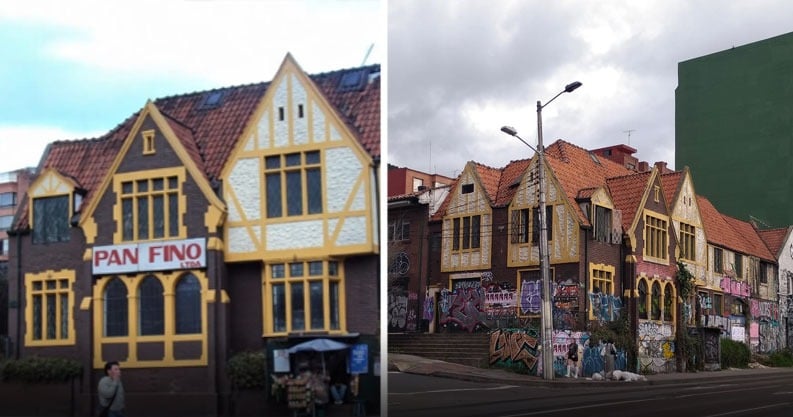
Among these structures, the corner property housing Pan Fino stands out as a cultural touchstone for generations of Bogotanos. Isidro Pinzón, who mastered European baking techniques, transformed the corner shop into a culinary institution. Utilizing traditional methods—including the use of lard to grant authentic textures and flavors to pastries—the bakery popularized local staples such as milhojas, brazos de reina (jelly rolls), roscones, and mojicones.
Following Pinzón’s death in the 1990s, the bakery closed its doors. The building subsequently transitioned through various iterations as cafes and bars, most notably housing the StatuaRota tavern until 2013, before eventually falling into severe abandonment.
The current legal holders of the land are La Urbanizadora Lindaraja S.A.S. (owned by the Cote Restrepo brothers) and Inversiones Lapage Decopa and Decobe (subsidiaries of the UBICOR S.A.S. corporate group). In September 2024, these corporate entities successfully secured a demolition license from Urban Curatorship No. 3 of Bogota. Their initial vision: to erect a towering 10-story residential and commercial complex featuring 135 apartments. However, the demolition permit does not automatically grant authorization for new construction, creating a regulatory stalemate that has left the historic corner in an administrative limbo.

Chronology of a Regulatory Battle: Protection Granted and Revoked
The trajectory of the properties from neglected ruins to protected heritage, and back to vulnerable real estate assets, highlights the shifting political and administrative priorities of Bogota’s district governance over the past decade.
- 1935–1943: The land, previously belonging to landowner Luis Calderón Tejada, is developed into a series of English-style residential properties. The structure destined to become Pan Fino is erected between 1939 and 1943.
- 1940s–1990s: Isidro Pinzón opens Pan Fino, turning it into one of Bogota’s most celebrated artisanal bakeries for over 50 years.
- 1990s: Pinzón passes away, leading to the closure of the bakery. The building undergoes various commercial transformations, eventually housing the StatuaRota tavern until 2013, after which it enters a prolonged period of physical decline and abandonment.
- 2019: During the second administration of Mayor Enrique Peñalosa, local residents in Chapinero petition the District Institute of Cultural Heritage (IDPC) to declare the properties as Cultural Interest Assets (BIC). The then-director, Mauricio Uribe González, rejects the petition, arguing the buildings lack sufficient architectural value.
- Late 2020: Under the administration of Mayor Claudia López, Culture Secretary Nicolás Montero requests a reassessment of the properties from the new IDPC director, Patrick Morales.
- 2021: The IDPC evaluates a cluster of five houses on the site, noting structural damage, interior modifications, and reduced front gardens. Following a vote in the District Heritage Council, three of the five houses—including the Pan Fino property—are selected for preservation.
- November 23, 2021: The IDPC issues Resolution 873, officially granting the properties typographic conservation status to shield them from demolition.
- February 2022: Despite appeals from property owners, the IDPC ratifies its protection decision.
- December 6, 2023: In an abrupt reversal, the District Heritage Council recommends lifting the conservation status.
- March 2024: The order to lift the heritage protection becomes officially effective, stripping the buildings of their legal safeguards.
- September 2024: Real estate interests—comprising Urbanizadora Lindaraja S.A.S., Inversiones Lapage Decopa, and Decobe (UBICOR S.A.S.)—obtain an official demolition license from Urban Curatorship No. 3.
Supporting Data: Architectural and Urban Metrics
To understand the scale of the transformation, urban planners and historians point to the specific typology of the Chapinero properties:
- Original Construction Date: 1935 (master planning phase); 1939–1943 (exact construction window for the targeted block).
- Architectural Style: English-style residential architecture, characterized by pitched roofs, brick facades, and integrated front gardens (antejardines), which were emblematic of Bogota’s suburban expansion toward the north during the mid-20th century.
- Affected Complex: A cluster of five original residential structures, out of which three were initially granted protective status in 2021 due to their historical continuity.
- Proposed Development Project: A 10-story high-rise residential tower encompassing 135 apartment units alongside ground-floor commercial spaces, promoted by Urbanizadora Lindaraja S.A.S. and the UBICOR S.A.S. group.
- Current Permitting Status: Demolition authorized as of late 2024; new construction licenses remain unapproved or restricted under current zoning parameters.
Official Responses and Institutional Disconnects
The controversy surrounding the Carrera Séptima properties exposes deep fissures within Bogota’s cultural management institutions. The stark policy shifts between successive mayoralties underscore how political appointments can radically alter the fate of urban heritage.
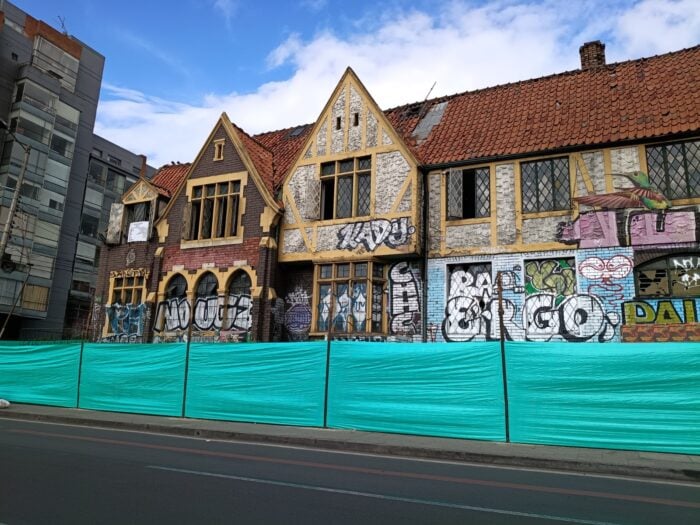
When local residents first raised concerns in 2019, the IDPC—under Mauricio Uribe González during the Peñalosa administration—dismissed the neighborhood’s historical claims, ruling that cumulative alterations had diminished the structures’ original architectural integrity. This perspective prioritized structural purity over intangible cultural memory, effectively greenlighting future real estate encroachment.
Conversely, the subsequent intervention in late 2020 by Culture Secretary Nicolás Montero, acting under Mayor Claudia López, demonstrated a temporary swing toward preservationist ideals. Patrick Morales, heading a newly commissioned IDPC evaluation, attempted to rescue the memory of the enclave by securing typographic conservation status via Resolution 873 in November 2021.
However, the legal defense crumbled under the weight of technical assessments submitted by property owners, which highlighted undeniable structural decay, interior remodeling, and the truncation of original front gardens. By December 2023, the District Heritage Council capitulated to these realities, advising the total removal of protections—a bureaucratic pivot that was finalized in March 2024. Critics of the process argue that allowing heritage structures to fall into deliberate abandonment is a common speculative tactic employed to manufacture the very "deterioration" used as legal justification for demolition.

Implications: The Erasure of Bogota’s Intangible Heritage
The demolition of the English-style houses and the former home of Pan Fino transcends a simple real estate transaction; it represents a symptom of a larger identity crisis gripping Bogota. As high-rise developments aggressively colonize traditional neighborhoods like Chapinero, the physical markers of the city’s twentieth-century expansion are systematically vanishing.
For the older generation of Bogotanos, the loss of Pan Fino strips away another tangible connection to a slower, more intimate urban fabric where local commerce was anchored by family-owned master trades. The aroma of lard-based pastry dough, the distinct architecture of English-influenced domestic design, and the corner social dynamics are being replaced by homogenous, high-density residential towers tailored to transient populations and speculative investors.
Furthermore, the legal paradox—where developers possess a license to tear down history without an immediate, approved blueprint for new construction—leaves the property vulnerable to becoming yet another vacant, blighted lot in a prime metropolitan corridor. Whether the district will tighten its heritage loopholes or continue to watch its architectural memory converted into concrete and glass remains an open, pressing question for the city’s future.



Leave a Reply