

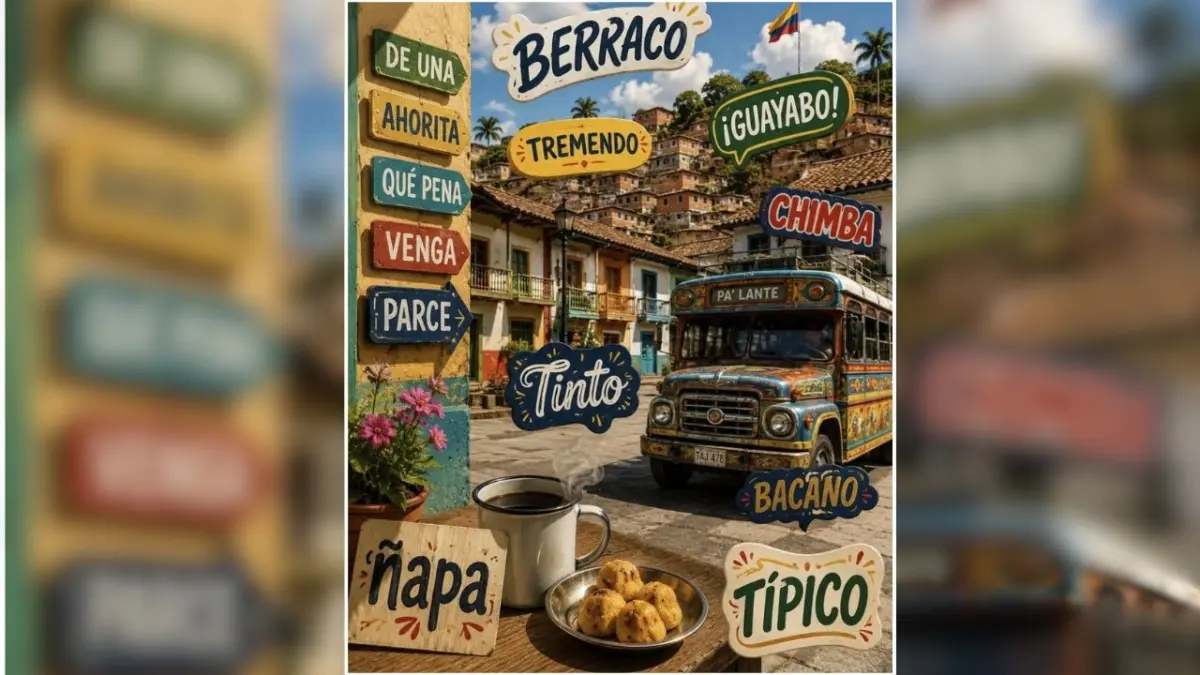
In Colombia, an unspoken agreement governs daily communication—a parallel language constructed not through formal grammar or academic instruction, but through an intricate system of idioms, proverbs, and colloquialisms. Embedded in neighborhood corner shops (tiendas de barrio), around family dining tables, and within parental reprimands, these expressions form an invisible social fabric that defines the nation’s collective psyche.
Rather than relying purely on literal vocabulary, Colombian Spanish utilizes nuanced phrasing loaded with humor, indirectness, and social solidarity. Expressions such as asking for a purchase using the phrase "¿Me regalas…?" ("Will you gift me…?") or pooling funds among friends by saying "Hagamos vaca" ("Let’s make a cow") represent more than casual slang; they are linguistic markers of a distinct cultural identity passed down through generations.
                    COLOMBIAN COLLOQUIAL EXPRESSIONS
                                   │
      ┌────────────────────────────┼────────────────────────────┐
      ▼                            ▼                            ▼
COMMERCIAL COURTESY          SOCIAL COHESION              PARENTAL/HUMOR
 "¿Me regalas...?"           "Hagamos vaca"         "No me abra los ojos..."
 ("Will you gift me?")      ("Let's make a cow")     ("Don't roll your eyes")
Main Facts
The reliance on colloquial idioms—commonly referred to locally as dichos or colombianismos—is a defining characteristic of Colombian interpersonal dynamics across all socio-economic strata. These expressions function as an informal social code, enabling speakers to convey complex emotional, economic, and disciplinary messages without absolute literalness.
Among the most widespread expressions identified in regional speech patterns are:
Commercial and Transactional Courtesy
- "¿Me regalas…?" (Literally: "Will you gift me…?"): Used universally in place of "Véndame" ("Sell me") or "Deme" ("Give me"). When a customer asks a shopkeeper, "¿Me regalas un kilo de carne?" ("Will you gift me a kilo of meat?"), there is no expectation of receiving the item for free. Instead, it functions as a politeness strategy designed to soften transactional encounters and eliminate perceived imperiousness.
Economic and Community Cooperation
- "Hagamos vaca" (Literally: "Let’s make a cow"): Refers to the practice of crowd-pooling money among a group to purchase shared items, such as food, beverages, or event tickets. The term reflects a communal approach to micro-economics and social gatherings.
- "Tome pa’ la gaseosa" (Literally: "Take this for a soda"): A colloquial phrase accompanying a modest tip or a small monetary token of gratitude given for a favor rendered. It reframes financial compensation as a friendly gesture rather than a formal business transaction.
Social Wit and Discretion
- "Le cuento el milagro, pero no el santo" (Literally: "I’ll tell you the miracle, but not the saint"): Deployed when sharing gossip or sensitive information while deliberately withholding the identity of the person involved, allowing the speaker to satisfy curiosity while preserving personal discretion.
- "¿Usted qué come que adivina?" (Literally: "What do you eat that makes you guess?"): A playful rhetorical question directed at someone who correctly predicts an outcome or discerns a hidden truth with uncanny accuracy.
Practical Humor and Familial Discipline
- "Mugre que no mata, engorda" (Literally: "Dirt that doesn’t kill you makes you fat"): Used to rationalize consuming food that has accidentally fallen onto the floor, embodying a pragmatic, lighthearted attitude toward minor mishaps.
- "No me abra los ojos que no le voy a echar gotas" (Literally: "Don’t open your eyes wide at me; I’m not going to give you eyedrops"): A classic reprimand employed primarily by mothers and grandmothers when a child reacts to discipline with a defiant gaze.
Chronology
The development of Colombia’s vernacular lexicon spans several centuries, reflecting the country’s demographic shifts, geography, and historical events.
COLONIAL ERA             19TH - MID-20TH CENTURY     LATE 20TH CENTURY        21ST CENTURY
Synthesis of Spanish,    Rural-to-Urban Migration;   Mass Media & TV           Digital Era & Global
Indigenous & African     Distinct Regional Dialects   Broadcasting Dialects    Slang Preservation
Oral Traditions          Emerge                      Nationwide               via Social Media
      │                            │                            │                            │
      ▼                            ▼                            ▼                            ▼
  [Phase 1]                    [Phase 2]                    [Phase 3]                    [Phase 4]
Phase 1: Colonial Era and Ethno-Linguistic Synthesis
During the Spanish colonial period, Castilian Spanish collided with diverse Indigenous language groups (such as Muisca and Quechua) and African linguistic influences brought via the transatlantic slave trade. Expressions rooted in agricultural life and communal survival began taking shape during this era, blending European Catholic proverbs with local oral storytelling traditions.
Phase 2: 19th to Mid-20th Century Regional Isolation
Colombia’s mountainous topography historically isolated its regions, giving rise to distinct linguistic enclaves:
- Paisa (Antioquia and the Coffee Axis)
- Cundiboyacense (Bogotá and the central highlands)
- Costeño (Caribbean coast)
- Valluno (Pacific/Cauca Valley)
- Santandereano (Northeastern Andes)
During this period, phrases like "Hagamos vaca" gained traction in agrarian communities where livestock represented tangible collective wealth. Family structures served as the primary vehicle for preserving and transmitting these oral dictums.
Phase 3: Late 20th Century Urbanization and Mass Media
As rural populations migrated to major urban centers like Bogotá, Medellín, and Cali during the mid-20th century, regional expressions blended within cities. The rise of national radio networks and television dramatizations (telenovelas) standardized regional idioms across the country, turning local phrases into recognized national markers.
Phase 4: 21st Century Digital Adaptation and Institutional Mapping
In the digital age, messaging platforms, memes, and social media have accelerated the spread of colloquial language. Rather than diluting local speech, digital communication has revitalized old adages, providing a platform for younger generations to celebrate, archive, and reimagine traditional colombianismos.
Supporting Data
Linguistic and sociological analyses highlight the deep integration of informal language into Colombian public life.
+-----------------------------------------------------------------------------------+
|                        LINGUISTIC AND USAGE CHARACTERISTICS                        |
+------------------------------+----------------------------------------------------+
| Metric / Aspect              | Description / Finding                              |
+------------------------------+----------------------------------------------------+
| Institutional Mapping        | Over 6,000 distinct terms recorded in the         |
|                              | Diccionario de Colombianismos (Instituto Caro y    |
|                              | Cuervo).                                           |
+------------------------------+----------------------------------------------------+
| Cross-Generational Retention | >90% recognition rate among urban youth for key    |
|                              | idioms like "¿Me regalas...?" and "Hagamos vaca".  |
+------------------------------+----------------------------------------------------+
| Sociolinguistic Function     | Pragmatic politeness, mitigating social tension,   |
|                              | and enforcing informal group norms.                |
+------------------------------+----------------------------------------------------+
Institutional Codification
The Instituto Caro y Cuervo, Colombia’s flagship linguistic research center, has documented thousands of native colloquial expressions. Their landmark publication, the Diccionario de Colombianismos, contains over 6,000 terms and idioms unique to Colombian speech, affirming that informal speech patterns are essential components of the nation’s cultural heritage.
Pragmatic Politeness and Social Dynamics
Linguistic studies examining transactional speech in South America reveal that Colombia exhibits one of the highest uses of indirect, deferential phrasing in commercial settings. The phrase "¿Me regalas…?" serves as a textbook example of "negative politeness" in sociolinguistics—a conversational mechanism designed to avoid imposing on the listener.
      DIRECT DEMAND                         INDIRECT DEFERENTIAL
  "Véndame un kilo de carne"  ──────►  "¿Me regalas un kilo de carne?"
     ("Sell me a kilo")                    ("Will you gift me a kilo?")
  [Potential Social Friction]             [Softened Transaction / Courtesy]
Field surveys conducted in urban retail settings show that over 80% of native Colombian customers employ deferential request forms when interacting with service staff, favoring phrases like "¿Me regalas…?" or "¿Me regala una mirada?" over direct imperatives.
Demographic Ubiquity
Data from linguistic surveys indicate that key expressions transcend socio-economic divides:
- "Hagamos vaca" is utilized by over 90% of university students and young professionals to describe shared financial contributions.
- "Mugre que no mata, engorda" retains near-universal recognition across both rural and urban households, functioning as a cultural touchstone spanning multiple generations.
Official Responses
Linguists, cultural authorities, and educational institutions have increasingly recognized everyday idioms as vital elements of Colombia’s intangible cultural heritage.
Academic and Research Institutions
Representatives from the Instituto Caro y Cuervo have emphasized that colloquial phrases should not be viewed as grammatical errors or vulgarities, but rather as legitimate linguistic adaptations.
"Colloquial Colombian Spanish reflects an oral heritage that is dynamic and deeply empathetic," noted scholars involved in lexicographical research at the institute. "Phrases like ‘¿Me regalas…?’ are not requests for charity; they are cultural formulas designed to maintain social harmony and express respect within daily transactions."
Ministry of Culture Initiatives
Colombia’s Ministry of Culture has integrated oral traditions into its heritage preservation strategies. Public media outlets, including Radio Nacional de Colombia, regularly produce content analyzing regional idioms to foster cross-regional understanding and preserve linguistic history amidst rapid globalization.
Foreign Language and Integration Programs
Educators working with international visitors and diplomatic personnel in Colombia frequently incorporate colloquial instruction into their curricula. Language experts point out that foreign speakers who rely solely on textbook Spanish often experience communication hurdles in Colombia, where informal indirectness plays a central role in daily encounters.
Implications
The widespread usage and durability of these everyday expressions have far-reaching effects on Colombian society, culture, and external relations.
                                IMPLICATIONS
                                     │
      ┌──────────────────────────────┼──────────────────────────────┐
      ▼                              ▼                              ▼
SOCIAL COHESION              CROSS-CULTURAL FRICTION         HERITAGE PRESERVATION
Fosters empathy & solidarity  Challenges non-native speakers  Resists global homogenization
across economic classes      unaccustomed to indirectness    through digital storytelling
Social Cohesion and Cultural Identity
Everyday idioms serve as a powerful unifying force in a historically fragmented nation. By employing shared humor and indirect phrasing, individuals from diverse regional backgrounds establish immediate rapport. Phrases like "Hagamos vaca" reinforce communal solidarity and mutual aid, preserving collective values within an increasingly individualized society.
Intercultural Friction and Integration
For migrants, tourists, and foreign professionals, Colombia’s indirect speech patterns can occasionally lead to misunderstandings:
- A newcomer might interpret "¿Me regalas…?" literally, mistaking an everyday purchase request for a plea for a free item.
- The phrase "Tome pa’ la gaseosa" might be misconstrued as a literal instruction to buy a beverage, rather than an informal tip.
Understanding these nuances is crucial for foreign workers, international businesses, and diplomatic missions operating in the country.
Preservation Versus Global Homogenization
As global media and international Spanish dialects circulate via streaming platforms and social media networks, concerns linger over the potential homogenization of regional speech. However, Colombia’s colloquial lexicon has demonstrated remarkable resilience. By adapting classic adages like "No me abra los ojos…" or "Le cuento el milagro, pero no el santo" into modern digital content, younger generations continue to defend and evolve their unique oral heritage—ensuring that this parallel language remains vibrant for years to come.

Leave a Reply