


Main Facts
On October 8, 2026, a quiet morning in Reykjavik, Iceland, was interrupted by a phone call that would alter literary history—though the recipient initially refused to answer it. Anne Carson, the celebrated Canadian poet, essayist, and classicist, was at home drinking tea, eating biscuits, and reading the London Review of Books. True to her lifelong aversion to modern interruptions, when her telephone rang, she ignored it. Then, she got up to sweep the floor.
It was only after her husband, Robert Currie, convinced her to return the missed call that Carson learned she had been awarded the 2026 Nobel Prize in Literature by the Swedish Academy.
Carson thus became the 19th woman in 123 editions of the prize to receive the world’s most prestigious literary honor. Characteristically unimpressed by grand displays of institutional reverence, Carson remarked that the selectors must be "all crazy." According to Ingrid Carlberg, permanent secretary of the Nobel Committee, Carson was listening to the wind when the historic news finally reached her.
The Swedish Academy’s citation recognized Carson for her "audacious and transgressive body of work that continuously dialogues with classical antiquity while forging radically new literary forms." Spanning poetry, translation, essay, and hybrid visual-textual formats, her writing resists simple categorization. Upon learning of the substantial monetary award attached to the prize—valued at 12 million Swedish kronor (approximately $1.2 million USD)—Carson immediately turned her thoughts toward philanthropy, mentioning plans to support an old friend in need and continuing her longtime support of Médecins Sans Frontières (Doctors Without Borders).
Following the brief bureaucratic commotion of the announcement, Carson did what any true poet of the margins would do: she turned off her phone again and went for a walk in the woods with her husband.
Chronology: From Port Hope to Reykjavik
The Early Years and the Discovery of Greek
Born in Toronto, Canada, in 1950, Anne Carson’s literary awakening was both precocious and unconventional. During her adolescence, she experienced a profound intellectual turning point: at the age of fifteen, she encountered a bilingual edition of Sappho, the archaic Greek lyrical poet whose surviving fragments have scandalized and captivated readers for millennia.
Captivated by the cadence and mystery of the ancient text, Carson took a bold step a year later. She convinced her Latin teacher, Alice Cowan, at her high school in Port Hope, Ontario, to teach her ancient Greek during their lunch breaks. That ancient language became the lens through which she would view the modern world, shaping a lifelong aesthetic defined by economy, emotional precision, and structural fragmentation.
Academia and the Crossing of Borders
Carson pursued formal studies in classical literature at the UNIVERSITY of Toronto, laying the groundwork for a distinguished academic career. She would eventually teach and lecture at elite institutions across North America, including McGill University, Princeton University, and New York University.
However, her academic pursuits never operated in isolation from her creative output. Rather than treating classical antiquity as a dead archive, Carson treated it as a living quarry, mining myths, philosophies, and historical fragments to interpret contemporary human grief, desire, and alienation.
The Breakthroughs: Autobiography of Red and Nox
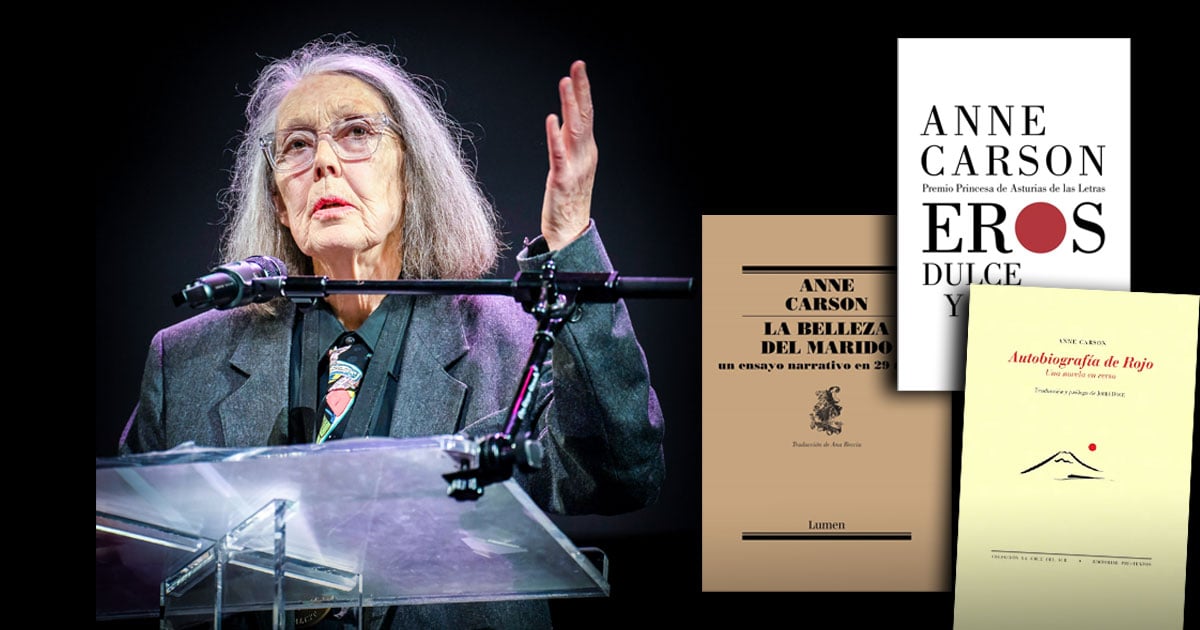
In 1998, Carson published Autobiography of Red, a work that defied traditional genre boundaries by transforming the myth of Geryon—a red-bodied monster slain by Hercules in Greek mythology—into a contemporary novel in verse. The book was a critical sensation, establishing Carson as a singular voice capable of rendering ancient archetypes starkly modern and deeply vulnerable.

More than a decade later, in 2010, she published Nox, an elegiac, book-object constructed around the sudden death of her estranged brother. Presented as an accordion-fold box containing photographs, letters, dictionary entries, and handwritten translations of a poem by Catullus, Nox revolutionized how grief could be documented on the page. It solidified her reputation as an author who viewed literature not as a polished product, but as an ongoing archaeological dig into human memory.
October 8, 2026: The Nobel Morning
The culmination of this decades-long resistance to literary convention arrived on an ordinary October day in Iceland. While global media outlets scrambled to draft breaking news bulletins, Carson was busy sweeping her floors and reading criticism. Her reluctant acceptance of the Nobel call highlights a career defined by an unwavering commitment to the interior life over the external machinery of fame.
Supporting Data and Literary Profile
To understand the weight of Anne Carson’s Nobel Prize, one must examine the statistical and cultural landscape of the award. In its 123-year history, the Nobel Prize in Literature has been overwhelmingly dominated by male authors. With Carson’s selection, she becomes only the 19th woman to win the prize, joining an elite lineage that includes Selma Lagerlöf, Toni Morrison, Wisława Szymborska, Louise Glück, and Annie Ernaux.
| Metric / Fact | Detail |
|---|---|
| Year of Birth | 1950 (Toronto, Canada) |
| Nobel Year | 2026 |
| Ranking Among Women | 19th female laureate in 123 editions |
| Prize Amount | 12 million SEK (~$1.2 million USD) |
| Key Works | Autobiography of Red (1998), Nox (2010) |
| Core Disciplines | Poetry, Essay, Translation, Classical Scholarship |
| Designated Philanthropies | Médecins Sans Frontières, personal aid for acquaintances |
Carson’s methodology as a writer rejects standard narrative arcs. Her advice to writers—and to anyone attempting to make sense of existence—is characteristically unorthodox: "Begin in the middle."
Her texts frequently refuse to offer definitive conclusions. Instead, they present themselves as field notes, archaeological surveys, or domestic notebooks. In Nox, she writes about the limits of language when confronted with catastrophic loss, noting that translation is never a clean transfer of meaning, but an agonizing negotiation with what remains untranslatable. This ethos permeates her translations of classical Greek tragedies (such as Euripides and Sophocles), which crackle with contemporary urgency while maintaining structural fidelity to antiquity.

Official Responses and Public Reaction
The announcement sent immediate shockwaves through the international literary community, drawing praise from fellow poets, critics, and cultural ministers alike. However, the contrast between the institutional jubilation of the Swedish Academy and Carson’s personal reaction provided a moment of gentle irony that quickly captured public fascination.
When Ingrid Carlberg, permanent secretary of the Swedish Academy, managed to get through to Carson’s household after the initial missed call, she noted that the poet seemed far more attuned to the Icelandic weather than to the gravity of the accolade.
Asked by reporters how she planned to spend the substantial monetary prize of 1.2 million dollars, Carson’s response bypassed personal luxury entirely. She immediately recalled an old friend who had long struggled with housing stability and reiterated her and her husband’s commitment to humanitarian causes, specifically highlighting Médecins Sans Frontières.
Despite her reputation as a reclusive intellectual who shuns the media spotlight, Carson did allow herself a brief moment of pragmatic humor regarding the commercial consequences of the award. Quizzed about the sudden influx of attention, she dryly observed that a shiny gold sticker on the cover of her books would undoubtedly help sell a few more copies.
Academic institutions where Carson once taught, alongside Canadian cultural bodies, issued glowing statements celebrating her victory. Yet, true to form, the laureate herself was nowhere near a microphone or a television camera.

Implications: What Carson’s Win Means for Contemporary Literature
The awarding of the 2026 Nobel Prize in Literature to Anne Carson carries profound implications for the global literary canon, signaling a shift in how institutions value hybridity, poetry, and intellectual independence.
1. The Validation of Hybrid Genres
For decades, major literary prizes have maintained rigid boundaries between genres, typically favoring traditional novels or conventional lyrical poetry collections. Carson’s entire career has been a systematic dismantling of these boundaries. By honoring a writer whose texts cross-pollinate verse, essay, translation, visual art, and classical scholarship, the Swedish Academy has signaled that the future of literature lies in hybrid forms that reflect the fractured nature of modern consciousness.
2. A Triumph for Classical Scholarship and Translation
Carson is, first and foremost, a classicist. Her intimate knowledge of ancient Greek and Latin informs every line she writes. In an era where the humanities face declining institutional support and universities increasingly prioritize STEM fields over classical education, Carson’s Nobel win serves as a powerful reminder of the enduring relevance of antiquity. It demonstrates that the ancient world is not a dusty museum exhibit, but a living mirror for contemporary human experience.
3. Redefining Literary Celebrity
In an age dominated by self-promotion, social media branding, and 24-hour news cycles, Anne Carson represents an entirely different model of authorship. Her insistence on privacy, her refusal to pander to the literary industrial complex, and her immediate retreat into the Icelandic wilderness after receiving the highest honor available to a writer offer a radical blueprint for artistic integrity.
As the literary world digested the news of her victory, Carson remained true to the poetics of her own work—where silence, space, and the quiet rustle of the wind take precedence over the noise of the world. In the words of one of her most enduring verses, while the global literary establishment clamored at her door, the poet simply stayed inside, listening to the weather change.




Leave a Reply