

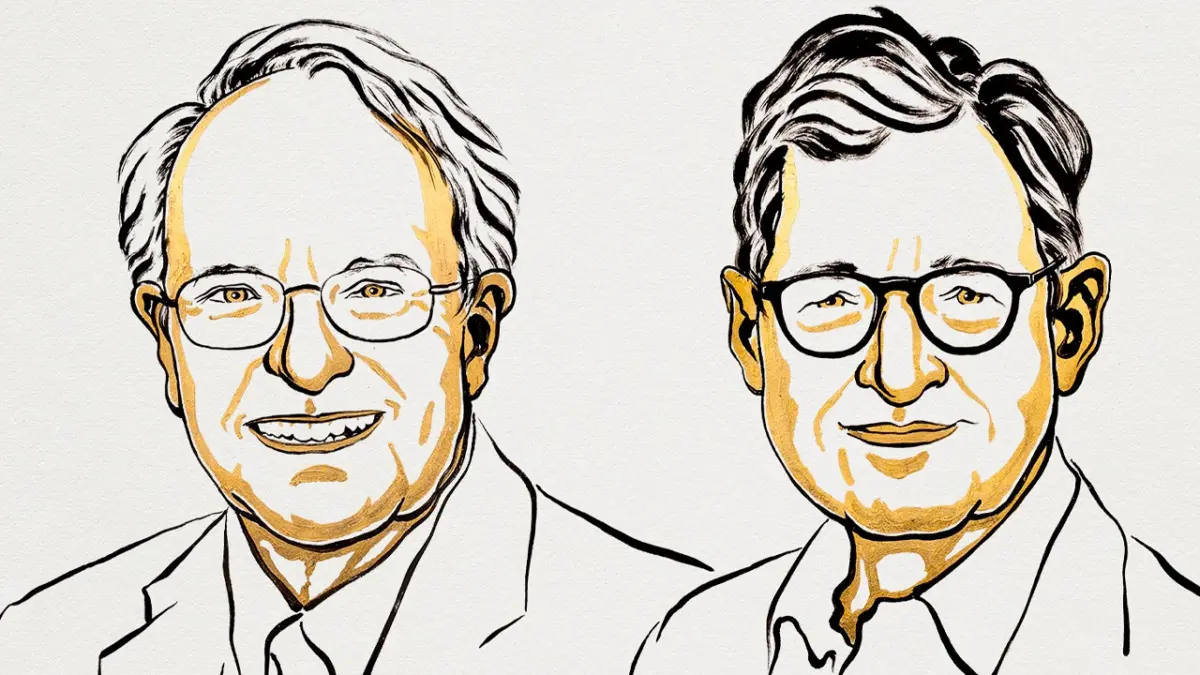
STOCKHOLM — In an era defined by post-pandemic inflation shocks, escalating geopolitical tensions, and rapid transitions in monetary policy, the Royal Swedish Academy of Sciences has chosen to honor the theoretical bedrock that helps modern governments navigate these turbulent waters. American economists Robert E. Hall and Michael Woodford have been awarded the 2026 Nobel Memorial Prize in Economic Sciences for their profound contributions to the microfoundations of macroeconomic stabilization.
Announced on Monday, October 12, 2026, the prestigious prize recognizes how the laureates’ groundbreaking research bridged the gap between individual human behavior and economy-wide stability. Their theoretical models have become standard operating equipment for central banks and ministries of finance across the globe, fundamentally shaping how policymakers respond to crises, manage inflation, and steer market expectations.
The award, officially known as the Sveriges Riksbank Prize in Economic Sciences in Memory of Alfred Nobel, carries a monetary award of 12 million Swedish kronor (approximately $1.2 million USD), which will be shared equally between Hall, a professor at Stanford University, and Woodford, a professor at Columbia University.
1. Main Facts: The Core Contributions of Hall and Woodford
The 2026 Nobel Prize celebrates two intellectual giants whose careers have individually and collectively transformed macroeconomics. For decades, macroeconomic policy was often driven by aggregate observations—looking at broad numbers like gross domestic product (GDP) or national unemployment rates without always understanding the granular, individual mechanisms driving those numbers. Hall and Woodford changed that paradigm.
Robert E. Hall: Understanding Consumer Behavior and Labor Markets
Robert Hall’s research has long focused on how ordinary households and businesses make decisions over time. By examining the microeconomics of consumer choices, Hall provided critical insights into how people smooth their consumption in the face of fluctuating incomes.
Furthermore, Hall’s work on labor markets and unemployment dynamics challenged traditional assumptions. He demonstrated how structural frictions and labor market behavior influence the depth and duration of economic recessions. His empirical and theoretical frameworks have allowed policymakers to better diagnose why unemployment spikes during crises and how labor market policies can mitigate economic pain.
Michael Woodford: Redefining Monetary Policy and Expectations
Michael Woodford is widely regarded as one of the most influential monetary economists of the late 20th and early 21st centuries. His monumental 2003 book, Interest and Prices: Foundations of a Theory of Monetary Policy, single-handedly modernized the theoretical framework used by central banks.
Woodford championed the "New Keynesian" approach, proving that monetary policy works not merely through the mechanical adjustment of current interest rates, but largely by managing public expectations about the future. His work laid the theoretical groundwork for forward guidance—a policy communication tool where central banks signal their future policy intentions to influence long-term borrowing costs, consumer spending, and business investment. During the turbulent economic recovery following the COVID-19 pandemic and the subsequent global inflation surge, forward guidance became arguably the most crucial instrument in the Federal Reserve’s, European Central Bank’s, and other major monetary authorities’ toolkits.
2. Chronology: The Evolution of Modern Macroeconomics
To understand the magnitude of Hall and Woodford’s achievement, it is necessary to trace the historical evolution of macroeconomic thought over the past half-century, a timeline marked by ideological shifts, severe economic crises, and continuous methodological refinement.
1970s–1980s: The Breakdown of Traditional Models and the Search for Microfoundations
For decades following World War II, Keynesian economics dominated policy circles, relying heavily on large-scale econometric models that tracked aggregate variables. However, the stagflation crises of the 1970s—characterized by simultaneous high inflation and high unemployment—shattered the credibility of these traditional models.
During this period, economists like Robert Lucas introduced the "Lucas Critique," arguing that policymakers cannot reliably predict the effects of a change in economic policy if they ignore how individual expectations change in response to that policy. Robert Hall stepped into this intellectual vacuum, pioneering research that grounded macroeconomic phenomena in rigorous microeconomic optimization—studying how rational individuals and firms make decisions.
1990s: The Rise of Dynamic Stochastic General Equilibrium (DSGE) Models
Throughout the 1990s, academic economics moved toward building comprehensive models that could simulate entire economies under uncertainty. These Dynamic Stochastic General Equilibrium (DSGE) models became the gold standard for policy analysis. However, early versions struggled to account realistically for monetary policy’s actual impact.
2003: Michael Woodford’s Interest and Prices
The publication of Michael Woodford’s Interest and Prices marked a watershed moment. Woodford successfully integrated sticky prices (the idea that prices do not adjust instantaneously to economic shocks) into a rigorous micro-founded framework. He demonstrated that even in a world where markets are populated by forward-looking, optimizing agents, monetary policy remains a powerful stabilization tool through its influence on expectations. This framework provided central banks with a unified theory of inflation and output determination.
2008–2009: The Global Financial Crisis and Stress-Testing Theory
When the Global Financial Crisis struck in 2008, traditional economic models faced fierce criticism for failing to predict the collapse. Yet, the crisis also proved the value of Woodford and Hall’s frameworks. As central banks slashed interest rates to zero and deployed unconventional tools—such as quantitative easing (QE) and aggressive forward guidance—they relied heavily on New Keynesian models to simulate the anticipated paths of recovery.
2020–2026: Pandemic Shocks, Inflation Surges, and Vindication
The post-pandemic era brought unprecedented challenges: massive supply chain disruptions, energy crises, and inflation rates not seen in four decades. Central banks were forced to rapidly pivot from ultra-loose monetary policies to aggressive tightening cycles. Throughout this volatility, the policy frameworks pioneered by Hall and Woodford served as the navigational charts for central bankers trying to engineer a "soft landing." The 2026 Nobel Prize thus arrives as a timely validation of frameworks that successfully guided the global economy through its most complex modern trials.
3. Supporting Data and Economic Impact
The influence of Hall and Woodford is not confined to academic ivory towers; it is embedded in the daily operations of global financial governance.
- Policy Adoption: Over 90% of inflation-targeting central banks globally utilize variations of New Keynesian DSGE models—descendants of Woodford’s theoretical architecture—to forecast inflation and set benchmark interest rates.
- Forward Guidance Efficacy: Empirical studies following the 2008 financial crisis showed that clear communication and forward guidance by the U.S. Federal Reserve reduced market volatility by up to 35% during critical transition periods, directly validating Woodford’s hypotheses on the power of expectations.
- Labor Market Resilience: Hall’s research on job-finding and job-separation rates has been utilized by the U.S. Bureau of Labor Statistics and economic think tanks to construct modern labor market pressure indicators, helping governments design more effective unemployment insurance and retraining programs during structural economic shifts.
4. Official Responses and Academic Acclaim
The announcement from Stockholm generated immediate praise from the global economic community, highlighting the practical necessity of theoretical research.
"Robert Hall and Michael Woodford have fundamentally changed the way we understand economic stabilization," said Jakob Svensson, Chair of the Committee for the Prize in Economic Sciences. "By showing how individual decisions ripple across the macroeconomy, and by decoding how expectations drive monetary policy, their work has provided governments and central banks with the tools necessary to cushion economies against severe shocks."
Dr. Gita Gopinath, First Deputy Managing Director of the International Monetary Fund (IMF), took to social media to congratulate the laureates:
"A richly deserved Nobel Prize for Bob Hall and Michael Woodford. Their insights into consumer behavior, labor dynamics, and the anchoring of inflation expectations through monetary policy have been indispensable for policymakers worldwide, especially through the complex crises of recent years."
At Stanford University, colleagues gathered to celebrate Robert Hall’s decades-long dedication to empirical rigor, while at Columbia University, faculty and students lauded Michael Woodford for redefining modern monetary economics for a new generation.
5. Implications: What This Means for the Future of Economic Policy
As the global economy faces new headwinds—including artificial intelligence disruption, demographic aging, climate transition risks, and shifting international trade dynamics—the frameworks established by Hall and Woodford will remain vital.
The Challenge of Modern Expectations
In an era dominated by algorithmic trading, social media-driven financial sentiment, and rapid information flows, managing public expectations is more challenging than ever. Central banks must refine the forward guidance models pioneered by Woodford to ensure credibility in an environment where inflation shocks can spread globally in a matter of hours.
Integrating Micro Data into Macro Policy
Looking forward, economic institutions are increasingly incorporating "heterogeneous agent New Keynesian" (HANK) models—an evolution of the work honored today. HANK models recognize that not all households respond to interest rate changes in the same way, especially when wealth inequality is high. By factoring in the distinct financial vulnerabilities of different income brackets, modern policy can be targeted much more effectively, a direct intellectual descendant of Hall and Woodford’s insistence on rigorous microfoundations.
Conclusion
The 2026 Nobel Prize in Economics honors more than mathematical formulas or theoretical abstractions; it honors the intellectual architecture that protects millions of citizens from the ravages of severe recessions and runaway inflation. By connecting the choices of the individual citizen to the health of the entire global economic system, Robert Hall and Michael Woodford have ensured that economic policymaking remains grounded, responsive, and resilient.




Leave a Reply