
Main Facts
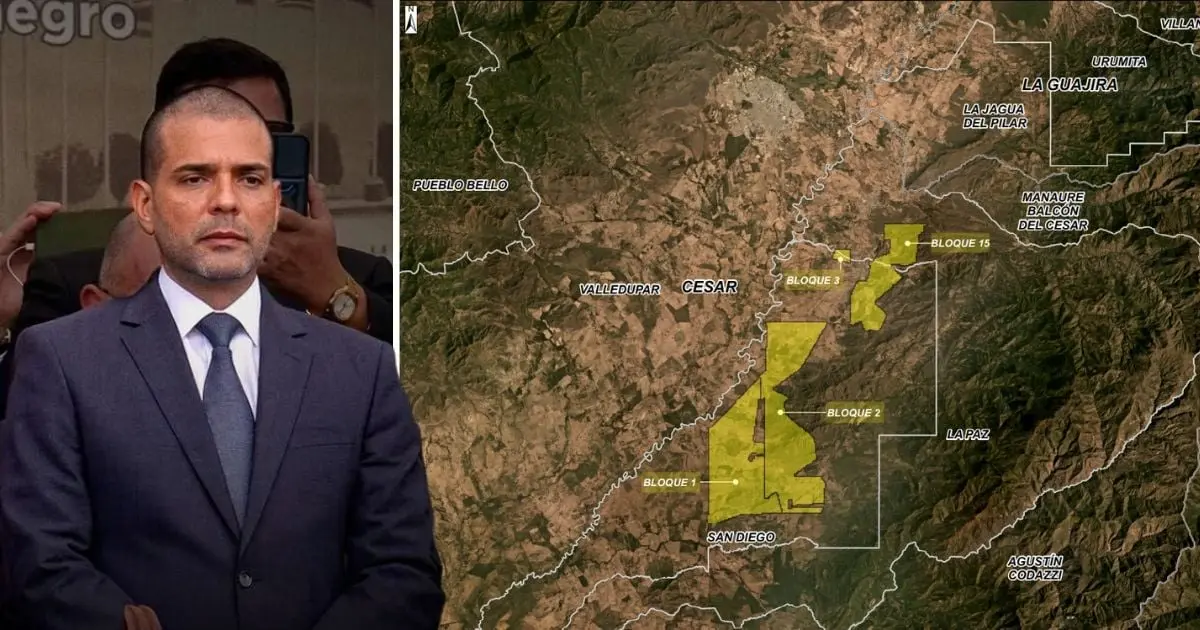
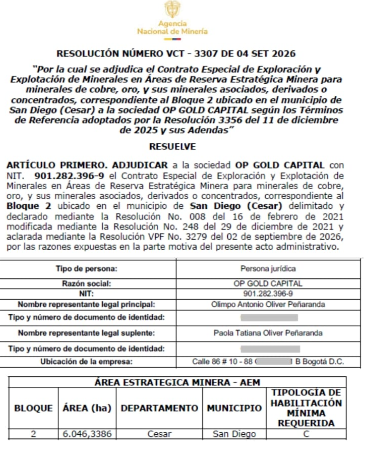
Months after surviving a high-profile assassination attempt in an upscale neighborhood of Bogotá—a botched hit that tragically claimed the lives of a prominent rice businessman and his bodyguard—Colombian mining entrepreneur Olimpo Oliver Peñaranda has returned to the public eye under striking circumstances. The National Mining Agency (ANM, for its initials in Spanish) has officially awarded four mining blocks to OP Gold Capital, a company led by Oliver Peñaranda.
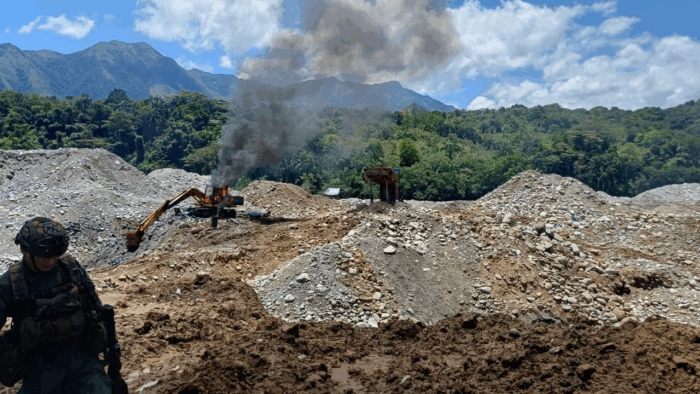
The concession encompasses blocks 1, 2, 3, and 25, located in the municipality of San Diego within the northern department of Cesar. According to official statements from the ANM, the allocation of these territories—designated for the exploration and exploitation of copper, gold, and other minerals—was the result of an objective competitive bidding process initiated in late 2025.
For Peñaranda, often referred to in national media circles as a modern "gold czar," this victory represents a significant institutional milestone. However, it arrives against a backdrop of intense controversy, legal entanglements, and unresolved questions regarding his security. The public revelation of the concession coincides with Peñaranda’s reappearance at public events, notably a military recognition ceremony at the José María Córdova Military Academy, signaling a high-level return to the corporate and social spheres despite the persistent threats shadowing his business operations.
Chronology of Events and Legal Trajectory
To understand the weight of OP Gold Capital’s recent victory in Cesar, it is necessary to trace the trajectory of Olimpo Oliver Peñaranda through Colombia’s turbulent mining and legal landscapes over the past decade.
Origins and Early Legal Battles (2015–2017)
According to investigative reports by journalist Daniel Coronell, Peñaranda hails from a well-established and prestigious family with extensive land holdings across the Caribbean departments of Córdoba and Sucre. Leveraging his family’s capital and regional influence, Peñaranda gradually transitioned into the high-stakes world of mineral extraction.
In 2017, Peñaranda’s name became permanently linked to the history of the Walter mine, one of the most prolific and fiercely contested gold deposits in the southern region of Bolívar. To consolidate his interests and secure legal titles, Peñaranda turned to the prominent firm De la Espriella Lawyers. It was during this period that he crossed paths with Daniel Peñarredonda, who later served as the director of the legal firm.
Peñarredonda’s primary mandate was to defend the corporate interests of entities such as Coopcaribona and Minecar—firms in which Peñaranda held stakes or maintained close operational ties. This defense involved aggressive legal maneuvers against local independent and informal miners operating in the south of Bolívar. These miners maintained that they had occupied and worked the land first, thereby claiming historical rights to the gold extraction. The legal battle over the Walter mine set a precedent for corporate-versus-informal mining disputes in Colombia, laying bare the fierce competition for resource control.
The Expansion and the Bidding Process (2025)
As his corporate footprint expanded, Peñaranda positioned his flagship mining vehicle, OP Gold Capital, to bid on state-allocated territories. Capitalizing on the Colombian government’s push for structured, transparent bidding processes through the ANM, OP Gold Capital entered the competitive selection process launched in late 2025 for mining blocks in San Diego, Cesar. Despite regulatory scrutiny and administrative delays common in Colombia’s mining sector, the company successfully outmaneuvered rival bidders to secure blocks 1, 2, 3, and 25.

The Bogotá Assassination Attempt and Reappearance (2026)
The trajectory of Peñaranda’s business ventures took a violent turn in early 2026. While visiting the upscale La Cabrera neighborhood in northern Bogotá, Peñaranda became the target of a precision hit squad.
The assassination attempt failed due to what authorities later described as a tragic case of mistaken identity. The sicario (hitman) confused Peñaranda with another individual, opening fire and killing Gustavo Aponte, a prominent rice entrepreneur, alongside Aponte’s bodyguard, Luis Gabriel Gutierrez, outside a local fitness facility.
Seven months after the harrowing incident, Peñaranda resurfaced in public view during a military recognition ceremony at the Escuela Militar de Cadetes José María Córdova. Dressed in a sharp dark blue suit and seated near high-ranking military and government officials, Peñaranda’s reappearance underscored his resilience and his deep connections within Colombia’s political and security establishments.
Supporting Data: The Landscape of Colombian Mining
The operations of OP Gold Capital and figures like Peñaranda unfold within a deeply complex macroeconomic and security framework defined by the tension between formal industrial extraction and the country’s vast underground economy.
- Scale of Illegal Mining: According to joint reports from the Procuraduría General de la Nación (Attorney General’s Office) and the Defensoría del Pueblo (Ombudsman’s Office), Colombia loses approximately 55 tons of gold annually to illegal extraction and smuggling operations. This illicit trade generates billions of pesos that frequently fund armed conflict.
- Diversification into Critical Minerals: While Peñaranda initially built his reputation in gold extraction—typified by his ventures in southern Bolívar—the new concession in San Diego, Cesar, explicitly incorporates copper and other multi-mineral resources. This shift mirrors a broader global and national push toward securing critical transition minerals, aligning with government incentives to formalize and diversify mining output.
- The SAE Asset Management Controversy: The economic ecosystem surrounding precious metals in Colombia continues to face institutional challenges. Investigative reports have highlighted controversies surrounding billions of pesos managed by the Sociedad de Activos Especiales (SAE) during the administration of President Gustavo Petro regarding state-seized gold companies, illustrating the constant vulnerability of the sector to corruption and administrative oversight failures.
- Geographical Risk Profiles: The departments of Cesar, Bolívar, Córdoba, and Sucre represent historical crossroads of agricultural wealth, cattle ranching, and mineral deposits. However, their geographic fragmentation and historical state absence have turned them into battlegrounds for armed actors seeking to control logistical corridors and natural resource rents.
Official Responses and Security Hypotheses
The simultaneous expansion of OP Gold Capital’s mining portfolio and the ongoing investigations into the attempt on Olimpo Peñaranda’s life have elicited varied responses from state agencies, security forces, and legal experts.
The National Mining Agency (ANM) and Transparency
The ANM has staunchly defended the legitimacy of the concession awarded to OP Gold Capital. In official statements, the agency emphasized that the allocation of the four blocks in San Diego, Cesar, was the result of a rigorous, objective convocatoria (call for bids) initiated in late 2025. The ANM maintains that all participating firms underwent strict compliance checks regarding financial capacity, technical expertise, and legal standing, insulating the process from political favoritism or backroom dealings.
The Attorney General’s Office (Fiscalía) and Motives for the Attack
The Fiscalía General de la Nación has pursued multiple parallel lines of investigation regarding the failed assassination attempt in La Cabrera. Investigators have categorized the hypotheses into two primary directions:
- Retaliation by Armed Groups: Peñaranda has consistently maintained that his aggressive corporate efforts to formalize operations, expel illegal miners, and secure state titles at the Walter mine in southern Bolívar made him a prime target for insurgent groups. According to statements attributed to the businessman, armed factions such as the dissident factions of the FARC and the National Liberation Army (ELN)—both of which have historically financed their operations through unmonitored gold extraction in the region—viewed his legal interventions as a direct threat to their illicit revenue streams. Law enforcement agencies have not ruled out the possibility that residual or active insurgent networks contracted the hit squad that mistakenly executed Gustavo Aponte.
- Financial Disputes and Private Debt: Concurrently, investigators are examining a more terrestrial and commonplace motive: private financial disputes and debt collection. Given the vast sums of capital required to sustain large-scale mining operations, legal disputes with former partners, disgruntled investors, or creditors remain a standard hazard in the sector. The Fiscalía continues to analyze financial records and communications associated with Peñaranda’s corporate network to determine whether a commercial dispute triggered the contract killing.
Implications of the Concession
The awarding of four vital mining blocks in Cesar to OP Gold Capital carries profound economic, political, and security implications for Colombia:
1. The Intersection of Corporate Mining and Personal Security
The case of Olimpo Peñaranda highlights the perilous nexus between high-stakes capital investment and extreme personal risk in Colombia’s resource-rich peripheries. The ability of an entrepreneur to survive a sophisticated assassination attempt in the capital and subsequently secure a major state-sanctioned mining concession months later illustrates a surreal duality: corporate legitimacy operating hand-in-hand with the shadow of underworld violence. It raises urgent questions about the state’s capacity to protect individuals who challenge entrenched illegal economies.
2. The Formalization vs. Displacement Dilemma
While the ANM champions the entry of formal enterprises like OP Gold Capital as a necessary step to curb illegal mining and environmental degradation, local resistance remains a persistent hurdle. As seen in southern Bolívar, the introduction of corporate titles often displaces small-scale, informal miners who have subsisted on these lands for generations. This dynamic risks igniting social unrest and embedding corporate actors in protracted land conflicts that can easily escalate into localized violence.
3. Economic Diversification in Cesar
Historically dependent on large-scale open-pit coal mining, the department of Cesar faces an uncertain economic future amid global decarbonization trends and the gradual phase-out of fossil fuels. The introduction of copper and gold exploration projects by firms like OP Gold Capital signals a strategic pivot toward critical minerals. If managed transparently and effectively, these projects could catalyze regional economic diversification; however, failure to integrate local communities risks repeating past cycles of social conflict and environmental degradation.
4. Institutional Credibility and Transparency
As the Petro administration and regulatory bodies push for greater transparency in natural resource management, the scrutiny surrounding high-profile beneficiaries of state concessions will only intensify. The ability of agencies like the ANM to maintain public trust hinges on absolute clarity in how public tenders are awarded, ensuring that multi-mineral blocks contribute equitably to national development rather than merely enriching well-connected private elites navigating hazardous security landscapes.