

The global economy is increasingly defined by its reliance on digital infrastructure. From the high-performance graphics processing units (GPUs) training artificial intelligence models in hyper-scale data centers to the microcontrollers embedded in everyday household appliances, semiconductors and digital hardware have become the foundational bedrock of modern civilization.
According to data released by the Semiconductor Industry Association (SIA), global semiconductor sales surged to an unprecedented $627.6 billion in 2024, representing an extraordinary 19.1% growth compared to the previous year.
However, this explosive economic expansion conceals two critical vulnerabilities: an extreme geographical concentration of manufacturing capacity in East Asia and a rapidly accelerating ecological crisis driven by obsolete electronic waste (e-waste). While the hardware sector drives trillions of dollars in downstream economic value, the physical supply chain remains highly centralized, and its environmental footprint is increasingly unsustainable.
Main Facts: The Geography of Hardware and the Economics of Silicon
The production of digital hardware—a category encompassing silicon wafers, printed circuit boards (PCBs), liquid crystal displays (LCDs), and final device assembly—is dominated by a select few nations.
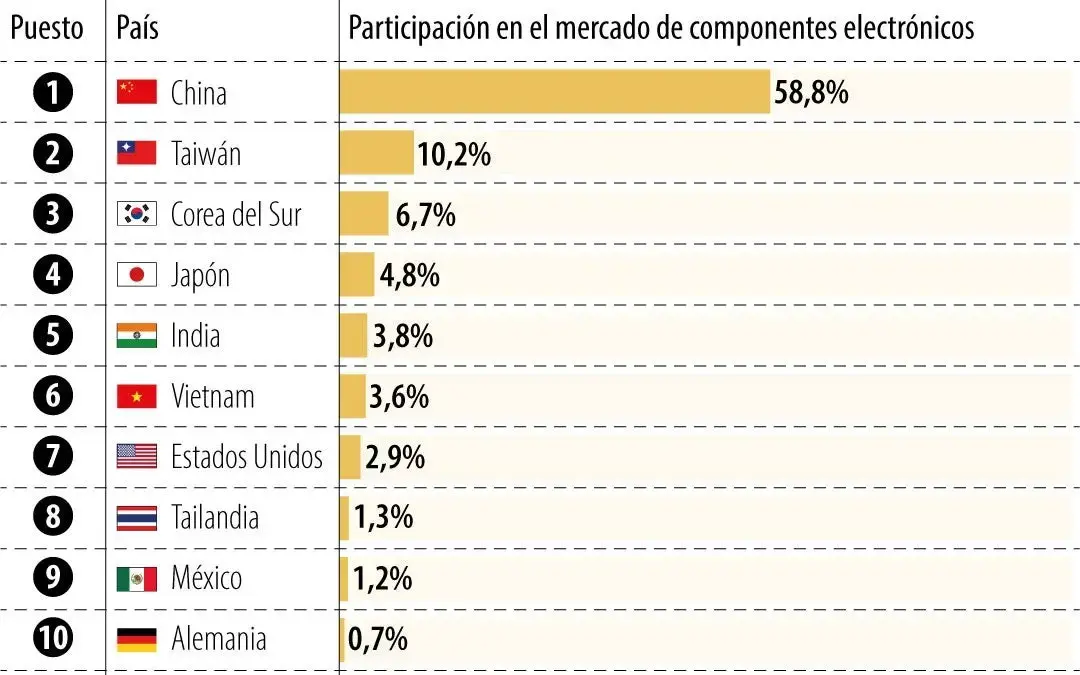
Global Digital Hardware Capacity Share (%)
│
├── China ─────────────────────────────────────────────────── 58.8%
├── Taiwan ─────────────────── 10.2%
├── South Korea ────────────── 6.7%
├── Japan ──────────────────── 4.8%
├── India ──────────────────── 3.8%
├── Vietnam ────────────────── 3.6%
└── United States ──────────── 2.9%
The Asian Manufacturing Monolith
According to the climate and energy think tank Ember, China alone commands 58.8% of the world’s digital hardware capacity. This represents nearly three-fifths of the global market. China’s comprehensive industrial ecosystem spans the entire manufacturing spectrum, producing everything from raw silicon and intermediate components like PCBs and display panels to consumer-ready smartphones and computers.
Behind China, the East Asian cluster further cements the region’s dominance:
- Taiwan holds 10.2% of global capacity, driven by its unparalleled mastery of advanced semiconductor fabrication.
- South Korea accounts for 6.7%, anchored by its dominant position in memory chip (DRAM and NAND flash) manufacturing and display technologies.
- Japan maintains a 4.8% share, specializing in high-purity silicon wafers, chemical precursors, and advanced manufacturing equipment.
Together, these four East Asian nations control 80.5% of the world’s digital hardware manufacturing capacity, leaving the rest of the world heavily dependent on a geographically concentrated and geopolitically sensitive corridor.
Emerging Hubs and the Western Paradox
Outside of the dominant East Asian bloc, Southern and Southeastern Asia are gradually expanding their footprints:
- India has claimed the fifth position globally with a 3.8% market share, fueled by aggressive government incentives to attract smartphone assembly and component manufacturing.
- Vietnam closely follows with 3.6%, positioning itself as a primary alternative for companies seeking to diversify their supply chains away from mainland China.
In contrast, the United States presents a stark paradox. While US-based tech giants such as Nvidia, Intel, and AMD design the world’s most sophisticated chips and dictate market trends, the physical manufacturing capacity located within the US stands at a meager 2.9% of the global total. This stark divergence highlights the "fabless" business model pioneered by American firms, which rely on overseas foundries—primarily in Taiwan—to manufacture their proprietary designs.
Chronology: The Road to Asymmetry and Waste
To understand how the digital hardware industry reached this high-stakes concentration and environmental bottleneck, it is necessary to examine the structural shifts over the past several decades.
CHRONOLOGY OF THE DIGITAL HARDWARE INDUSTRY

1980s ─── Birth of the Pure-Play Foundry Model
          • TSMC founded in Taiwan (1987)
          • Separation of chip design from physical manufacturing

1990s ─── The Great Migration to China
          • Multinationals relocate assembly to mainland China
          • Low labor costs and massive infrastructure investments

2010 ──── The E-Waste Baseline Established
          • Global e-waste recorded at 34 million metric tons
          • Rapid cycle of consumer electronics obsolescence begins

2020 ──── The Pandemic Bottleneck (2020–2022)
          • Severe global chip shortages disrupt automotive and tech sectors
          • Western nations realize extreme vulnerability of outsourced fab capacity

2022 ──── The E-Waste Milestone
          • Global e-waste reaches 62 million metric tons (82% increase since 2010)
          • Only 22.3% of electronic waste is documented as properly recycled

2024 ──── The AI and Silicon Supercycle
          • Global semiconductor sales hit $627.6 billion (19.1% year-on-year growth)
          • Geopolitical tension drives localized manufacturing initiatives (CHIPS Acts)
Supporting Data: The Environmental Toll of the Silicon Boom
The rapid cycle of hardware acquisition, use, and disposal has triggered an environmental crisis. The convenience of modern technology contrasts sharply with the toxic reality of its disposal.
According to the Global E-waste Monitor 2024, a joint report published by the International Telecommunication Union (ITU) and the United Nations Institute for Training and Research (UNITAR), 62 million metric tons of e-waste were generated globally in 2022. This represents a staggering 82% increase from the 34 million metric tons recorded in 2010.
Global E-Waste Generation & Recycling Gap (2022)
┌────────────────────────────────────────────────────────────────┐
│ Total E-Waste Generated: 62 Million Metric Tons                │
├──────────────────────────────┬─────────────────────────────────┤
│ Recycled & Documented        │ Unmanaged / Landfill / Informal │
│ 13.8 Million Metric Tons     │ 48.2 Million Metric Tons        │
│ (22.3%)                      │ (77.7%)                         │
└──────────────────────────────┴─────────────────────────────────┘
The data highlights a profound systemic failure in the circular economy:
- The Recycling Deficit: Only 22.3% of the 62 million metric tons of e-waste in 2022 was formally documented as collected and recycled in accordance with environmental standards.
- The Fate of the Remaining 77.7%: Approximately 48.2 million metric tons of electronic waste ended up in landfills, was incinerated, or was processed through informal, unregulated recycling networks—often in developing countries.
- Economic Loss: The ITU and UNITAR estimate that the metals contained in the unmanaged e-waste of 2022—including gold, copper, iron, and highly critical rare earth elements—were worth approximately $62 billion in lost secondary raw materials.
- Toxic Proliferation: Unregulated burning and acid-leaching of e-waste in informal sectors release highly toxic substances, such as lead, mercury, cadmium, and brominated flame retardants, into local soil and water tables.
Official Responses: Geopolitical Realignment and Environmental Regulation
The dual challenges of supply chain vulnerability and mounting e-waste have forced governments and international bodies to transition from laissez-faire market policies to active state interventions.
Geopolitical and Industrial Policy Responses
Recognizing that a physical disruption in East Asia could halt global manufacturing, Western governments have committed hundreds of billions of dollars to domesticate semiconductor manufacturing:
- The United States: Passed the CHIPS and Science Act, allocating over $52 billion in direct subsidies and tax incentives to construct advanced semiconductor fabrication facilities (fabs) domestically. This initiative has attracted major investments from Intel, TSMC, and Samsung to build cutting-edge facilities in Arizona, Ohio, and Texas.
- The European Union: Implemented the European Chips Act, aiming to double the EU’s share of global semiconductor production capacity to 20% by 2030, backed by more than €43 billion in public and private investments.
- India: Launched the Modified Programme for Development of Semiconductors and Display Manufacturing Ecosystem, offering up to 50% fiscal support for semiconductor fabs, which successfully attracted major multi-billion-dollar joint ventures.
Environmental Policy Responses
On the ecological front, regulatory bodies are attempting to curb the growth of electronic waste through legislative mandates:
- The European Union’s Right to Repair Directive: Designed to extend the lifespan of electronics by forcing manufacturers to make spare parts and repair manuals available to independent repair shops and consumers at reasonable prices.
- Eco-Design Regulations: New EU rules mandate that smartphones and tablets must feature easily replaceable batteries and be designed for disassembly to facilitate recycling.
- UN Sustainable Development Goals (SDGs): The ITU has set a target to increase the global e-waste recycling rate to 30% by the late 2020s, though current trends suggest that without aggressive enforcement, this target will be missed.
Implications: The High Stakes of the Digital Future
The current configuration of the global digital hardware market carries profound implications for geopolitics, economic stability, and global ecological health.
Geopolitical Fragility and the "Taiwan Chokepoint"
With 80.5% of digital hardware capacity concentrated in China, Taiwan, South Korea, and Japan, the global economy is highly vulnerable to regional conflict or natural disasters. Taiwan’s dominance in manufacturing the world’s most advanced microchips (holding over 90% of the market for sub-5-nanometer chips) means that any disruption in the Taiwan Strait could trigger a global economic depression, halting the production of cars, medical equipment, and consumer electronics worldwide.
The True Cost of the AI and Cloud Boom
The rapid expansion of artificial intelligence, high-performance computing, and 5G infrastructure is intensifying both the semiconductor demand and the e-waste crisis. AI data servers require specialized GPUs that consume vast amounts of energy to manufacture and have shorter operational lifespans due to rapid technological obsolescence. This accelerates the retirement of older servers, generating a massive volume of commercial-grade e-waste that current recycling infrastructures are unequipped to handle.
The Urgent Need for a Circular Electronics Economy
The current "take-make-waste" linear economic model of the tech sector is unsustainable. If the growth rate of e-waste continues on its current trajectory, annual e-waste generation is projected to surpass 80 million metric tons by 2030.
To avert an environmental crisis, the electronics industry must transition to a closed-loop system. This transition requires:
- Designing for Circularity: Using modular components that can be easily upgraded, repaired, and disassembled.
- Urban Mining: Scaling up specialized metallurgical facilities capable of safely recovering high-purity gold, copper, and rare earth elements from old circuit boards, reducing the need for destructive raw-material mining.
- Extended Producer Responsibility (EPR): Legally requiring hardware manufacturers to finance and manage the end-of-life recycling of the products they sell.
While silicon has powered unprecedented human progress and wealth creation, the physical reality of hardware manufacturing and disposal is catching up with the digital economy. The future of technology will depend not only on how fast we can design the next generation of microchips, but on our ability to secure their supply chains and responsibly manage them once they become obsolete.




Leave a Reply