


Introduction
Incorporating an arm routine into a home workout schedule is significantly easier when you have a clear plan for what to do with a pair of dumbbells. Recently popularized fitness trends have highlighted accessible routines designed to strengthen and tone the upper body without requiring a commercial gym membership.
Drawing inspiration from fitness professional Yaneth Ponce, who routinely utilizes a pair of five-kilogram (approximately 11-pound) dumbbells for her home regimens, everyday practitioners are discovering that effective upper-body training is remarkably straightforward. However, successfully implementing these exercises requires more than just copying a specific weight or movement; it demands an understanding of proper biomechanics, progressive overload, and individual physical capacity.
This comprehensive guide explores a targeted five-movement home arm routine—covering biceps, triceps, and shoulders—while evaluating essential fitness principles, expert guidelines from institutions like the Mayo Clinic, and scientific realities regarding muscle strengthening versus fat loss.
Main Facts: The Five-Movement Home Arm Routine
The foundation of Ponce’s viral home routine centers on five core exercises targeting the primary muscle groups of the upper arms and shoulders. While Ponce herself frequently employs five-kilogram weights, fitness experts universally emphasize that load selection must be customized to the individual’s current strength level.
The routine is strategically divided into targeted movements for the biceps, triceps, and shoulders:
1. The Biceps Focus
- The Hammer Curl: Performed by holding the dumbbells with a neutral grip (palms facing each other) and flexing the elbows. A popular variation involves a cumulative sequence: lifting with one arm, then the other, and finally with both arms simultaneously, concluding with ten repetitions of the simultaneous phase. This grip places greater emphasis on the brachialis and brachioradialis muscles, contributing to overall arm thickness.
- The Traditional Bicep Curl: Executed with palms facing upward (supinated grip). Practitioners are instructed to keep their elbows pinned tightly to the sides of the torso and strictly avoid body momentum or swinging. The prescribed structure features four sets of 15 repetitions, promoting muscular endurance and hypertrophy.
2. The Triceps Focus
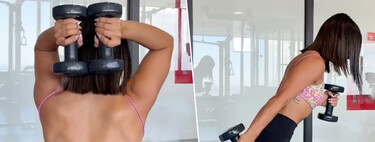
- The Triceps Kickback: Executed with the torso hinged forward at the hips. The practitioner extends the elbow backward, driving the dumbbell up while keeping the upper arm completely stable and parallel to the floor. The routine incorporates ten precise repetitions per set.
- The Overhead Dumbbell Triceps Extension (Cupa): This movement involves holding a single dumbbell vertically with both hands behind the head, then pressing it upward until the arms are fully extended. The protocol calls for four sets of 15 repetitions, with an explicit reminder to keep the elbows tucked inward toward the head to maximize triceps recruitment.
3. The Shoulder Focus
- The Seated Overhead Shoulder Press: Performed while sitting upright in a chair to support the spine. The dumbbells are pressed overhead from shoulder height, ensuring a neutral spine and engaged core. While specific set and rep ranges for this movement can vary depending on the practitioner’s endurance, it serves as a crucial compound exercise to complement the isolation work of the arms.
Ponce recommends performing this comprehensive upper-body session two to three times per week, allowing at least one full day of rest between sessions to facilitate muscle recovery and pairing it with lower-body or core training on alternate days.
Chronology & Evolution of Home Fitness Training
The shift toward home-based resistance training has evolved rapidly over the past decade, accelerated by technological advancements, social media fitness platforms, and changing lifestyle demands.

The Rise of Digital Fitness (Pre-2020)
Long before home workouts became a global necessity, fitness professionals began utilizing digital platforms like Instagram and YouTube to democratize strength training. Traditional bodybuilding was largely confined to specialized gyms equipped with heavy cable machines and rack systems. However, trainers recognized that functional fitness could be effectively achieved using minimalist equipment, such as a single pair of adjustable or fixed-weight dumbbells.
The Pandemic Shift (2020–2022)
During global lockdowns, home workouts transitioned from a convenient alternative to an essential practice. Millions of individuals invested in basic home gym equipment, sparking a massive surge in digital workout routines. Trainers adapted their programming to focus on high-density, low-footprint exercises that could be executed in small spaces, such as living rooms or home offices.
The Evidence-Based Digital Era (2024–Present)
Today, fitness content creators face increasing scrutiny to balance aesthetic promises with scientifically sound advice. The integration of sports science into social media fitness has shifted the conversation away from rapid transformation claims toward sustainable habits. Contemporary routines—such as those shared by Ponce and analyzed by fitness journalism platforms like Semana and Vitónica—emphasize longevity, proper technique, and the critical distinction between building muscle and spot-reducing fat. Recent updates to institutional guidelines, such as Mayo Clinic’s strength training publications in mid-2026, continue to reinforce that minimalism in equipment does not mean a compromise in physiological effectiveness.
Supporting Data & Expert Guidelines
To maximize the benefits of a home dumbbell routine while minimizing the risk of injury, practitioners must look beyond social media demonstrations and consult established sports medicine frameworks.
Weight Selection and Muscle Fatigue
A common pitfall for beginners is adopting the exact weight used by an experienced trainer. A five-kilogram dumbbell may serve as an ideal training stimulus for an advanced athlete, but it could lead to poor form or strain for a novice.
According to guidelines from the Mayo Clinic regarding strength training technique, the ideal weight is one that allows the practitioner to lift it comfortably between 12 and 15 times while achieving a level of effort that thoroughly fatigues the target muscle. If the exerciser cannot maintain proper execution—such as maintaining a stable core or avoiding momentum—the weight must be reduced immediately. Furthermore, warm-ups lasting five to ten minutes of light aerobic movement and dynamic stretching are essential to prepare the joints and connective tissues.
Volume: Quality Over Quantity
The traditional prescription of four sets per exercise is not a mandatory starting point for beginners. Mayo Clinic’s strength-training guides indicate that a single, well-executed set of 12 to 15 repetitions using an appropriate load can yield significant muscular adaptations for many individuals. As strength increases and the movement becomes easier, volume and resistance can be systematically increased.
Quantifying Effort: Repetitions in Reserve (RIR)
Modern exercise science utilizes the concept of "Repetitions in Reserve" (RIR) to measure workout intensity more accurately than simply tracking the weight of a dumbbell. As highlighted in fitness analyses by publications like Vitónica, RIR measures how many additional repetitions a person could physically complete with proper form before reaching absolute failure at the end of a set. For home routines, aiming for a range of 1 to 3 RIR ensures that the muscle is adequately stimulated without inducing excessive central nervous system fatigue or injury.
Official Responses and Scientific Consensus
The fitness industry frequently encounters marketing claims promising rapid body transformations, localized fat loss, and miraculous aesthetic results in record time. However, sports scientists, medical researchers, and institutional bodies offer a more grounded, evidence-based perspective.
The Myth of Spot Reduction
A persistent myth in physical conditioning is that exercising a specific muscle group will burn the fat directly surrounding it—the idea that doing bicep curls will eliminate upper-arm fat ("bat wings"), or that core exercises will melt abdominal fat.
Comprehensive scientific research overwhelmingly refutes this notion. A prominent meta-analysis published in Human Movement (2022), which synthesized data from 13 independent studies and 1,158 participants, directly investigated the hypothesis of exercise-induced localized fat reduction. The researchers compared fat loss in trained limbs versus untrained limbs and found no statistically significant localized reduction attributable to targeted exercise.
Official statements from exercise physiologists emphasize that while resistance training builds and tones underlying skeletal muscle, overall body fat reduction is governed by systemic energy balance (caloric expenditure versus caloric intake) and genetics. Therefore, performing triceps kickbacks will strengthen and define the triceps muscle, but it will not selectively burn the fat layer residing over it.
Implications for Practitioners
Understanding the mechanics, science, and limitations of a home dumbbell arm routine carries several practical implications for anyone embarking on a fitness journey:
- Personalization is Paramount: Copying a trainer’s exact load (such as five-kilogram weights) without assessing personal strength is a recipe for injury. Equipment must match current conditioning levels.
- Technique Trumps Volume: Sacrificing form to complete higher repetitions or heavier sets diminishes the effectiveness of the exercise and places undue stress on joints. Controlled movements, full ranges of motion, and strict adherence to form yield superior results.
- Realistic Aesthetic Expectations: Practitioners must separate muscle hypertrophy (strengthening and shaping muscle tissue) from fat loss. An effective arm routine will improve functional strength, metabolic health, and arm firmness, but visible definition depends equally on overall body composition and nutritional habits.
- Consistency Over Intensity: Sustainable fitness is built on manageable, repeatable habits. Committing to two or three well-structured home sessions per week, combined with adequate rest, proper nutrition, and progressive overload, will produce long-lasting health and physical benefits far superior to any short-lived, high-intensity craze.




Leave a Reply