

Main Facts
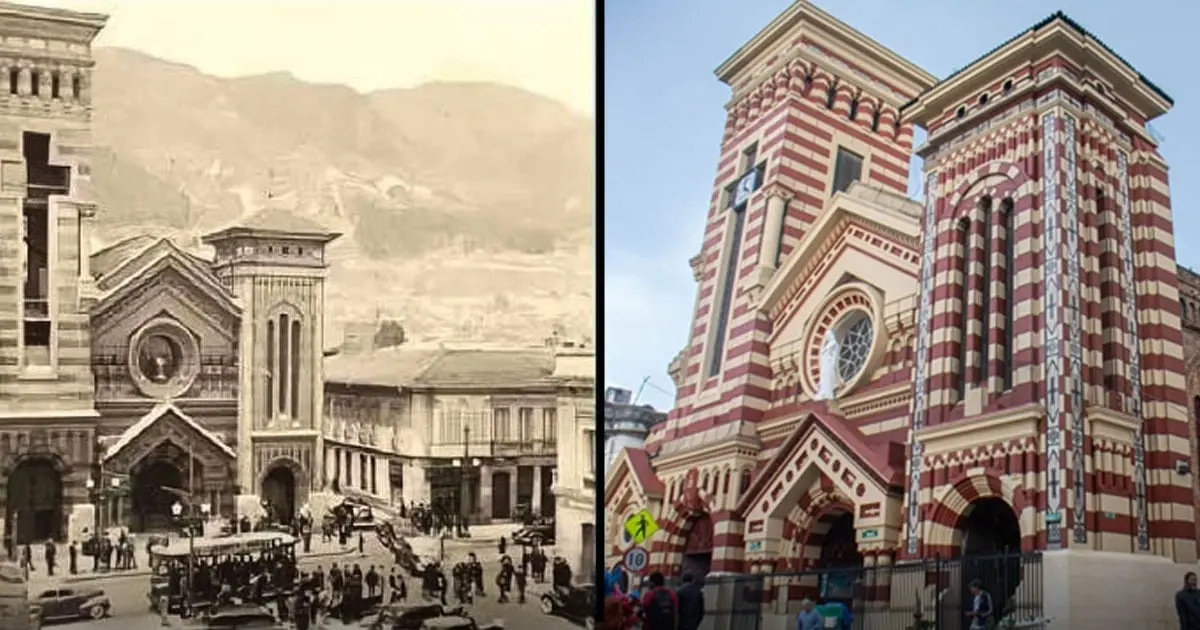
Nestled in the beating heart of downtown Bogotá, the historic neighborhood of Las Nieves stands as a living testament to the Colombian capital’s centuries-long metamorphosis. What began more than four centuries ago as a humble, outlying colonial settlement centered around a modest chapel has transformed into one of the most dynamic, heavily trafficked urban corridors in the country.
Today, while Las Nieves counts a modest resident population of roughly 13,783 people, it swells exponentially on weekdays. An estimated 56,998 daily commuters, students, and shoppers pour into its grid, bringing the total daytime circulation to nearly half a million souls navigating its bustling thoroughfares. Bounded to the north by the historic Recoleta de San Diego (now Calle 26) and the upscale slopes of Bosque Izquierdo and La Macarena, to the south by the historic San Francisco River bed (now Avenida 19), to the west by Carrera 13, and to the east by the towering Eastern Hills (Cerros Orientales), the neighborhood acts as a bridge connecting Bogotá’s colonial past with its frantic, modern present.
Las Nieves is defined by striking contrasts. It is a place where university campuses sit shoulder-to-shoulder with century-old bakeries, and where the echoes of colonial craftsmen—silversmiths, carpenters, and painters—linger beneath the shadow of high-rises and the Carrera Séptima pedestrian corridor. Yet, beneath its asphalt and concrete, Las Nieves guards layers of forgotten history: rivers buried beneath grand avenues, vanished parks erased by modernization, and immigrant communities that left an indelible mark on the nation’s commercial and cultural identity.
Chronology: From Colonial Outpost to Modern Metropolis
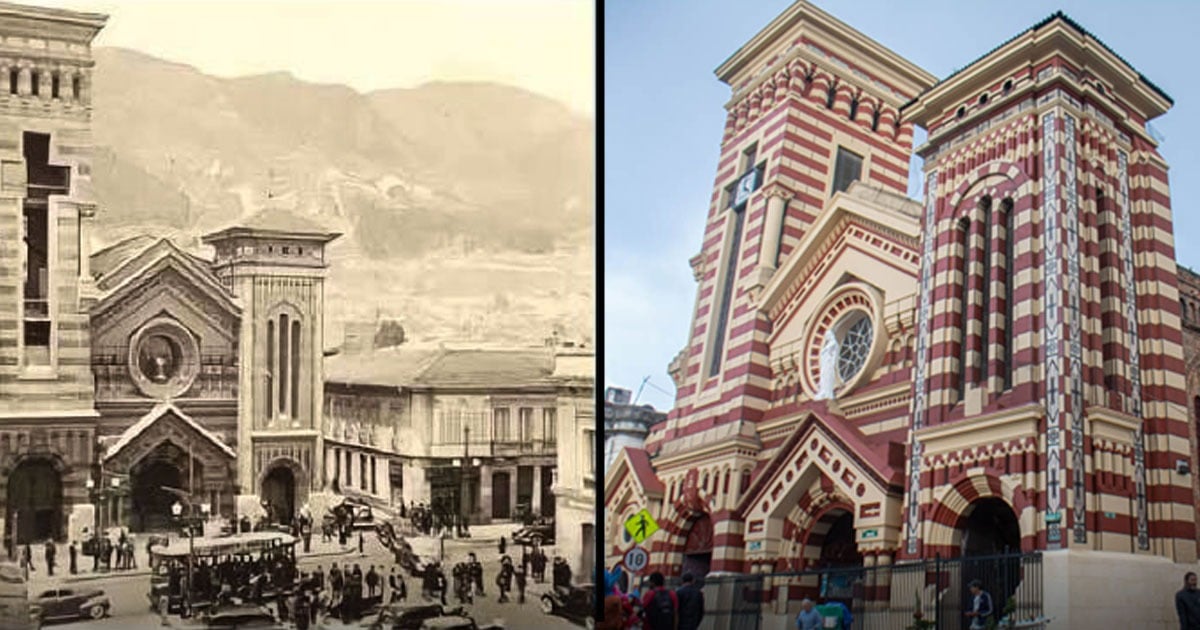
The history of Las Nieves is fundamentally intertwined with the birth of Bogotá itself. Its timeline reflects the broader socio-political shifts that turned a fledgling Spanish military camp into a sprawling Andean metropolis.
1538–1585: The Genesis of a Parish
Unlike many modern neighborhoods that grow outward through planned real estate developments, Las Nieves originated as one of the four foundational ecclesiastical and civil parishes of the nascent Santafé de Bogotá, established in 1538 following the Spanish conquest.
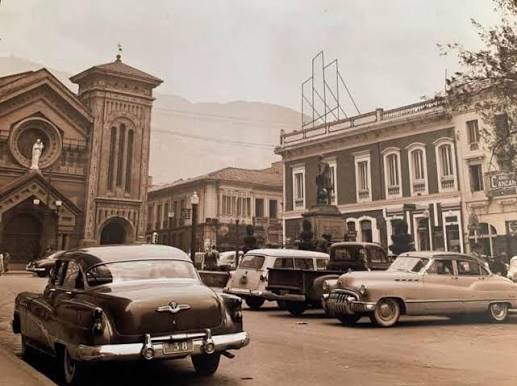
The area’s physical footprint began to take definitive shape in 1568, when the city’s mayor, Cristóbal Ortiz Bernal, championed the construction of a small chapel. Recognizing the expanding population north of the primary civic center, Archbishop Luis Zapata de Cárdenas officially consecrated and blessed the temple on March 23, 1585, christening it the Parish of Our Lady of the Snows (Nuestra Señora de Las Nieves). At the time, it stood alongside La Catedral (facing the main plaza, now Plaza de Bolívar), San Victorino (to the west, serving as a trade route toward Fontibón and the Magdalena River port of Honda), and Santa Bárbara (to the south).

1774: The Birth of the First Eight Barrios
For the first two centuries of its existence, Santafé operated largely under a loose ecclesiastical structure. That changed fundamentally on November 10, 1774, under the administration of Viceroy Manuel de Guirior. Seeking to impose administrative order and military oversight, the Spanish crown reorganized the city, converting the four original parishes into four military districts and establishing Bogotá’s first eight formal neighborhoods: Las Nieves, Las Cruces, Egipto, La Candelaria, Belén, Santa Bárbara, Usaquén, and La Catedral.
As part of this decree, eight newly appointed civilian mayors were ordered to name the rudimentary network of dirt paths and assign formal street numbering. Names like Calle del Patriarca, Calle de Quesada, Calle de La Carnicería, Calle de La Fatiga, and El Chorro de Santo Domingo began to appear on maps, anchoring Las Nieves into the municipal consciousness.
The 19th and Early 20th Centuries: Commerce, Culture, and Contrasts
By the 19th century, Las Nieves had solidified its reputation as a bustling hub of artisanal labor and commerce. The streets surrounding Carrera Séptima became home to seamstress workshops, tailors, modistes, and craftsmen. Furthermore, the early decades of the 20th century saw the arrival and integration of Jewish and Ashkenazi immigrant communities, who established thriving commercial ventures along the trade corridors.
The late 19th and early 20th centuries also introduced spaces of leisure and public health initiatives that reshaped the landscape:
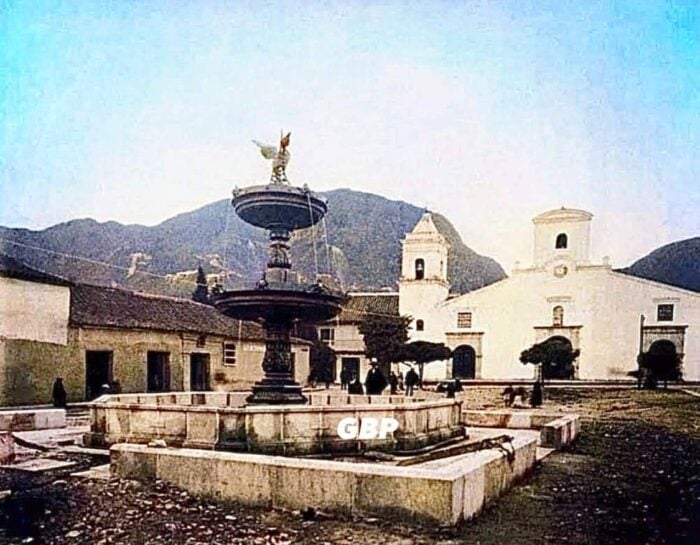
- July 24, 1883: The inauguration of the Parque Centenario, Bogotá’s very first dedicated sports and recreational park, which a year later hosted the city’s inaugural carousel.
- August 6, 1910: In celebration of the centennial of Colombia’s Independence, a bronze statue of the scientist and patriot Francisco José de Caldas—crafted by French sculptor Charles Raoul Verlet—was unveiled in the neighborhood’s Parque Caldas, later enhanced with formal gardens in 1918.
- 1916–1938: Under mayoral initiatives aimed at public sanitation (notably championed by Mayor Andrés Marroquín Osorio via Law 10 of 1915), a monumental 20-year engineering project began to canalize the city’s open waterways. The historic San Agustín and San Francisco rivers were buried, culminating in 1938 with the creation of the iconic Avenida Jiménez and Calle 7.
The Mid-20th Century: Culinary Landmarks and Urban Erasure
As the mid-century approached, Las Nieves cemented its culinary legacy with the establishment of iconic, European-style artisan bakeries that still operate today: La Florida (founded in 1936), Belalcázar (1943), El Cometa (1946), and Pastel Gloria Doña Pachita (1950).
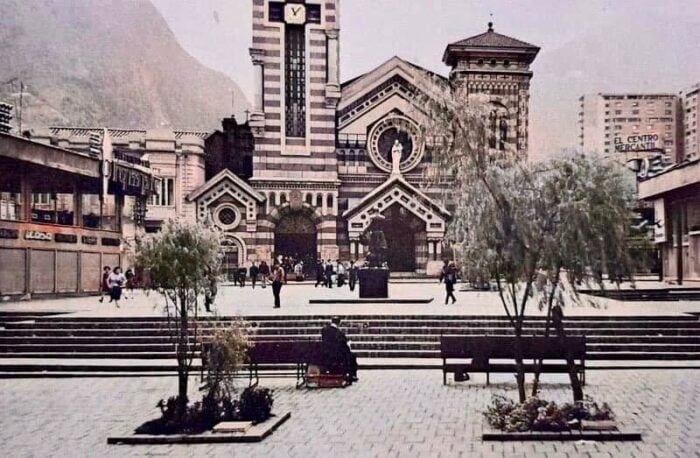
However, progress came at a heavy historical cost. In 1958, the historic Parque Centenario—along with its decades of social memory—was completely demolished to make way for the construction of Avenida El Dorado (now Calle 26), effectively burying a vibrant chapter of Las Nieves beneath asphalt to accommodate the automobile age.
Supporting Data
Understanding the current gravity of Las Nieves requires examining the demographic and infrastructural metrics that define its daily rhythm:
- Resident Population: Approximately 13,783 permanent residents live within the neighborhood boundaries, maintaining a historic residential core amidst rapid commercialization.
- Daily Floating Population: An influx of 56,998 visitors arrives every single day, drawn by universities, administrative offices, workshops, and retail stores.
- Total Daily Foot Traffic: Combined estimates indicate that upward of 500,000 people circulate through or adjacent to the Las Nieves corridor daily, making it one of the busiest transit zones in downtown Bogotá.
- Foundational Milestone: Established as a physical chapel in 1568 and officially consecrated as a parish on March 23, 1585, making it the second-oldest parish church district in the Colombian capital.
- Century-Old Culinary Heritage: Houses some of the oldest continually operating European-style bakeries in Bogotá, dating from the mid-1930s to the 1950s.
Official Responses and Heritage Preservation
The duality of Las Nieves—balancing its status as a fragile historical archive against its role as a high-density commercial hub—has prompted ongoing interventions from municipal authorities, urban planners, and cultural heritage institutions.
District agencies, including the Instituto de Desarrollo Urbano (IDU) and the Instituto Distrital de Patrimonio Cultural (IDPC), have repeatedly emphasized the necessity of balancing urban renewal with historical preservation. In recent master plans for downtown Bogotá, municipal officials have prioritized the revitalization of pedestrian spaces along Carrera Séptima and the integration of the historic riverbeds (such as the subterranean paths of the San Francisco River) into public memory projects.

Furthermore, cultural preservationists have collaborated with local academic institutions and neighborhood associations to safeguard surviving architectural vernaculars. While commercial pressures and real estate development threaten historic facades, official city guidelines increasingly designate traditional storefronts—such as the heritage bakeries La Florida and Belalcázar—as cultural landmarks worthy of special protection. These entities work in tandem to ensure that infrastructural upgrades, such as the expansion of public transit corridors and green urban pockets, do not erase the colonial and republican foundations embedded beneath the pavement.
Implications
The story of Las Nieves is a microcosm of urban evolution across Latin America: the tension between remembering the past and accommodating the relentless demands of modernity.
Cultural and Social Impact
The survival of Las Nieves through nearly five centuries demonstrates the remarkable resilience of localized community structures. Despite the construction of major thoroughfares like Calle 26 and Avenida Jiménez—which physically fractured historical spaces like the Parque Centenario—the neighborhood has continually reinvented itself. It transitioned from a colonial enclave of artisans and elites into a thriving commercial artery, and finally into a vibrant academic and transit hub frequented by hundreds of thousands daily.
Economic and Urban Planning Lessons
For modern urban planners, Las Nieves offers critical lessons in high-density, mixed-use zoning. Long before contemporary urbanism championed the "15-minute city," Las Nieves organically achieved a seamless integration of residential life, commerce, education, and religious heritage within a few square blocks. However, the neighborhood also serves as a cautionary tale regarding the historical costs of auto-centric urban planning. The loss of green spaces, the burial of natural waterways, and the demolition of recreational parks in the 20th century underscore the importance of preserving ecological and historical integrity in developing urban centers.
Ultimately, every time a commuter rushes past a restored colonial doorway, stops for a pastry at a 1930s bakery, or walks across the subterranean path of the San Francisco River, they are participating in an unbroken 500-year-old tradition. Las Nieves remains living proof that Bogotá’s future cannot be understood without walking through its historic past.



Leave a Reply