

By [Your Name/Environmental Desk]
Published: October 24, 2026
1. Main Facts: The Intersection of Clean Energy and Wildlife
As the global transition toward renewable energy accelerates, vast expanses of land are being transformed into photovoltaic (PV) solar parks. While these installations are vital for curbing carbon emissions and mitigating climate change, environmental scientists have long debated their impact on local ecosystems. Critics and conservationists frequently raise concerns that massive solar arrays fragment habitats, disrupt migratory corridors, and pose direct threats to local wildlife.
However, understanding the nuanced reality of how animals interact with these industrial-scale energy hubs has historically proven difficult. Traditional ecological surveys are often sporadic, labor-intensive, and prone to missing subtle, long-term behavioral changes.
To bridge this knowledge gap, a groundbreaking study conducted by researchers at the Argonne National Laboratory deployed an innovative combination of high-definition camera technology and artificial intelligence. By monitoring five distinct solar facilities across Arizona, Illinois, and Massachusetts over several years, the research team compiled a staggering 19,000 hours of daytime footage.
Processing thousands of hours of video through machine-learning algorithms allowed scientists to log tens of thousands of wildlife observations. The findings paint a surprisingly vibrant picture: rather than serving as sterile industrial zones, solar farms are frequently utilized by birds, insects, and even mammals for foraging, nesting, resting, and traveling. Furthermore, despite analyzing thousands of hours of intense daytime activity, the researchers did not record a single confirmed bird collision with the solar infrastructure, challenging long-held assumptions regarding the hazards of photovoltaic arrays.
2. Chronology: Unlocking the Secret Life of Solar Farms
The journey to understanding how wildlife adapts to photovoltaic infrastructure represents a major leap forward in ecological monitoring methodology.
The Setup (2019–2024)
Between 2019 and 2024, researchers at Argonne National Laboratory selected five representative solar energy facilities strategically placed across diverse geographic landscapes and ecosystems. These included arid desert environments in Arizona, Midwestern agricultural and transitional lands in Illinois, and densely vegetated, temperate zones in Massachusetts. To capture continuous activity without human interference, the team installed specialized automated cameras capable of recording high-definition daylight video. Over the multi-year monitoring period, the cameras accumulated more than 19,000 hours of raw footage, capturing everything from soaring raptors to cautious ground-dwelling mammals.
The AI-Powered Filter (2024–2025)
Faced with a massive data deluge—thousands of hours of video—manual review by human researchers alone would have taken years. To solve this bottleneck, the scientific team deployed advanced artificial intelligence algorithms trained specifically to detect, isolate, and track moving objects within complex environments.
The AI system analyzed a targeted subset of 4,373 hours of video. Whenever movement was detected, the technology automatically clipped the footage into concise, reviewable video segments. Human researchers then verified the AI’s classifications, categorizing the animals, tracking their specific behaviors, and noting their exact interactions with the physical solar hardware.
Publication of Findings (Early 2026)
Following extensive data processing, statistical modeling, and peer review, the study—authored by Y. Hamada, A. Z. Szymanski, P. F. Tarpey, and L. J. Walston—was published in the journal Diversity (Vol. 18, No. 2, p. 95). The study provided the scientific community with unprecedented empirical data regarding how fauna navigate, utilize, and coexist with large-scale renewable energy installations.
3. Supporting Data: What the Cameras Captured
The sheer volume of data collected during the study underscores the unexpected ecological richness found within the perimeter fences of modern solar facilities. When the AI-filtered video segments were cataloged, the numbers revealed a bustling micro-ecosystem:
- Total Wildlife Observations: The research team logged a combined total of nearly 95,000 discrete animal observations across the monitored sites.
- Avian Activity (68,646 observations): Birds made up the vast majority of recorded wildlife. Interestingly, roughly 54% of avian observations captured birds flying at altitudes high enough to preclude any direct interaction with the solar panels or mounting structures. However, approximately 33% of observations showed birds actively engaging with the infrastructure—flying low between rows, perching on panel frames, landing on the ground to forage, carrying nesting materials, and, in rare instances documented by the cameras, engaging in mating rituals (such as finches observed copulating directly on top of the panels).
- Insect Activity (25,968 observations): A diverse array of insects was documented utilizing the microclimates created by the solar arrays. Pollinators including bumblebees, butterflies, dragonflies, and various species of wasps were frequently recorded moving among the vegetation that grows beneath and around the panels.
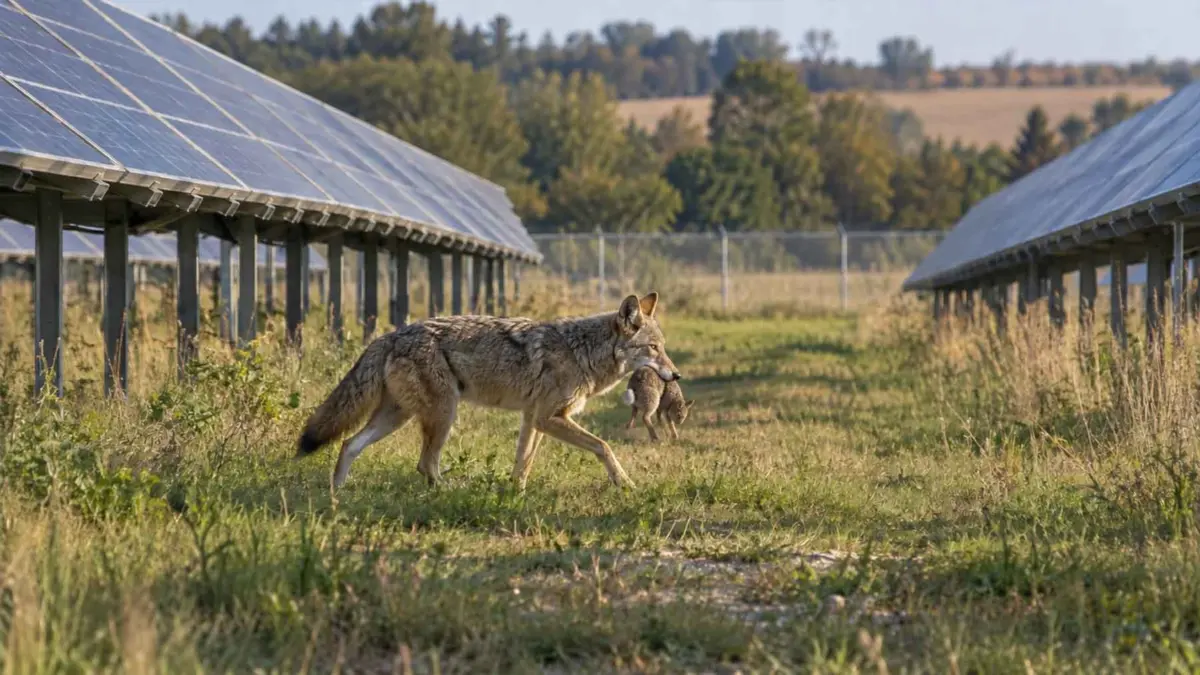
- Mammalian Activity (169 observations): While mammals were less frequently captured by the daytime cameras, their appearances yielded some of the study’s most fascinating behavioral insights. In the arid Arizona desert, cameras recorded black-tailed jackrabbits and coyotes traversing the facility. In the Northeastern and Midwestern sites, young red foxes and woodchucks (marmots) were documented moving through the arrays. Rare behavioral captures included coyotes carrying prey items and marmots transporting plant matter and twigs.
4. Official Responses and Scientific Context
The findings have sparked considerable interest—and careful nuance—within the broader scientific and renewable energy communities. Ecologists and industry stakeholders are utilizing the data to refine how solar farms are designed and managed.
Dr. L. J. Walston, one of the lead researchers on the Argonne National Laboratory study, emphasized that while the data reveals animals successfully navigating solar facilities, it should not be interpreted as proof that renewable energy installations are entirely benign or universally identical.
"The enormous variations we observed across the five different solar parks make it abundantly clear that not all facilities function the same way," the research team noted in their published findings. Factors such as the surrounding regional landscape, local micro-climates, ground vegetation management policies, and fencing design play monumental roles in determining how local wildlife experiences a solar facility.
Addressing the "Lake Effect" Hypothesis
One of the most critical elements of the study relates to the long-standing ecological concern known as the "lake effect" hypothesis. For years, scientists have hypothesized that the flat, dark, highly reflective surfaces of photovoltaic panels might mimic bodies of water when viewed from the air, potentially tricking migratory or local birds into attempting water landings or causing disoriented mid-air collisions.
During the thousands of hours of daytime video reviewed by the Argonne researchers, not a single confirmed collision between a bird and the solar infrastructure was documented.
However, the researchers urge caution against sweeping generalizations. The study did capture moments of clumsiness or near-misses—such as a finch losing its footing while walking along a metal rack, a woodpecker struggling with an awkward landing, a robin slipping on a glass panel, and a starling glancing off a panel edge. Crucially, none of these observed slips resulted in visible injury or mortality.
Furthermore, the authors stress that daytime video monitoring does not completely rule out nocturnal collisions (such as those involving migratory songbirds navigating at night), nor does it disprove the lake effect under specific lighting and weather conditions. Instead, the study provides concrete baseline data demonstrating that many species routinely incorporate solar installations into their daily home ranges without catastrophic disruption.
5. Implications for the Future of Renewable Energy
As nations race to meet net-zero carbon targets, the footprint of utility-scale solar energy will continue to expand. The insights gleaned from the Argonne National Laboratory study offer a roadmap for harmonizing clean energy production with biodiversity conservation.
Rethinking Vegetation and "Agrivoltaics"
One of the most profound implications of the study is the potential for intentional habitat management within solar parks. Because insects, birds, and small mammals readily utilize the shaded microclimates and protected ground beneath solar panels, operators have a unique opportunity to cultivate pollinator-friendly habitats. Planting native wildflowers, grasses, and shrubs beneath and between arrays—a practice known increasingly as "agrivoltaics" or low-impact solar development—can actively support declining insect and bird populations while simultaneously improving the efficiency of the solar panels (as vegetative ground cover reduces ambient heat reflection, keeping photovoltaic cells cooler and more efficient).
Designing Wildlife-Friendly Infrastructure
The study also highlights the importance of site-specific environmental impact assessments. Because wildlife utilization varied dramatically based on geography, local ecology, and facility management styles, developers can no longer rely on a one-size-fits-all approach. Incorporating permeable fencing that allows small-to-medium mammals safe passage, avoiding sensitive migration corridors during site selection, and maintaining ecological connectivity around the perimeter of solar farms will be essential best practices for the next generation of clean energy projects.
Ultimately, the marriage of artificial intelligence and long-term ecological monitoring is revolutionizing how we understand our impact on the natural world. By peering past the glass and steel of modern energy farms, science is revealing a resilient natural world adapting—and in some cases, finding refuge—within the very infrastructure designed to power our sustainable future.
To read the complete peer-reviewed study, reference: Hamada, Y., Szymanski, A. Z., Tarpey, P. F., & Walston, L. J. (2026). Artificial intelligence-assisted daytime video monitoring for bird, insect, and other wildlife interactions with photovoltaic solar energy facilities. Diversity, 18(2), 95. DOI: 10.3390/d18020095.


Leave a Reply