

MONTERÍA, COLOMBIA — In an unprecedented collaborative effort aimed at bridging the socio-economic and infrastructural divide in rural Colombia, Colgas, Hocol (a subsidiary of the Ecopetrol Group), and the Mayor’s Office of Tierralta have successfully operationalized a pioneering Gas Natural Sintético (Synthetic Natural Gas – GNS) distribution network. This landmark initiative brings clean, reliable, and continuous gas service to regions historically isolated from the National Transportation System (Sistema Nacional de Transporte de gas natural).
At the same time, regional leadership has stepped forward to address broader energy challenges, reassuring citizens that proactive measures are being taken to safeguard the electrical grid against environmental phenomena like El Niño. Together, these initiatives highlight a comprehensive push toward long-term energy security, poverty reduction, and environmental sustainability in the Department of Córdoba.
1. Main Facts
The core of this groundbreaking infrastructure project centers on bringing piped gas to regions that lack traditional gasoducto (pipeline) connections. Historically, communities outside the central distribution matrix have had to rely on expensive liquefied petroleum gas (LPG) cylinders, electricity, or harmful biomass such as firewood for cooking and daily domestic needs.
The initial rollout focuses on the Montevideo sector of Tierralta, a municipality in the department of Córdoba. Key parameters of the project include:
- Initial Investment: An injection of approximately $300 million Colombian Pesos for the first phase.
- Target Reach (Short-Term): The project aims to connect 1,000 households within the Montevideo sector during its inaugural year of operation.
- Long-Term Projections: Buoyed by the initial success in Tierralta, Colgas is already planning to replicate the model in other geographically isolated municipalities, setting a target to integrate 10,000 additional users by the year 2027.
- Technology Employed: The project utilizes Synthetic Natural Gas (GNS), stored and transported via localized systems. A dedicated local station in Tierralta is periodically supplied by specialized tanker trucks (carrotanques) transporting the fuel directly from the Colgas plant in Cartagena. From this station, an external distribution network channels the gas through proper service lines (acometidas) directly into residential kitchens.
- Financial Subsidies & Incentives: To guarantee that lower-income families can afford the transition, users receive a 50% discount on connection rights and internal network installation costs. The remaining 50% is structured into a flexible five-year financing plan. Additionally, participating households receive a complimentary cooking stove, and residents in socio-economic strata 1 and 2 (estratos 1 y 2) are fully eligible to access existing national government utility subsidies.
2. Chronology of the Initiative
The realization of the Tierralta GNS project is the result of months of strategic planning, inter-institutional cooperation, and logistical engineering. While formal operations launched recently in Montería and Tierralta, the timeline of development highlights a rigorous approach to off-grid energy access:
- Phase I — Conceptualization and Feasibility (Late 2022 – Early 2023): Recognizing the high rates of energy poverty in Córdoba, energy sector stakeholders Colgas and Hocol began assessing alternative distribution methodologies. Traditional pipeline expansions were deemed economically unviable for isolated rural zones due to rugged terrain and vast distances from trunk lines. The partners identified Synthetic Natural Gas (GNS) paired with a localized micro-grid as the optimal technical solution.
- Phase II — Alliance Building and Local Government Integration (Mid 2023): Colgas and Hocol (a member of the Ecopetrol business group) formalized an agreement with the Mayor’s Office of Tierralta. This public-private partnership was designed not only to build infrastructure, but to directly subsidize connection costs, ensuring equitable access for marginalized populations.
- Phase III — Logistical Infrastructure and Plant Integration (Late 2023): Engineering teams established the local holding station in Tierralta. Simultaneously, supply chains were secured, integrating the Colgas production facility in Cartagena as the primary source point for the GNS fuel, to be transported reliably via specialized vehicular fleets (carrotanques).
- Phase IV — Operational Launch and First Connections (Current Period): The network went live in the Montevideo sector. Concurrently, local leaders gathered to review regional energy security measures, culminating in public declarations regarding both gas access and national power grid stability.
3. Supporting Data & Socio-Economic Context
The urgency of this project is underscored by stark government statistics detailing energy poverty, health hazards, and multidimensional deprivation in the region. For decades, the reliance on traditional biomass for cooking has created significant public health and environmental challenges.
According to data compiled by the Ministry of Mines and Energy:
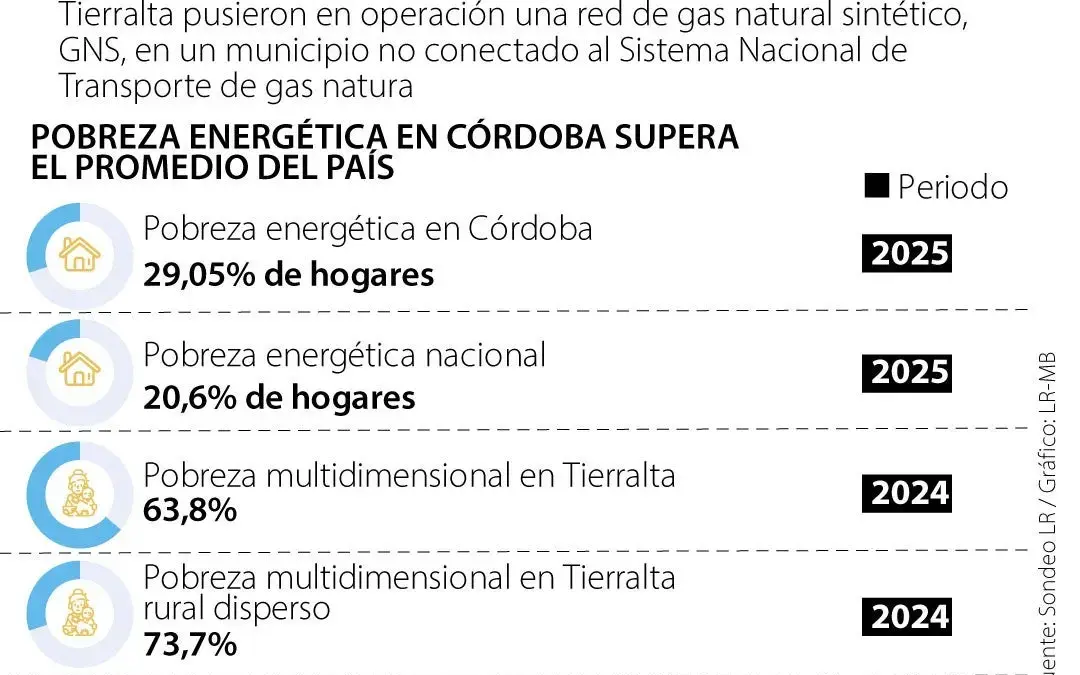
- Energy Poverty in Córdoba: Approximately 29.05% of households in the department of Córdoba experience energy poverty—a figure significantly higher than the national average of 20.6%.
Data from the National Administrative Department of Statistics (DANE) further contextualizes the local vulnerability:
- Multidimensional Poverty in Tierralta: The overall multidimensional poverty rate within the municipality of Tierralta stands at a staggering 63.8%.
- Rural Vulnerability: In the dispersed rural zones surrounding Tierralta, multidimensional poverty climbs even higher, reaching 73.7%.
Health and Environmental Impacts
Prior to the implementation of the GNS network, a substantial portion of rural and semi-urban households in Tierralta relied heavily on wood-burning stoves (leña) for daily cooking. This practice exposes families—particularly women and children who spend the most time indoors—to high concentrations of indoor air pollution, leading to chronic respiratory illnesses, cardiovascular complications, and eye damage.
Furthermore, the gathering of firewood contributes directly to local deforestation and ecosystem degradation. By introducing an affordable, clean-burning alternative, the project actively combats environmental degradation while drastically improving indoor air quality. Luis Felipe Ocampo, Legal and Corporate Affairs Manager for Colgas, emphasized this paradigm shift:
"This type of program incentivizes the use of low-emission energy sources that allow for a direct improvement in quality of life."
4. Official Responses & Energy Security
Beyond the local gas rollout in Tierralta, municipal and corporate leaders have had to address broader macroeconomic and climatic concerns threatening Colombia’s broader energy landscape—most notably, the compounding pressures of the El Niño climate phenomenon on national electricity generation.
During a high-level regional meeting addressing these concerns, the Mayor of Tierralta, Jesús David Contreras Rodríguez, delivered a strong message of reassurance to the citizenry regarding the stability of the power grid. Addressing public anxiety over potential energy rationing, Mayor Contreras Rodríguez stated unequivocally that structural measures are being successfully implemented to prevent blackouts.
"The President has made a commitment that there will be no blackout, and the entire energy industry sector is equally committed to ensuring there is no blackout. We can resolve this challenge not solely through the willpower of the national government, but through the joint efforts of the private sector and the energy sector as a whole," stated Mayor Contreras Rodríguez.
The Mayor stressed that navigating the vulnerabilities exposed by El Niño requires absolute coordination between local governments, national regulatory bodies, and corporate stakeholders like Ecopetrol, Hocol, and Colgas. By diversifying local energy matrices—such as introducing localized GNS solutions that reduce strain on traditional electricity grids used for cooking—municipalities are actively contributing to decentralized energy resilience.
5. Strategic Implications
The successful launch of the Synthetic Natural Gas network in Tierralta serves as a micro-cosmic blueprint for broader national development. The implications of this public-private partnership extend across several critical sectors:
Technological Innovation in Energy Distribution
By bypassing the immense capital expenditures required to build thousands of kilometers of physical trunk pipelines (gasoductos troncales), the Colgas-Hocol model demonstrates that off-grid communities can still enjoy the benefits of clean, piped gas. Utilizing localized holding stations supplied by transport logistics (carrotanques) creates an adaptable, modular template that can be scaled across hundreds of isolated towns throughout Colombia and Latin America.
Bridging the Inequality Gap
Infrastructure projects are frequently critiqued for failing to reach the poorest demographics due to high upfront installation costs. By absorbing half of the connection and internal network fees, subsidizing appliances, and integrating national utility subsidies for strata 1 and 2, this project removes the financial barriers that trap low-income families in cycles of energy poverty.
Environmental and Public Health Dividends
Transitioning homes away from firewood drastically curtails household carbon footprints and protects fragile local forests. On a micro-level, eliminating indoor woodsmoke drastically reduces medical burdens on local healthcare facilities by preventing chronic obstructive pulmonary disease (COPD) and other smoke-related ailments.
Economic Scalability
With an initial target of 1,000 households in Tierralta for the current year and an ambitious roadmap scaling toward 10,000 users across multiple municipalities by 2027, the initiative proves that commercial viability can align seamlessly with corporate social responsibility (CSR) goals. Through the backing of major energy players like Hocol (a subsidiary of Ecopetrol) and industry specialists like Colgas, rural energy democratization is transitioning from a policy ideal into a tangible, measurable reality.
Note: Reporting supported by collaborative insights provided through Hocol.




Leave a Reply