

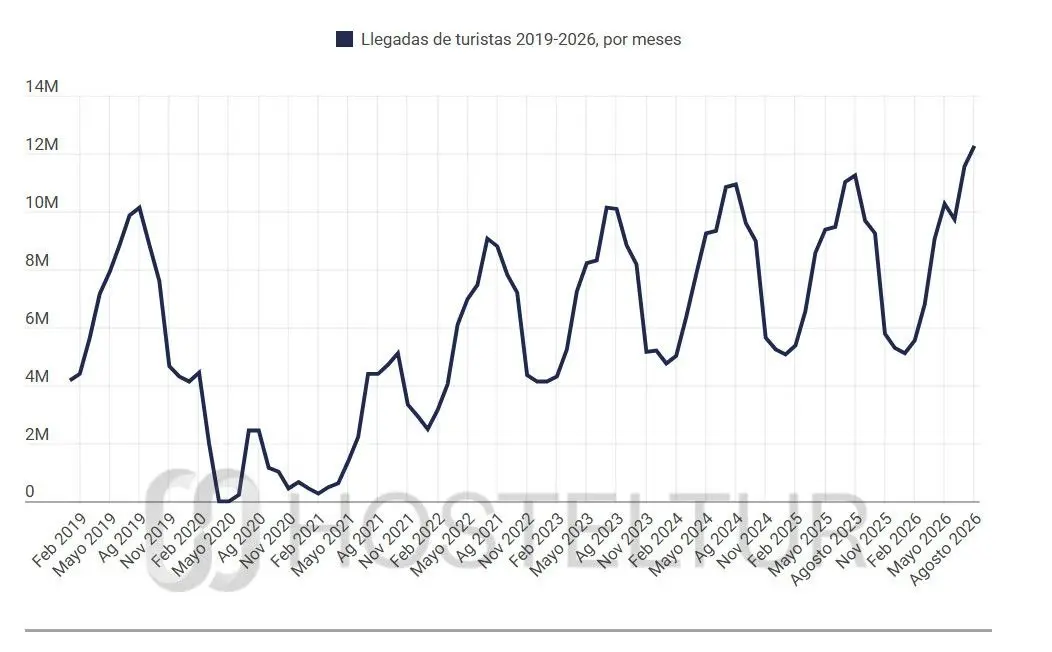
MADRID — Spain’s tourism juggernaut continues to break historical records, welcoming a staggering 12.3 million international travelers in August alone, according to the latest Frontur survey data published by the National Institute of Statistics (INE). This represents a robust 9.2% increase compared to the same month in the previous year, pushing cumulative arrivals for the first eight months of the year to nearly 70.4 million visitors—a remarkable 21% surge over pre-pandemic levels recorded in 2019 (58.11 million).
Yet, beneath the glossy veneer of these nationwide success metrics lies a complex and increasingly fractured reality. A granular examination of the regional data reveals a widening chasm between Spanish autonomous communities aggressively pursuing volume expansion and those actively implementing containment strategies.
Driven by rising social discontent over overtourism, housing crises, and strained public infrastructure, traditional island powerhouses are pivoting toward a model of managed growth. Meanwhile, mainland destinations are experiencing hyper-growth, intensifying the national debate over the carrying capacity of Spain’s tourism-dependent economy.
Main Facts: The August Surge and Regional Divergence
The headline figures for August paint a picture of relentless demand. Spain welcomed approximately 12.25 million foreign visitors during the peak summer month. However, the distribution of these travelers was far from uniform, highlighting divergent regional policies and market dynamics.
The Balearic Islands maintained their position as the single most popular destination for international tourists in August, drawing 2.59 million visitors. However, year-on-year growth in the archipelago crawled at a modest 2.5%. A similar plateau was observed in the Canary Islands, where arrivals stalled at 1.24 million, marking a meager 0.3% increase.
In stark contrast, several mainland regions reported explosive double-digit growth. Andalusia emerged as a primary growth engine, surging 21.2% in August to reach two million international arrivals. The Community of Madrid followed with a 13% increase, while the Valencian Community and Catalonia posted growth rates of 9.4% and 9.1%, respectively.
This dichotomy is not accidental. It reflects an ideological and strategic split within Spain’s tourism sector. While regions like Andalusia are capitalizing on aggressive promotional campaigns and capacity utilization, island territories are intentionally applying the brakes. Faced with acute environmental and infrastructural limits, destinations like the Balearics and Canaries are shifting their focus from volume-driven metrics to value-driven yield management, prioritizing high-spending tourists over sheer headcounts.
Chronology of a Crisis: From Post-Pandemic Rebound to Social Backlash
To understand Spain’s current tourism crossroads, it is essential to trace the trajectory of the sector over the past half-decade:
- 2019 (The Pre-Pandemic Benchmark): Spain establishes itself as a global tourism titan, recording 58.11 million international arrivals in the first eight months of the year—a standard that would abruptly shatter with the onset of COVID-19.
- 2020–2022 (The Pandemic Disruption & Rapid Recovery): Global mobility grinds to a halt, followed by an aggressive post-lockdown rebound. Pent-up global demand triggers a "revenge travel" phenomenon, catching destinations off guard as they scramble to restaff.
- 2023–2024 (The Tipping Point): As arrival volumes surpass pre-pandemic highs, the systemic pressures of mass tourism become acute. Local communities in high-density areas begin to feel the squeeze, particularly concerning long-term housing affordability and urban congestion.
- Late 2024–2025 (The Rise of Social Protests): Widespread public demonstrations erupt across Barcelona, the Balearic Islands, and the Canary Islands. Citizens voice intense frustration over housing displacement, water scarcity, and environmental degradation, forcing tourism onto the front lines of national political discourse.
- 2025 (Legislative Counter-Offensives): Regional governments begin taking legislative action. The Balearic government passes its landmark "Tourism Containment Decree," while local municipalities across coastal Spain enact moratoria on new tourist accommodations.
- 2026 (The New Equilibrium): Data for the first eight months of 2026 (70.4 million arrivals) confirms that overall demand remains unyielding. However, the divergence between growing mainland regions and stabilizing island markets proves that policy interventions and social friction are successfully reshaping regional travel flows.
Supporting Data and Economic Intelligence
Despite growing domestic friction, Spain’s international standing as a tourism powerhouse remains remarkably resilient. According to the newly released Travel & Tourism Development Index (TTDI) 2026, compiled by the World Economic Forum (WEF), Spain comfortably retains its position in the global top three most competitive tourism economies.
The WEF report underscores Spain’s exceptional infrastructure, rich cultural resources, and world-class health and hygiene standards. However, the global economic body includes a cautionary note regarding the social dimensions of travel:
"The protests against mass tourism registered in Barcelona, the Balearic Islands, and the Canary Islands between 2024 and 2025 reflect how concerns over access to housing, overcrowding, and the erosion of local quality of life can trigger fierce social opposition, even in highly successful destinations."
This sentiment is echoed by the Tourism Perception Barometer, produced by LLYC, which tracks the steady decline of tourism’s public reputation across Spain’s autonomous communities. The data reveals a direct correlation between high tourist density and negative local sentiment, proving that public perception has become a critical key performance indicator (KPI) alongside hotel occupancy rates and average daily rates (ADR).
Official Responses and Policy Interventions: The Era of Containment
The mounting social pressure has transformed the political landscape. Regional and municipal authorities are no longer measuring success purely by arrival numbers; instead, they are deploying a sophisticated toolkit of legislative and administrative controls to manage destination carrying capacity.
1. The Balearic Islands: The Containment Decree
In response to chronic saturation, the Balearic government enacted the "Tourism Containment Decree" in 2025. Designed to cap hotel bed capacity and curb the expansion of tourist rentals, the decree establishes strict operational limits, effectively freezing the islands’ traditional mass-market growth model in favor of sustainable value capture.
2. The Canary Islands: Vacation Rental Regulation
The Canary Islands government has advanced comprehensive legislation establishing strict limits on new holiday homes (viviendas vacacionales). By restricting the unchecked spread of peer-to-peer rentals, policymakers aim to rebalance the housing market for local residents. Simultaneously, the Cabildo of Lanzarote has initiated official procedures to declare the entire island a "tourism-saturated zone," a designation that grants local authorities expanded powers to restrict new tourism-related licenses.
3. Seasonality Redistribution and Municipal Moratoria
Across the Spanish mainland and coastal enclaves, numerous municipalities have implemented temporary moratoria on new tourist accommodation licenses. Furthermore, destination marketing organizations (DMOs) are actively pivoting toward de-marketing peak summer months, running targeted campaigns to redistribute tourist flows into the shoulder seasons of May, September, and October.
Implications: The Future of the Spanish Tourism Model
The August 2025–2026 data cycles mark a structural turning point for Spain’s tourism industry. The era of unmitigated, volume-at-all-costs growth is drawing to a close, replaced by an era of managed transformation.
Economic Implications
While aggregate revenues will likely continue to climb due to inflation and higher average daily rates, destinations that cap their visitor numbers must prove that yield management can offset volume losses. Hoteliers, restaurateurs, and service providers in regions like the Balearics and Canaries will need to invest heavily in upscaling their offerings to attract higher-spending demographics.
Social Implications
Restoring the social license to operate is arguably the most urgent challenge facing Spain’s tourism sector. If regional governments fail to address housing affordability, public transport congestion, and environmental strain, social unrest could escalate, potentially damaging Spain’s international brand reputation over the long term.
Environmental and Infrastructure Implications
Climate change, water scarcity, and waste management are placing unprecedented demands on Spanish coastal and island municipalities. Policies that decouple economic growth from resource consumption—such as circular economy mandates in hotels and strict caps on cruise ship emissions and docking—will determine the long-term viability of Spain’s most treasured destinations.
As Spain approaches the final quarter of 2026 with nearly 70.4 million international visitors in the books, the nation stands as a global laboratory for sustainable tourism management. The lessons learned in the bustling streets of Barcelona, the sun-drenched coasts of Andalusia, and the regulated shores of the Balearics and Canaries will undoubtedly serve as a blueprint—or a warning—for overtourism hotspots worldwide.



Leave a Reply