

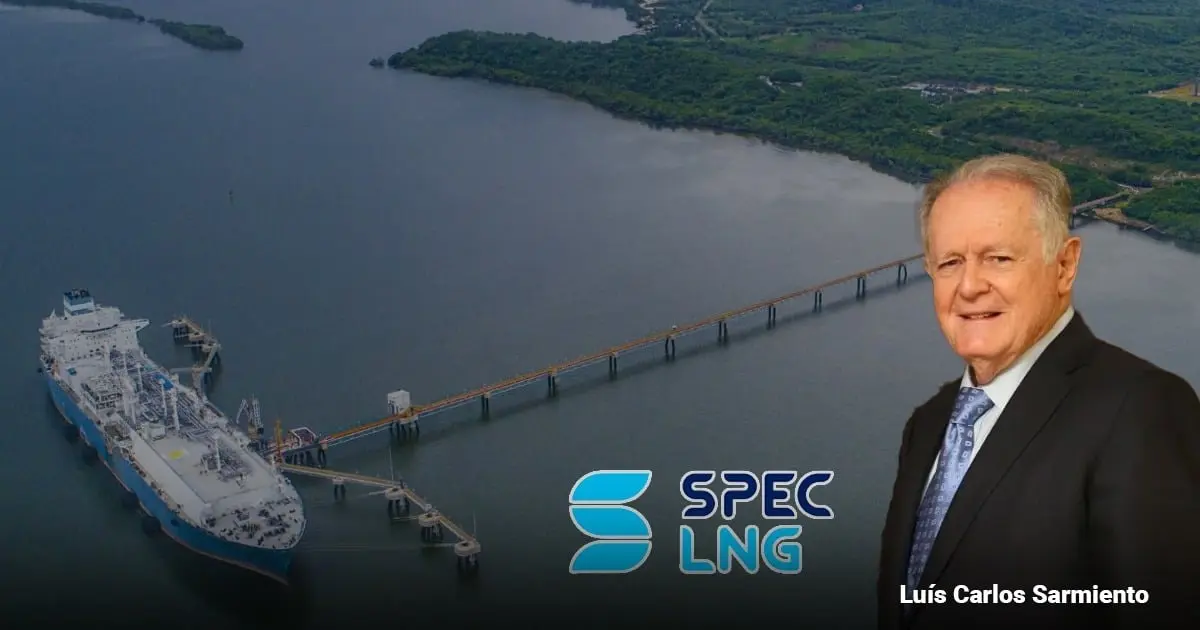
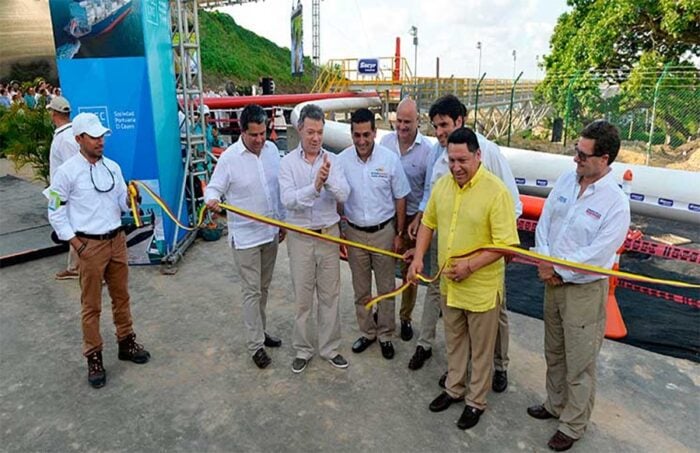
BOGOTÁ — In the high-stakes world of national energy security, foresight is often measured in years, if not decades. When the-then President of Colombia, Juan Manuel Santos, inaugurated the country’s first Liquefied Natural Gas (LNG) regasification plant on December 2, 2016, the project was envisioned primarily as an insurance policy. Spearheaded by prominent Colombian businessman Luis Carlos Sarmiento through Promigas—in which he holds a majority stake—the initiative was designed to guarantee a stable fuel backup for the thermal power plants clustered along the Caribbean coast: Tebsa, Termocandelaria, and Termoflores.
Nearly a decade later, that insurance policy has become the backbone of Colombia’s entire electrical grid. Amid a lingering decline in domestic gas production and the severe pressures of the El Niño weather phenomenon, the terminal operated by the Sociedad Portuaria el Callao (SPEC LNG) has evolved far beyond a regional safeguard. Today, it supplies between 35% and 40% of all the natural gas consumed in Colombia, rendering it the ultimate line of defense against widespread energy rationing.
1. Main Facts: The Anatomy of Colombia’s Energy Anchor
SPEC LNG stands as the only operational LNG regasification terminal in Colombia. Strategically situated in the industrial zone of Barú, Cartagena, the facility represents the primary infrastructure safeguard against the hydrological crises triggered by cyclical climate patterns like El Niño, which heavily strain a power matrix historically dependent on hydroelectric generation.
Ownership and Global Backing
The terminal’s ownership structure bridges domestic powerhouse leadership with international logistical muscle:
- Promigas (51%): A subsidiary of Corficolombiana, which belongs to Grupo Aval, Promigas stands as one of the premier natural gas transport and distribution operators in Latin America.
- Royal Vopak (49%): Acquired by the Dutch multinational conglomerate in 2019, Vopak brings world-class expertise in terminal management and liquid and gas storage infrastructure.
Royal Vopak itself boasts a rich lineage, tracing its origins to the 1999 merger of two historic Dutch shipping and logistics firms: Van Ommeren (founded in 1839) and Pakhoed (whose roots in the port operations of Amsterdam and Rotterdam date back to 1616). Control of the enterprise is held by the Dutch Van der Vorm family through HAL Holding—a private investment vehicle established after the family sold the historic Holland America Line (HAL), founded in 1873. Known globally for its exceptionally low-profile management style, the family oversees the group from Europe and Monaco.
Under the operational helm of General Manager José María Castro—who assumed the role in 2017 after spending 12 years developing new energy and LNG business ventures within Promigas—SPEC LNG has scaled its technical capabilities to match the nation’s escalating vulnerabilities.

2. Chronology: From Regional Insurance to National Critical Infrastructure
To understand how SPEC LNG became indispensable, one must trace its operational and regulatory evolution over the past decade:
- December 2016: President Juan Manuel Santos officially inaugurates the SPEC LNG terminal alongside executives from Sacyr, the engineering firm responsible for its construction and commissioning. The facility’s initial mandate is singular: secure uninterrupted fuel for Caribbean thermal power plants.
- 2017–2019: José María Castro takes over management. Promigas cements its operational efficiency, while international giant Royal Vopak acquires a 49% stake in the terminal, injecting global standards into its maritime logistics.
- 2020: Recognizing the progressive decline of continental gas reserves in regions such as Córdoba, Sucre, and Casanare, the Energy and Gas Regulatory Commission (CREG) issues pivotal measures. These regulatory updates allow SPEC LNG to make its idle capacity available to the broader wholesale market.
- 2023–2026: SPEC LNG opens structured calls for private traders and industrial players. The terminal transitions from a purely emergency thermal backup into a steady, reliable supplier for industrial operations, vehicular natural gas (GNV), and residential markets. Simultaneously, domestic gas production drops critically during the administration of President Gustavo Petro, elevating SPEC LNG’s role from important supplier to absolute national lifeline.
- Late 2026 / Early 2027: Projected timeline for the peak intensity and gradual easing of the current El Niño cycle, during which the national grid’s survival remains tethered to the uninterrupted functioning of the Barú terminal.
3. Supporting Data and Operational Capacity
The metrics governing Colombia’s energy balance illustrate the immense weight resting on the Barú facility:
- Hydrological Dependence: Under normal climatic conditions, Colombia relies on hydroelectric plants for 70% to 80% of its electricity generation. However, during El Niño events, this contribution drops sharply to between 45% and 55%, forcing thermal power plants to bridge the gap.
- Baseline vs. Peak Output: During normal rainy seasons, SPEC LNG contributes a modest 5% to 10% of the national daily gas consumption (roughly 50 to 100 million cubic feet per day, MMpcd). When severe droughts activate the full thermal generation fleet, the plant ramps up to its maximum operational capacity of 400 MMpcd, satisfying up to 40% of total national demand.
- Expansion Roadmap: To outpace growing demand, SPEC LNG is currently executing a phased expansion plan. Initial optimizations will raise baseline output to 450 MMpcd, while a larger engineering initiative targets a capacity between 530 and 600 MMpcd utilizing its Floating Storage and Regasification Unit (FSRU) and onshore facilities.
4. Official Responses and Industry Adjustments
As the structural decline of onshore gas fields—intensified between 2024 and 2026—pushed Colombia toward a precarious reliance on imported molecules, regulatory bodies and private investors mobilized to diversify the country’s import corridors.
The Pacific Regasification Project
To relieve the country’s heavy reliance on a single Caribbean entry point, Colombia has fast-tracked the Regasificadora del Pacífico in the Bay of Buenaventura. Spearheaded by Óscar Isaza, president of Grupo PIO (Ports and Infrastructure of the Pacific), this project utilizes an FSRU model with an initial injection capacity of 60 MMpcd. Connected to the Transportadora de Gas Internacional (TGI) pipeline in Yumbo via a 120-kilometer gas pipeline, the project represents an investment of approximately $128 million USD. Having surpassed 90% execution, its commercial launch relies heavily on the arrival of the Pargo Rojo carrier vessel from Asia, scheduled to dock in Valle del Cauca.
Amazonica LNG in the Caribbean
Complementing these efforts, private investors led by former Ecopetrol Vice President Alberto Consuegra—in operational partnership with the Jereh Group—are advancing the Amazonica LNG project in Puerto Nuevo, situated along the Magdalena River between Ciénaga and Santa Marta. Backed by a $180 million USD investment, this terminal will tie into Promigas’ existing network, projecting commercial operations by 2028.
5. Implications: Vulnerabilities, Single Points of Failure, and the Road Ahead
Despite the triumphs of private engineering and corporate foresight, Colombia’s current energy architecture exposes profound structural risks.

The Single-Point-of-Failure Dilemma
Because SPEC LNG has long been the sole operational regasification terminal in the country, the national grid faces a glaring structural vulnerability: a single point of failure. Any unforeseen technical contingency aboard the FSRU vessel or along the primary evacuation pipelines could instantaneously paralyze the Caribbean thermal fleet, leaving the nation defenseless against blackouts. Furthermore, maintaining continuous operations requires an unyielding, flawless maritime logistics chain for visiting methane carriers navigating the Bay of Barú.
Energy Sovereignty and the Future
The lessons of the mid-2020s gas crisis are unequivocal. Colombia’s transition away from self-sufficiency in domestic hydrocarbons has transformed liquefied natural gas from a strategic luxury into an absolute prerequisite for modern civil and industrial existence.
While upcoming infrastructure projects like the Pacific Regasification terminal and Amazonica LNG promise to decentralize import risks and provide long-awaited relief to regions historically stranded at the "end of the pipeline," the immediate stability of the nation continues to rest on the shoulders of facilities like SPEC LNG. Luis Carlos Sarmiento’s foresight a decade ago successfully averted an immediate catastrophe, but as Colombia looks toward the remainder of the decade, national energy security will demand sustained, aggressive infrastructure expansion, robust regulatory flexibility, and profound cooperation between the public and private sectors.




Leave a Reply