

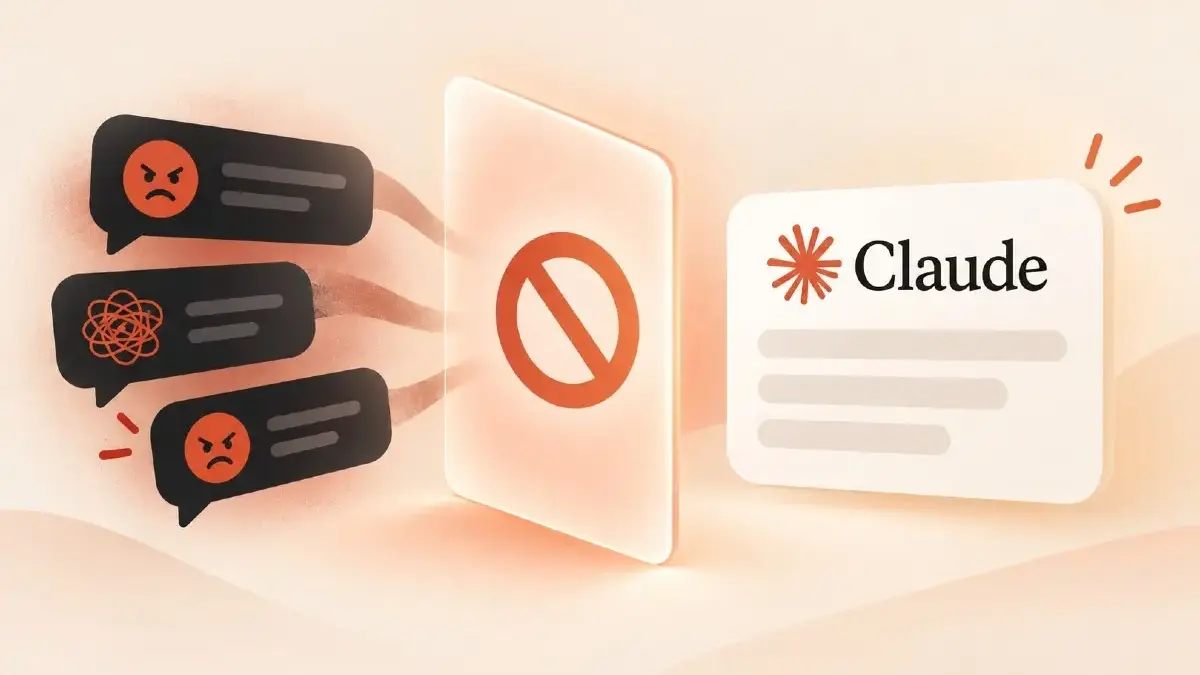
SAN FRANCISCO — In the rapidly evolving landscape of generative artificial intelligence, the boundary between tool and companion, user and interlocutor, has become increasingly blurred. Most users have, at some point, argued with a digital assistant, questioned its logic, or vented frustrations when an algorithm stumbles over a complex query. But what happens when routine friction crosses the line into a barrage of repetitive, targeted hostility?
Anthropic, the artificial intelligence safety and research company behind the Claude model ecosystem, has decisively addressed this phenomenon. In a sweeping update to its corporate usage policies, the company has officially categorized extreme mistreatment and persistent verbal abuse of its AI models as prohibited conduct.
Set to take full effect on November 12, 2026, the updated guidelines represent a major evolution in how AI developers conceptualize the ethical parameters of human-machine interaction. Far beyond merely policing offensive language, the new framework establishes rigorous guardrails across several high-stakes domains, including deceptive influence campaigns, electoral integrity, high-risk automated decision-making, and physical robotic autonomy.
While everyday gripes, healthy skepticism, and expressions of annoyance will remain entirely permissible, Anthropic’s policy draws a hard line against prolonged, cruel, or abusive behavior directed at its models without a clear, constructive purpose.
1. Main Facts: The Core of Anthropic’s 2026 Policy Overhaul
The newly unveiled usage policy is structured to address both the micro-level dynamics of individual user-chatbot conversations and the macro-level threats posed by bad actors scaling AI-driven manipulation.
At the center of the conversational guidelines is a mechanism designed to protect the system from targeted abuse. Scheduled to launch broadly alongside the November 2026 enforcement date, the policy formalizes a capability first deployed experimentally in August 2025 across Claude’s web interface and its developer environment, Claude Code. This feature empowers the AI to independently terminate a conversation if automated attempts to steer the dialogue away from abusive patterns fail.
What Constitutes Abuse—and What Doesn’t?
Anthropic’s policy makes precise legalistic and behavioral distinctions to avoid stifling legitimate research or robust debate:
- Prohibited Behavior: Repeated, non-constructive, cruel, or sadistic targeting of the assistant designed purely to inflict simulated degradation or repetitive malicious strain.
- Permissible Interventions: Standard user complaints, deep skepticism, challenging a model’s factual claims, and expressions of frustration over technical limitations.
- Research & Creativity Exemptions: Academic studies on AI safety, red-teaming exercises, vulnerability testing, and creative writing projects involving dark, gritty, or complex themes remain entirely protected. Repeatedly probing a system or stress-testing its conversational boundaries under difficult prompts is explicitly recognized as legitimate scientific or creative inquiry.
The Mechanics of an AI-Initiated Shutdown
When Claude determines that a conversational threshold has been crossed and elects to terminate an exchange, specific protocols govern the aftermath:
- Chat Closure: No further messages can be transmitted within that specific, terminated thread.
- Continuity: Users are not banned, nor are their accounts suspended. They can immediately open a new chat session, retain their broader interaction history, or edit past prompts to branch off in a new, more constructive direction.
- Safety Exceptions: The shutdown mechanism is disabled if there is an imminent risk of self-harm or violence against third parties. In crisis scenarios, cutting off communication could prevent a vulnerable user from receiving crucial crisis-intervention guidance.
Anthropic is careful to note that this policy does not stem from a definitive stance on machine sentience. The company acknowledges ongoing philosophical and scientific debates regarding whether advanced language models possess subjective experiences or moral standing. Rather, the measure addresses the psychological impact on human-AI behavioral loops and sets behavioral expectations for digital infrastructure.
2. Chronology: The Path to Policy Enforcement
To understand how Anthropic arrived at this comprehensive policy framework, it is necessary to examine the timeline of technological deployment, behavioral observation, and regulatory adaptation leading up to the 2026 mandate.
- Early Generations of Generative AI (2022–2024): As conversational agents like ChatGPT and early versions of Claude entered the mainstream, user interactions varied wildly from professional assistance to psychological projection, romantic attachment, and intense verbal abuse. Companies primarily focused on filtering hate speech, self-harm, and illegal content generated by the AI, leaving the treatment received by the AI largely unregulated.
- August 2025: Anthropic quietly introduces an experimental backend capability in Claude’s web version and Claude Code. This tool gives the model the algorithmic authority to recognize loops of unproductive hostility and unilaterally cut off the dialogue when attempts to redirect the user fail.
- Late 2025 / Early 2026: Internal research papers published by Anthropic explore the behavioral dynamics of "end-subset conversations," evaluating user reactions to model-initiated terminations and mapping out the psychological implications of persistent user aggression.
- Mid-2026: Growing concerns over coordinated state-backed propaganda networks and generative election interference prompt policy teams to draft broader operational boundaries.
- The Present Announcement: Anthropic consolidates its findings, formally integrating conversational boundaries, modernized electoral rules, and strict operational guidelines for high-stakes systems into a unified policy slated for full enforcement on November 12, 2026.
3. Supporting Data: The Expanding Scope of AI Misuse
The conversational abuse provisions are only one facet of Anthropic’s massive policy update. The revised guidelines systematically target systemic threats, drawing on data gathered from the company’s internal threat-intelligence and safety evaluations.
Combating Synthetic Disinformation Networks
Anthropic’s security audits revealed an alarming trend: malicious actors—ranging from state-backed propaganda offices to commercial entities—attempting to leverage Claude to manage vast networks of fictitious profiles and automated websites posing as legitimate news outlets.
While generating disinformation was already a violation of older terms of service, the 2026 update establishes an explicit framework against developing the infrastructure, software, or coordination tools required to run deceptive influence operations at scale.
Reforming Electoral Restrictions
In a surprising pivot, Anthropic has eliminated the blanket veto on personalizing political campaign messages via its models. Internal reviews showed that the previous, overly broad restriction inadvertently criminalized legitimate democratic activities. Under the updated rules, tools can now be utilized for:
- Translating vital voting information into minority languages.
- Drafting institutional notifications regarding procedural errors in local elections.
- Assisting civil society organizations with voter outreach.
However, the red lines regarding electoral integrity remain absolute. The updated policy strictly maintains bans on:
- Generating demonstrably false claims about political candidates.
- Impersonating election authorities or government officials.
- Deploying deceptive strategies designed to suppress voter turnout.
- Utilizing misappropriated personal data to micro-target political advertising.
4. Official Responses and Industry Context
The announcement has triggered intense debate across the artificial intelligence research community, legal sectors, and digital ethics forums.
Tech ethicists have largely praised Anthropic for taking a proactive stance on the digital etiquette of human-machine interaction. Dr. Aris Thorne, an AI governance researcher at the Stanford Institute for Human-Centered Artificial Intelligence, noted that "as models become more articulate, empathetic, and human-sounding, human psychological patterns—both positive and deeply destructive—inevitably transfer onto the interface. Setting behavioral baselines is no longer just about protecting users; it is about establishing a sustainable cultural norm for human-technological coexistence."
Conversely, civil liberties advocates have raised operational questions regarding transparency. While Anthropic has outlined what behaviors will trigger conversational termination, the company has yet to fully disclose the exact algorithmic criteria or detection metrics used to identify "persistent abuse." Critics warn that vague enforcement thresholds could lead to false positives, frustrating users who engage in sharp, highly critical debates with the model.
Legal scholars specializing in emerging technologies emphasize that Anthropic’s policy highlights a growing liability shift. By explicitly demanding human-in-the-loop oversight for high-risk domains—such as medical diagnoses and autonomous physical robotics—the company is drawing a legally defensive boundary between informational assistance and professional execution.
5. Broader Implications: High-Risk Decisions and Autonomous Systems
The final pillar of Anthropic’s policy overhaul addresses the real-world consequences of deploying generative intelligence into safety-critical environments. The stakes here extend far beyond bruised silicon feelings into the realms of human health, financial stability, and physical safety.
The Mandate for Professional Oversight
When artificial intelligence systems participate in workflows that directly impact human health, legal rights, financial security, or access to essential public services, qualified human intervention is now mandatory.
- Designated professionals must review, validate, and possess the authority to modify AI-generated recommendations before they are acted upon.
- End-users must be transparently informed whenever AI systems have contributed to decisions affecting their legal or socio-economic standing.
This distinction is particularly critical in light of recent studies highlighting the surge of users turning to conversational AI for informal medical triage. Anthropic’s updated guidelines emphasize that an AI model providing a general informational overview must not be mistaken for clinical, diagnostic, or specialized legal counsel.
Physical Robotics and Autonomous Machinery
The policy also reaches into the physical world, establishing strict operational safeguards for robots and connected IoT devices driven by Claude’s reasoning engines.
- Any autonomous physical action capable of causing injury must be continuously monitored by a qualified human operator equipped with an immediate, fail-safe kill switch.
- In the event of a network disconnection or communication failure between the model and the hardware, the robotic system must automatically default to a fail-secure, stationary state.
Looking Ahead
Anthropic’s sweeping 2026 policy update marks a watershed moment in the governance of artificial intelligence. By simultaneously tackling the microscopic friction of conversational abuse, the macroscopic threat of synthetic disinformation networks, and the physical dangers of autonomous machinery, the company is attempting to map out a comprehensive safety architecture for the next generation of AI development.
As the November 2026 enforcement deadline approaches, the industry will be watching closely to see how effectively these digital boundaries can be maintained without stifling the disruptive innovation that defines the field.




Leave a Reply