

By Global News Desk
Published: October 10, 2026
Main Facts
A full two months after a catastrophic magnitude 7.4 earthquake shook Colombia on August 10, 2026, the Unidada Nacional para la Gestión del Riesgo de Desastres (UNGRD) has released an updated and staggering national emergency balance. Centered originally in the remote municipality of San José del Palmar, Chocó, the massive seismic event rippled across the Andean and Pacific regions, leaving behind widespread infrastructural ruin, hundreds of thousands of displaced citizens, and a heavy toll on human life.
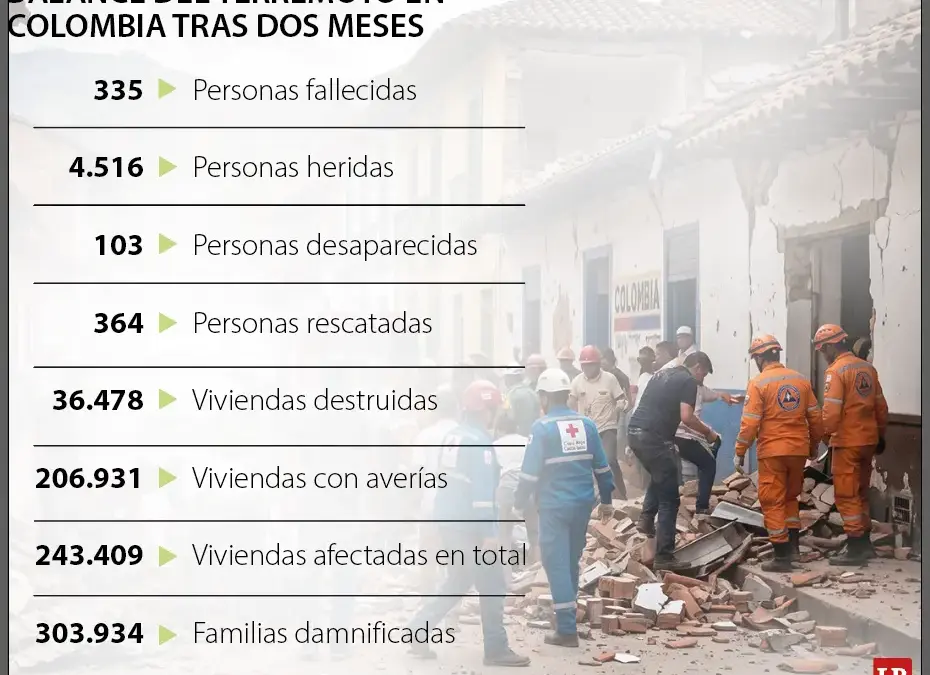
According to official figures compiled with a cutoff date of October 9, 2026, at 6:30 a.m., the disaster has claimed 335 lives, left 4,516 people injured, and registered 103 individuals as missing. Amid the ongoing search, rescue, and humanitarian efforts coordinated by local authorities and national agencies, emergency personnel have successfully rescued 364 people trapped beneath rubble or isolated by landslides triggered by the tremors.
The physical footprint of the disaster is equally devastating. The UNGRD reports that 243,409 housing units have sustained structural impacts, of which 36,478 homes were completely destroyed, while 206,931 suffered varying degrees of damage. Furthermore, through the Registro Único de Damnificados (RUD)—the national registry for disaster victims—authorities have confirmed that 303,934 families, representing a staggering 486,917 individuals, are officially classified as displaced or severely affected.
The ripple effects of the August 10 earthquake extended far beyond the department of Chocó. Official multi-agency assessments indicate that the disaster impacted 500 municipalities across 16 Colombian departments, turning what began as a regional geological shock into a multi-regional humanitarian crisis requiring unprecedented coordination between local, departmental, and federal governments.
Chronology of the Disaster and Immediate Aftermath
August 10, 2026: The Initial Shock
At approximately mid-day on August 10, 2026, a shallow yet powerful earthquake with a magnitude of 7.4 struck San José del Palmar, Chocó. Due to the topography of the region and the shallowness of the hypocenter, the seismic waves were felt intensely across western and central Colombia. Landslides immediately blocked critical roadways leading into Chocó and neighboring departments, isolating rural communities and complicating the rapid deployment of rescue teams, medical personnel, and emergency supplies.
August – September 2026: The Search and Stabilization Phase
In the weeks immediately following the disaster, the Sistema Nacional de Gestión del Riesgo de Desastres (SNGRD) mobilized search-and-rescue squads, incorporating specialized canine units, heavy machinery, and international humanitarian aid.
While initial reports focused heavily on the immediate search for survivors in the epicenter, subsequent weeks revealed the extensive secondary impacts of the earthquake. Continuous aftershocks—some exceeding magnitude 5.0—destabilized already compromised hillsides and structures, forcing hundreds of thousands of families to relocate to temporary shelters, tents, or makeshift camps.
October 9, 2026: The Two-Month Comprehensive Balance
Marking two months since the catastrophe, the UNGRD consolidated territorial reports into a definitive baseline dataset. This update reflects not only human and infrastructural losses, but also broadened humanitarian metrics, including animal welfare data and municipal-level distribution metrics. The report serves as the foundation for the upcoming medium- and long-term national reconstruction phase.
Supporting Data and Detailed Breakdown
The enormity of the crisis is best understood through a granular analysis of the data provided by the UNGRD and participating municipal entities. The statistics have been categorized into distinct operational components to guide targeted state intervention.
1. Human Casualties and Rescue Operations
The human cost of the disaster underscores the vulnerability of residential and commercial structures in the path of a major inland earthquake:
- Fallecidos (Fatalities): 335
- Heridos (Injured): 4,516
- Desaparecidos (Missing): 103
- Personas Rescatadas (Rescued Persons): 364
Emergency medical networks in Chocó and adjacent departments were pushed past capacity in the immediate aftermath, requiring air-ambulances and military transport to evacuate the critically injured to major medical hubs in Medellín, Cali, and Bogotá.
2. Housing and Infrastructure Impact
The destruction of the built environment represents one of the most financially and logistically daunting challenges facing the Colombian state:
- Viviendas Destruidas (Destroyed Homes): 36,478
- Viviendas con Averías (Damaged Homes): 206,931
- Total Viviendas Afectadas (Total Housing Impact): 243,409
3. Displaced Population (RUD Statistics)
The Registro Único de Damnificados provides the socio-economic framework required for delivering housing subsidies, food security, and financial aid:
- Familias Damnificadas (Affected Families): 303,934
- Personas Damnificadas (Registered Victims): 486,917
4. Animal Welfare Metrics
In a progressive step for modern disaster management in Colombia, the UNGRD formally incorporated animal casualties and rescues into its national balance, recognizing the vital role that domestic and livestock animals play in rural livelihoods:
- Animales Afectados (Affected Animals): 3,282
- Animales Rescatados (Rescued Animals): 3,003
5. Geographic Scope
- Municipios Afectados (Affected Municipalities): 500
- Departamentos Afectados (Affected Departments): 16
Official Responses and Institutional Coordination
The management of the San José del Palmar earthquake has tested the institutional architecture of Colombia’s disaster response framework, the SNGRD.
The Role of Municipalities and the UNGRD
The collection of disaster data relies on a decentralized mechanism wherein local municipal authorities evaluate damages, register affected households, and upload information into the national RUD system. The UNGRD acts as the central clearinghouse, standardizing reports, deploying federal resources, and coordinating logistical pipelines.
Following the release of the October 9 update, UNGRD leadership emphasized that while search-and-rescue operations have largely transitioned into recovery and stabilization efforts, the humanitarian phase remains active. Temporary housing provisions, psychological support for trauma victims, and the restoration of potable water and sanitation systems are currently prioritized in the 500 affected municipalities.
Inter-Institutional and Regional Cooperation
Governors and mayors across the 16 impacted departments have appealed for sustained fiscal support from the national government. Rebuilding 36,478 homes and repairing over 206,000 damaged structures will require a multi-year national reconstruction fund. Furthermore, the Ministries of Health, Education, and Agriculture have been tasked with restoring ruined clinics, schools, and agricultural supply chains that were crippled when the earth shook on August 10.
Implications for Colombia
The August 10 earthquake and its enduring aftermath carry profound socio-economic, political, and infrastructural implications for Colombia.
1. Structural Vulnerability and Building Codes
Experts point out that the high ratio of destroyed and damaged homes highlights systemic vulnerabilities in rural and semi-urban construction standards. Many traditional homes in Chocó and the western cordillera lacked seismic-resistant engineering, leaving them uniquely susceptible to a 7.4-magnitude event. The disaster has reignited urgent policy debates regarding the enforcement of national building codes (Norma Sismo Resistente) in remote and economically marginalized regions.
2. Economic and Fiscal Pressures
With nearly half a million individuals registered as damnificados and over 243,000 properties compromised, the fiscal cost of reconstruction will place a heavy burden on the national budget. Infrastructure repairs—spanning bridges, roads, hospitals, and schools across 16 departments—will require redirected public expenditures and potential international development loans.
3. Environmental and Livelihood Disruptions
The compounding crisis of mass landslides, blocked transport arteries, and agricultural devastation threatens food security in western Colombia. Moreover, the inclusion of over 3,000 affected animals in the official report highlights the secondary economic shock borne by rural families whose livestock and domestic animals perished or were displaced.
4. Long-Term Recovery Outlook
As Colombia passes the two-month mark since the San José del Palmar disaster, the focus is shifting inexorably from immediate emergency response to durable reconstruction. The success of this next phase will depend heavily on transparency in the distribution of aid, the efficiency of the RUD verification process, and the central government’s ability to turn statistical recovery metrics into tangible, safe homes and stabilized communities for the nearly 500,000 citizens affected.




Leave a Reply