

Global Technology Desk — The paradigm of learning how to code has undergone a fundamental transformation. Gone are the days when mastering software development required relying exclusively on rigid, multi-year university curricula, expensive bootcamps, or spending agonizing hours parsing through dense technical forums to fix a single syntax error. Today, artificial intelligence has rewritten the rules of technical education, offering personalized mentorship, instant debugging, and interactive simulations that adapt in real-time to a student’s cognitive pace.
Whether you are an absolute beginner looking to print your first "Hello, World!" or a seasoned developer brushing up on complex data structures for an upcoming technical interview, AI-driven tools have democratized access to top-tier coding education. Below is an exhaustive look at the top five platforms leading this educational revolution, categorized by their unique methodologies, strengths, and target audiences.
1. The Evolution of Technical Education: Main Facts
The integration of artificial intelligence into programming education is not merely a convenience; it represents a seismic shift in cognitive scaffolding. Traditional learning environments often suffer from a lack of immediate feedback. If a student encounters a roadblock at 2:00 AM, they must wait until office hours or rely on static documentation. AI tools eliminate this friction.
Key developments driving this educational shift include:
- Conversational Mentorship: Large Language Models (LLMs) can now act as patient, 24/7 private tutors capable of explaining abstract computing concepts through analogies tailored to an individual’s background.
- Real-Time Error Analysis: Instead of generic error logs, modern AI assistants diagnose the specific semantic or syntactic flaw in a user’s code block, explaining why it failed and how to prevent it in the future.
- Adaptive Workflows: Platforms now utilize algorithmic intelligence to gauge a student’s performance, automatically serving up remedial exercises or scaling up difficulty based on demonstrated competence.
Rather than replacing human effort, these tools act as force multipliers, freeing learners from the tedious mechanics of syntax memorization so they can focus on high-level logic, system design, and creative problem-solving.
2. Chronology of a Revolution: How We Got Here
To understand the current landscape of AI-assisted coding education, it is essential to trace the rapid evolution of these technologies over the past decade:
- Pre-2020 (The Static Era): Learning to code relied heavily on static textbooks, video-on-demand platforms (like Udemy and Coursera), and community-driven forums (like Stack Overflow). While powerful, these resources lacked interactivity and personalized pacing.
- 2020–2022 (The Rise of Autocomplete): The introduction of early AI pair programmers, most notably GitHub Copilot, revolutionized professional workflows. However, these tools were designed for productivity rather than pedagogy—often writing code for the user rather than teaching them how to write it.
- 2023–2024 (The Conversational Boom): The mainstream adoption of advanced LLMs like OpenAI’s ChatGPT introduced conversational debugging. For the first time, learners could ask “Why does this loop cause an infinite recursion?” and receive a contextual, step-by-step breakdown.
- 2025–2026 (The Specialized Educational Ecosystem): Today, AI is no longer a generic chatbot bolted onto a browser. Platforms have built domain-specific AI tutors natively into their architectures, creating closed-loop ecosystems specifically engineered for skill acquisition, algorithmic mastery, and technical interview preparation.
3. Deep Dive: The Top 5 AI Platforms for Learning to Code
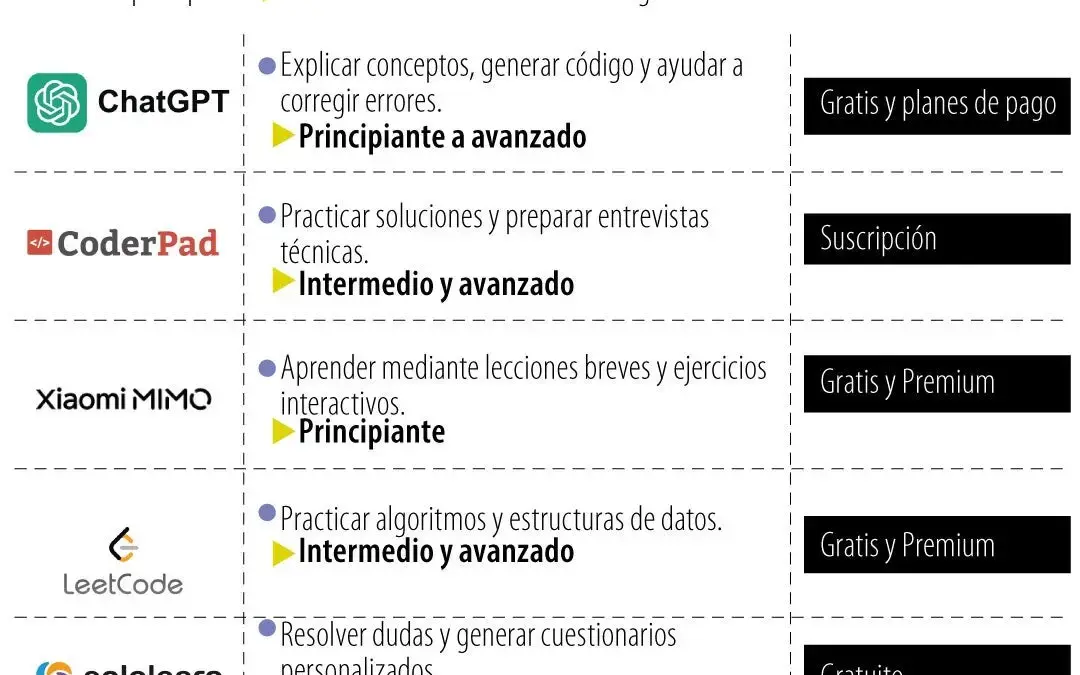
ChatGPT: Explanations and Conversational Code Assistance
ChatGPT remains the most flexible entry point for individuals seeking dynamic, conversational guidance. Rather than forcing a user into a linear curriculum, it operates as an on-demand sparring partner for intellectual inquiry.
- How it works for learners: Users can prompt the AI to explain complex concepts—such as Object-Oriented Programming (OOP), asynchronous JavaScript, or RESTful APIs—at varying levels of expertise. A novice can ask for an explanation using everyday analogies, while an advanced student can dissect memory management or garbage collection algorithms.
- Core applications: Generating boilerplates, comparing multiple solutions to the same programming problem, writing unit tests, and breaking down monolithic codebases into manageable pieces.
- Best practice for users: To maximize efficiency, learners should practice "contextual prompting." Instead of asking vague questions, users achieve the best results by providing their current code snippet, pasting the exact error trace, and explicitly stating the intended behavior.
CoderPad AI: Practical Programming and Technical Interview Readiness
For developers who have graduated past the basics and are preparing for the grueling gauntlet of corporate hiring, CoderPad offers an environment rooted in real-world professional assessment.
- The platform’s focus: Bridging the gap between academic knowledge and corporate technical interviews. It simulates the live coding environments used by major technology firms during hiring loops.
- AI Integration: CoderPad leverages AI to help candidates spin up initial code skeletons, formulate edge-case test data, and review alternative logical paths under pressure. Its collaborative nature allows developers to see how they reason through problems in real-time.
- Target Audience: Intermediate to advanced students. Because its primary design philosophy centers around evaluation and assessment, it is not structured as a tutorial site for absolute beginners.
Mimo: Micro-Learning and Interactive Mobile-First Mastery
Understanding that modern learners have fragmented schedules, Mimo has mastered the art of bite-sized, interactive education paired with built-in AI assistance.
- Curriculum structure: Offers structured learning paths across high-demand languages including Python, JavaScript, HTML, and CSS. The platform emphasizes active participation over passive consumption; users must constantly write and manipulate code to advance.
- The AI Tutor Role: When a concept proves difficult or an exercise triggers repeated failures, Mimo’s embedded AI steps in to provide gentle hints, correct misconceptions, and guide the user toward the solution without simply giving the answer away.
- Accessibility: Available across web and mobile applications, Mimo allows students to practice coding during commutes or short breaks, though full access to its expansive course catalog and advanced AI features requires a paid subscription.
LeetCode AI: Algorithmic Purity and Advanced Debugging
LeetCode is legendary within the software engineering community as the ultimate gymnasium for data structures and algorithms. With the integration of AI tools like Ask Leet and its dedicated programming agents, the platform has lowered the barrier to entry for tackling notoriously difficult computer science problems.
- Utility in skill-building: LeetCode focuses on optimizing logic, reducing time complexity ($O(N)$ optimization), and mastering foundational computer science structures (trees, graphs, dynamic programming).
- AI Features: Users can query the AI for strategic hints when stuck, analyze why a submission timed out, generate custom test cases to stress-test their solutions, and review side-by-side comparisons of different algorithmic approaches.
- When to use it: This platform is best utilized once a developer possesses a foundational grasp of a programming language and wants to sharpen their logical reasoning and performance-tuning capabilities.
SoloLearn: Integrated AI Tutoring for Structured Curriculums
Combining community engagement with gamified, modular learning, SoloLearn offers a comprehensive ecosystem for learning technologies ranging from Python and Java to SQL and C#.
- Kodie—The In-Lesson AI Tutor: Available through its premium MAX tier, Kodie acts as a dedicated companion embedded directly inside lessons. It breaks down answers, highlights logical flaws, and provides personalized explanations as users work through interactive code playgrounds.
- Community and Social Learning: Beyond the AI, SoloLearn fosters a vibrant peer-to-peer network where users can post questions, review community projects, and share insights.
- Subscription Model: While basic course materials are freely accessible, unlocking the full potential of Kodie and advanced learning tracks requires a paid plan.
4. Supporting Data and Industry Metrics
The shift toward AI-assisted technical education is backed by compelling data regarding efficiency and retention:
- Productivity Gains: Studies on AI pair programming indicate that developers using AI-assisted tools complete coding tasks up to 55% faster than those relying solely on traditional methods.
- Cognitive Load Reduction: Educational researchers note that reducing the time spent hunting down syntax errors decreases learner frustration, resulting in significantly lower dropout rates in online coding bootcamps.
- Market Adoption: Over 70% of emerging developers now incorporate some form of generative AI tool into their daily learning routine, marking a permanent cultural shift in how technical literacy is acquired.
5. Official Responses and Industry Perspectives
Edtech leaders and software engineering veterans have offered nuanced perspectives on this digital transformation.
- The Educational Consensus: Industry advocates emphasize that AI tutors democratize elite-level mentorship. Previously, personalized one-on-one coding instruction was prohibitively expensive, accessible only through high-cost bootcamps or private tutoring. AI provides a scalable, affordable proxy for this personalized guidance.
- Pedagogical Warnings: Computer science educators frequently issue cautions regarding over-reliance. If an AI tool generates 100% of a student’s code without requiring them to parse the underlying logic, the learner risks developing "tutorial hell" dependency—where they can prompt an application into existence but lack the foundational capability to debug structural architectural failures independently.
- The Corporate View: Hiring managers at major technology firms note that while candidates may write cleaner syntax faster thanks to AI assistants, the core traits they look for—architectural vision, edge-case anticipation, and robust logical reasoning—remain entirely human responsibilities that must be cultivated through rigorous practice on platforms like LeetCode and CoderPad.
6. Implications for the Future of Work
The integration of artificial intelligence into programming education signals a profound change in what it means to be a "software developer."
As AI tools become increasingly adept at writing boilerplate code, the value of human programmers is shifting away from mere syntax memorization toward system architecture, security oversight, creative problem-solving, and domain-specific logic. Aspiring developers entering the workforce must learn not just how to code, but how to supervise code—effectively acting as technical directors guiding AI systems to build secure, scalable solutions.
By combining the conversational adaptability of ChatGPT, the practical rigor of CoderPad, the micro-learning convenience of Mimo, the algorithmic depth of LeetCode, and the structured lessons of SoloLearn, modern learners have access to a more robust, personalized, and efficient educational toolkit than at any point in human history. The barrier to entry has never been lower—and the potential ceiling for human creativity has never been higher.




Leave a Reply