

By Global Affairs Desk
Published: Special Investigative Report
1. Main Facts
In an alarming new assessment that reshapes how the international community must view modern warfare, the United Nations Development Programme (UNDP) has released a comprehensive report detailing the catastrophic intersection of armed conflict, environmental degradation, and deep-seated human poverty. The findings paint a grim picture of a future where geopolitical violence is no longer merely a temporary disruption, but a permanent structural trap for the world’s most vulnerable populations.
According to the UNDP data, a staggering 59% of all people living in extreme poverty will soon reside in nations battered by environmental fragility, chronic conflict, and institutional violence. What was once measured as a temporary humanitarian emergency has metastasized into a generational crisis. More than 160 million people currently lack the necessary support systems to rebuild their lives in the wake of armed hostilities, while 118 million remain forcibly displaced from their ancestral homes.
Compounding these staggering human tolls is a severe contraction in global humanitarian funding. The growing discrepancy between survival and long-term recovery has left upwards of 250 million people entirely devoid of vital international assistance. The UNDP report underscores that modern warfare is uniquely destructive, leaving behind poisoned soils, cratered agricultural lands, decimated water tables, and levels of toxicity that will render entire regions uninhabitable and unfarmable for decades to come.
2. Chronology of a Chronic Crisis: From Acute Shock to Intergenerational Trauma
To understand how the global community arrived at this precarious juncture, it is essential to trace the evolution of conflict and humanitarian relief over the past several decades.
The Paradigm Shift of the Late 20th Century
For much of the post-Cold War era, international intervention operated on a classic linear model: an armed conflict would erupt, causing acute displacement and suffering; a ceasefire or peace accord would be signed; and international bodies, alongside non-governmental organizations (NGOs), would rush in with emergency food, medical aid, and shelter. This was followed by a rapid transition to infrastructural reconstruction and economic stabilization.
The 2010s: Protracted Crises and the Failure of Short-Term Aid
By the mid-2010s, this linear model collapsed under the weight of protracted conflicts in the Middle East and North Africa—most notably the Syrian civil war—and prolonged insurgencies across the Sahel and Horn of Africa. Wars stopped ending cleanly. Instead, they fragmented into multi-party, technology-driven attritional conflicts. The UNDP began documenting a phenomenon where displacement became generational. Children born in refugee camps grew to adulthood knowing no other reality, permanently reliant on short-term humanitarian rations that were never designed to be lifelong solutions.
The Post-Pandemic Shock and the 2025 Funding Drought
The compounding economic shocks of the COVID-19 pandemic, coupled with runaway inflation and supply chain fractures driven by the war in Ukraine, severely strained donor nations’ treasuries. By 2025, the international humanitarian architecture hit a historic breaking point. Global aid budgets experienced a dramatic contraction precisely at a moment when active conflict zones—ranging from Eastern Europe to the Middle East—multiplied. This funding drought widened the chasm between immediate life-saving interventions and sustainable recovery programs, stranding over a quarter of a billion people in systemic limbo.
3. Supporting Data and Regional Case Studies
The UNDP report transcends broad generalizations by presenting hard data and granular case studies from some of the most heavily impacted regions on Earth. The data illustrates a direct correlation between the intensity of modern munitions, agricultural paralysis, and environmental poisoning.
Ukraine: The Granary Turned Minefield
Before the escalation of hostilities, Ukraine was universally known as one of the world’s primary breadbaskets, supplying millions of tons of wheat, corn, and sunflower oil to global markets. Today, the UNDP identifies Ukraine as one of the most heavily contaminated countries on the planet by explosive remnants of war.
- Agricultural Paralysis: Thousands upon thousands of kilometers of fertile black-earth farmland have been declared hazardous due to unexploded ordnance (UXO), anti-personnel mines, and heavy metal leaching from artillery shells.
- Recovery Efforts: Through meticulous demining operations spearheaded by international coalitions and local agencies, over 15,444 square miles of arable land have thus far been cleared and restored to agricultural productivity. However, millions of acres remain locked behind high security risks, threatening regional and global food security.
Syria: Decades of Contaminated Soil
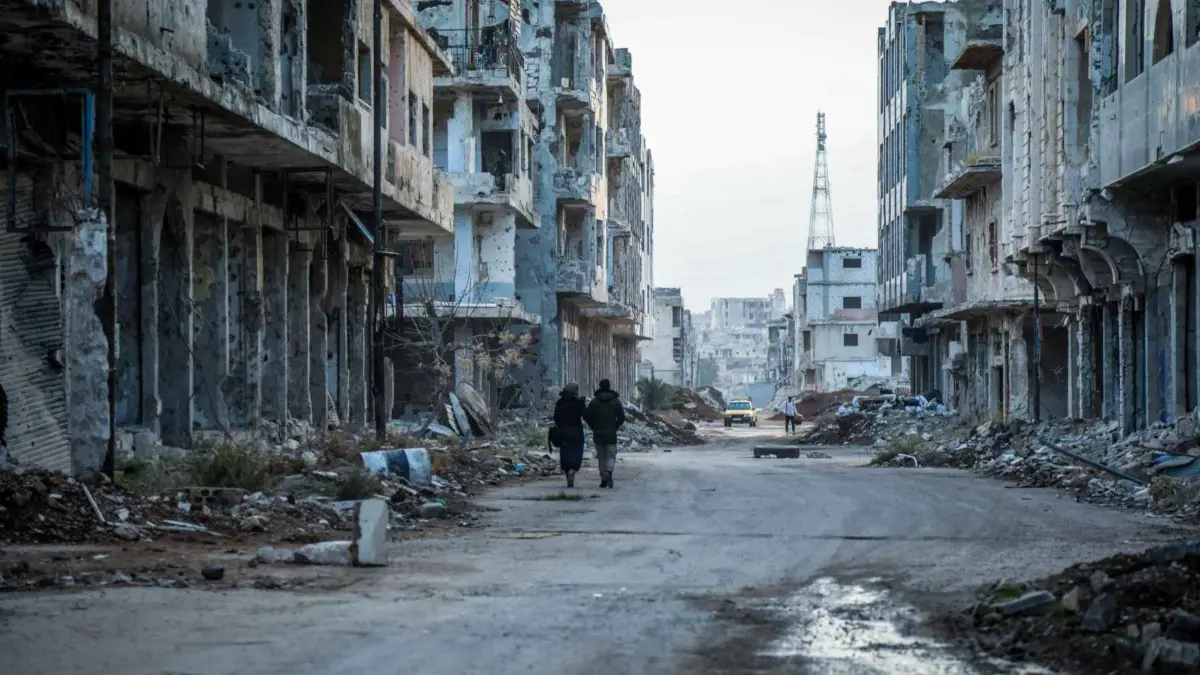
In Syria, years of relentless urban warfare and aerial bombardment have left vast swathes of agricultural land choked with unexploded munitions and toxic rubble. Traditional farming communities—already reeling from historic droughts linked to climate change—find their primary livelihood permanently disabled. Even as active combat subsides in certain regions, the agricultural footprint remains severely compromised, preventing displaced populations from returning to self-sufficiency.
The Gaza Strip: An Unprecedented Humanitarian and Ecological Collapse
The situation in the Gaza Strip represents what the UNDP describes as a catastrophic convergence of total physical destruction and acute environmental collapse.
- Sanitation and Water: Millions of residents are entirely cut off from access to safe, potable drinking water. Sewage treatment facilities have been pulverized, leading to raw sewage flooding streets and contaminating underground aquifers.
- Soil Toxicity: The sheer volume of high-explosive ordnance dropped on a densely populated coastal enclave has left the soil heavily saturated with toxic chemicals, heavy metals, and pulverized building materials containing asbestos and other carcinogens.
- The Long-Term Outlook: According to UN assessments, a vast majority of Gaza’s land will remain chemically and structurally unviable for agricultural cultivation or safe human habitation for the foreseeable future, creating an unprecedented ecological dead zone.
4. Official Responses and Diplomatic Debates
The release of the UNDP report served as a central flashpoint during the most recent United Nations General Assembly. Global leaders, diplomats, and environmental ministers converged to debate the undeniable nexus between security, climate change, and human development.
The General Assembly Consensus
During high-level plenaries, representatives from across the Global South and North alike underscored that traditional diplomacy is failing to adapt to the realities of the Anthropocene. Speaker after speaker highlighted that modern wars are no longer fought in a vacuum; they inevitably unleash cascading ecological disasters that cross international borders.
A coalition of climate-vulnerable nations argued forcefully that the international community spends trillions of dollars on military escalations while chronically underfunding climate adaptation and post-conflict ecological restoration. They demanded that environmental destruction caused by military aggression be formally recognized under international law as a severe violation of universal human rights.
The UNDP’s Call to Action
Achim Steiner and other high-ranking officials within the UN Development Programme issued an urgent ultimatum to international financial institutions, donor states, and regional security pacts. The status quo of treating environmental destruction as a secondary byproduct of war is no longer tenable. The agency stressed that security cannot be achieved through the barrel of a gun alone if the very land sustaining human life is systematically poisoned and rendered sterile.
5. Strategic Implications and the UNDP’s Three-Step Roadmap
Recognizing that conventional humanitarian relief models are buckling under the weight of chronic, overlapping crises, the UNDP has unveiled an ambitious, integrated three-step strategic framework designed to pivot the global community away from endless emergency management and toward sustainable resilience.
[Phase 1: Response & Recovery]
       │
       ▼
[Phase 2: Transition & Institutional Transformation]
       │
       ▼
[Phase 3: Prevention & Long-Term Resilience]
Phase 1: Response and Immediate Recovery
The foundational pillar of the UNDP’s strategy focuses on stabilizing acute crises by bridging the gap between humanitarian aid and early recovery.
- Restoring Essentials: Re-establishing basic public services, healthcare networks, and local economic engines through robust public-private partnerships and enhanced international cooperation.
- Targeted Interventions: Ensuring that aid delivery is not merely palliative, but actively lays the groundwork for economic self-reliance, preventing communities from sinking into permanent dependency on foreign rations.
Phase 2: Transition and Institutional Transformation
Moving beyond short-term fixes, the second phase places its primary focus on strengthening local and national institutions.
- Capacity Building: Deploying targeted technical and financial investments to help war-torn societies rebuild legal frameworks, environmental protection agencies, and governance structures.
- Durable Stability: By empowering local governance, this phase ensures that post-conflict societies possess the internal mechanisms required to manage natural resources, land rights, and infrastructure maintenance without perpetually outsourcing their survival to international actors.
Phase 3: Prevention, Preparation, and Resilience
The ultimate culmination of the UNDP agenda centers on structural foresight and disaster risk reduction.
- Designing Future-Proof Policies: Utilizing the hard-earned lessons and operational data gathered from grueling demining and ecological recovery efforts in Ukraine, Syria, and Gaza to craft proactive global defense and environmental policies.
- Mitigating Future Crises: By building systemic resilience into fragile states before conflicts boil over, the international community can dramatically reduce future humanitarian burdens, safeguarding both human populations and the delicate biosphere upon which all future civilization depends.
Conclusion
The latest UNDP report serves as a stark, unvarnished warning to global policymakers: humanity can no longer afford to treat war and environmental collapse as isolated phenomena. As 59% of the world’s extreme poor brace for a future defined by the toxic overlap of violence and ecological fragility, the imperative for coordinated international action has never been more absolute. Whether the global community chooses to adopt the UNDP’s three-step roadmap—or continues down the path of dwindling aid and chronic conflict—will define not only the geopolitical landscape of the 21st century, but the very viability of human life on Earth.




Leave a Reply