


By Investigative Desk
Published exclusively for Financial and Legal Insights
Main Facts: The Battle Over 220 Pesos and the Tech Giant of Colombian Tolls
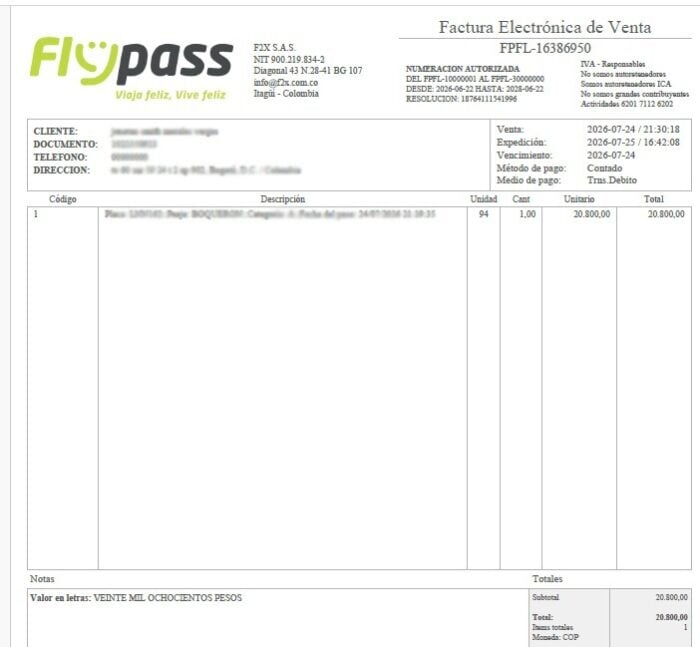
Flypass, the pioneering electronic toll and parking payment platform that revolutionized highway transit in Colombia, is currently navigating turbulent legal waters. The company is facing a high-stakes class-action lawsuit spearheaded by prominent attorneys Hernán Panesso and Manuel García. The legal challenge targets alleged irregular charges of 220 pesos applied to at least 20 users across various national toll stations.
The core of the legal dispute centers on whether a private technological intermediary has the legal right to charge amounts exceeding the official, state-regulated toll tariffs. According to the plaintiffs, these unauthorized micro-charges—detected in services like Flypass’s "Pasa y Paga" (Pass and Pay) and direct card debits—violate the regulatory framework established by the Colombian Ministry of Transport.
The case is currently being meticulously reviewed before the Second Civil Circuit Court of Itagüí (Juzgado Segundo Civil del Circuito de Itagüí). While the financial sum per transaction appears trivial at first glance—equivalent to a fraction of a US cent—the broader implications of a class-action lawsuit against a dominant market player could fundamentally alter the business model of electronic toll collection (ETC) systems throughout the country.

Flypass, operated through its parent company F2X, has firmly defended its operations, arguing that the disputed charges were either temporary system glitches that were subsequently refunded or part of specialized, voluntary premium plans chosen by specific consumers. Nonetheless, this judicial confrontation adds to a growing list of regulatory headaches for a company that has otherwise enjoyed exponential commercial success in the Colombian infrastructure sector.
Chronology: From System Glitches to the Courtroom
To understand how a 220-peso charge escalated into a formal judicial class action, it is essential to trace the timeline of events, regulatory investigations, and corporate responses leading up to the current legal battle.
Early 2026: The Systemic Cross-Data Incident
According to F2X’s defense statements, the genesis of some contested transactions dates back to the opening months of 2026. During this period, the Flypass platform experienced a technical malfunction that inadvertently crossed customer databases. This internal software error triggered supplementary charges on a subset of user accounts. The company maintains that upon discovering the anomaly, it initiated automated and manual reversals, refunding the extra funds to the affected parties so that no unearned revenue was retained.
Mid-2026: Mobilization of Legal Experts
As concerns mounted regarding discrepancies in toll billing statements, a group of affected consumers organized to seek formal legal representation. They retained Hernán Panesso—an alumnus of the Universidad del Rosario with an Oxford master’s degree and extensive experience in economic regulation, consumer protection, and high-profile corporate litigation (including representation for Aerorepública and Deportes Quindío)—alongside Manuel García, a specialist in public and private law from the Universidad Externado de Colombia with postgraduate credentials in Capital Markets Law from the Universidad Javeriana.

The Filing of the Class Action
Armed with a legal interpretation of Ministry of Transport resolutions, Panesso and García filed a class-action lawsuit (acción de grupo). They argued before the Second Civil Circuit Court of Itagüí that technological intermediaries are strictly bound to state-mandated toll limits and cannot unilaterally impose administrative or supplementary fees that inflate the official cost of transit for everyday motorists. The defense of Flypass was swiftly assumed by attorney Yuri Valbuena.
Supporting Data: The Scale of Flypass and Prior Regulatory Scrutiny
To contextualize the magnitude of the legal challenge against Flypass, one must examine the company’s financial footprint, transaction volume, and historical interactions with regulatory watchdogs in Colombia.
Commercial Dominance and Financial Performance
Founded as a paisa innovation that transformed how Colombians navigate highways and urban parking structures, Flypass has grown into an undisputed industry leader. Key metrics underscore its market footprint:
- Annual Revenue: In 2023, Flypass registered operating revenues totaling approximately 35,000 million Colombian pesos.
- Transaction Volume: By 2025, the platform processed over 65 million individual electronic transactions, embedding itself deeply into the daily logistics of Colombian motorists.
- Ownership Structure: The company is controlled by key founders and executives Juan Camilo Henao, Juan Manuel Vicente Pérez, and Luis Lorenzo Botella.
Precedents with the Superintendency of Industry and Commerce (SIC)
The current class action does not exist in a vacuum. Flypass has previously drawn the attention of Colombia’s consumer protection and market transparency authority, the Superintendency of Industry and Commerce (SIC).

- The 2025 Sanction: In 2025, the SIC slapped Flypass with a substantial first-instance administrative fine of 745 million pesos following an investigation into consumer practices.
- Current Status: Flypass promptly impugned the decision. Because the penalty was issued in the first instance and subsequently appealed, the matter remains sub judice, awaiting a definitive second-instance resolution.
Official Responses: Arguments from the Plaintiffs and the Defense
The courtroom battle features a stark contrast in legal interpretations and factual explanations regarding the controversial 220-peso levies.
The Plaintiffs’ Position (Panesso and García)
The legal team representing the motorists bases its strategy on strict compliance with transport regulations. Their core tenets include:
- State Regulation Primacy: Resolutions issued by the Ministry of Transport dictate the exact pricing framework for national toll infrastructure. Intermediaries are granted authorization to facilitate digital payments, but this does not grant them carte blanche to create unapproved surcharges.
- Consumer Protection: Even micro-charges, when multiplied across millions of transactions and distributed among unsuspecting users, constitute a massive structural extraction of capital that violates consumer trust and transparency laws.
- Systemic Correction: The plaintiffs are demanding structural judicial orders forcing Flypass to overhaul its billing architecture, transparently account for all incidental fees, and properly indemnify the consumer base.
The Defense’s Position (F2X and Yuri Valbuena)
Represented by attorney Yuri Valbuena and backed by parent company F2X, Flypass has pushed back against allegations of systemic abuse or illicit enrichment:
- The Glitch Defense: F2X reiterates that the instances flagged early in 2026 were anomalies rooted in a temporary software malfunction. The company insists that corrective measures were deployed and reimbursements issued, meaning no capital was illicitly seized.
- Specialized Service Tiers: In scenarios where the 220-peso charge persisted outside of software glitches, the company argues that these fees correspond to distinct, non-standard user profiles. Customers subscribed to premium or customized account tiers agree to specific operational conditions and ancillary service fees that differ from basic accounts.
- Regulatory Compliance: The defense maintains that at no point has Flypass breached the structural legal norms governing toll pricing, framing the dispute as a misunderstanding of digital platform fee structures versus state-mandated road tariffs.
Implications: What This Means for the Future of Electronic Tolls in Colombia
As the Second Civil Circuit Court of Itagüí prepares to weigh the arguments and issue its findings, the outcome of this litigation carries profound ramifications for the broader fintech, transport, and consumer rights ecosystem in Colombia.
1. Precedent for Technological Intermediaries
The rapid digitization of public services and infrastructure—ranging from electronic toll tags (TAGs) to digital parking meters—relies heavily on private tech companies acting as bridges between citizens and state-concessioned services. If the court rules in favor of Panesso and García, it could establish a rigid legal boundary restricting how private apps structure convenience fees, service charges, or subscription add-ons. Conversely, a victory for Flypass would validate the operational flexibility digital platforms require to manage micro-transactions and specialized service tiers.
2. Financial and Reputational Exposure
While a 220-peso charge per user across 20 identified instances might seem financially minor for a firm processing over 65 million transactions annually, the class-action nature of the suit opens the door for potential expansion. If the court permits the discovery phase to unearth broader patterns across thousands or millions of accounts, the cumulative financial liability—alongside punitive damages—could escalate dramatically. Furthermore, managing dual fronts of legal pressure—the ongoing SIC appeal and the civil class action—demands significant legal capital and poses reputational challenges for a brand built on seamless efficiency and trust.
3. Heightened Consumer Vigilance
Incidents of this nature invariably catalyze greater public scrutiny. Colombian motorists are increasingly auditing their digital statements, toll tags, and automated bank debits. This cultural shift toward hyper-vigilance means that tech platforms operating in the mobility space will face zero tolerance for unexplained billing discrepancies, no matter how fractional the amount may appear.
Next Steps in the Judicial Process
The legal duel between Hernán Panesso, Manuel García, and Yuri Valbuena is far from over. The Itagüí court’s upcoming determinations will dictate whether the class action advances toward a formal judgment on liability and damages. Until then, the case serves as a landmark test case for the legal limits of digital innovation in Colombia’s vital transport corridors.




Leave a Reply