

By César Noragueda
Specialized Journalist in Cinema, Science, and Critical Thought
Updated: August 8, 2026 | 19:00
Main Facts
An ordinary plastic water pipe, a window frame, or a discarded credit card share a common destiny once they break or outlive their utility: they become waste. For decades, much of this discarded material consists of polyvinyl chloride—better known as PVC—a cheap, highly durable, and ubiquitous polymer whose second life has proven notoriously difficult to orchestrate.
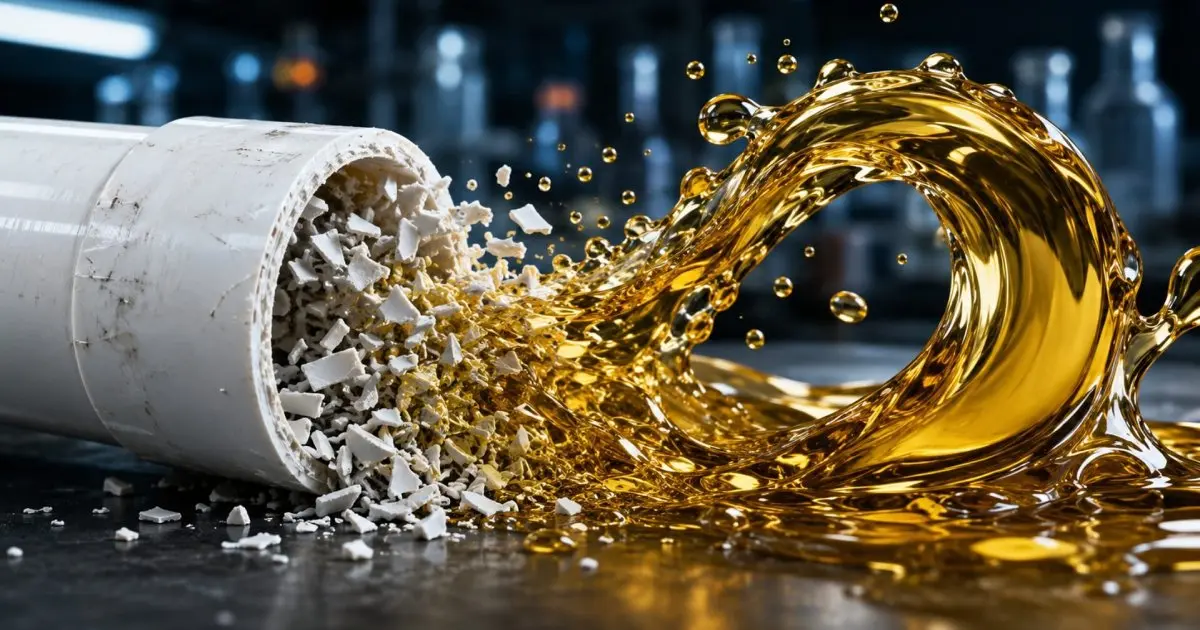
However, a breakthrough published in the prestigious journal Nature by a research team led by Guoliang “Greg” Liu at Virginia Tech has upended the conventional mechanics of recycling. Rather than attempting the arduous task of melting down and remolding PVC into another rigid plastic object, Liu’s team engineered a chemical process that transforms this notorious waste stream into a completely different, high-value product: synthetic lubricants known as polyalphaolefins (PAOs).
The breakthrough relies on a transformative chemical intervention that strips away the material’s problematic chlorine content and restructures its stubborn carbon skeleton. By mixing PVC with alpha-olefins and aluminum chloride at moderate temperatures, the researchers achieved a greater than 99.98% reduction in chlorine, converting a rigid, hazardous environmental nuisance into an oily fluid capable of outperforming commercial motor and machinery lubricants in wear-resistance tests.
Chronology of the Discovery: From Laboratory Impasse to Chemical Breakthrough
The journey toward transforming hard plastic into fluid lubricant was neither linear nor immediate; it was born out of scientific trial, error, and an eventual pivot in strategic thinking.

The Initial Impasse: Tackling the Gummy Residue
When the Virginia Tech team first began experimenting with breaking down PVC chains, their early attempts yielded products that were far from desirable. Instead of obtaining clean, reusable plastic building blocks, the chemical breakdown produced substances that were soft, sticky, gummy, and structurally erratic.
Rather than abandoning the experiments, lead researcher Guoliang Liu recognized a hidden opportunity in failure. If the degraded polymer chains refused to solidify into rigid structures and instead remained oily and long-chained, the strategy could be shifted entirely. Instead of forcing the material back into a solid plastic mold, the laboratory decided to break the chains down further into precise segments and capitalize on their viscous, fluid textures.
Refining the Recipe: Temperature and Solvents
To turn a rigid polymer into an engineered fluid, the team developed a reaction combining PVC with alpha-olefins—hydrocarbons capable of integrating into new chemical networks—and aluminum chloride, a Lewis acid that acts as an electron-pair acceptor to catalyze the transformation.
Maintained at a relatively modest 70 degrees Celsius for approximately three hours, the reaction simultaneously strips away chlorine atoms and slices up the original carbon skeleton while grafting on new hydrocarbon branches.
During subsequent experimentation, the choice of solvent proved critical. The team discovered that using hexans (a mixture of hydrocarbon solvents) rather than other alternatives like dichloromethane minimized unwanted side reactions. This specific choice prevented excessive fragmentation and promoted a comb-like molecular architecture—featuring a primary backbone with long, stable branches—which aligns smoothly under pressure to optimize tribological performance (how well surfaces glide against one another).

Peer Review and the Chlorine Milestone
As the research advanced to peer review for Nature, rigorous demands were placed on the team to prove the complete eradication of chlorine. Because PVC consists of approximately 56.7% chlorine by mass, any leftover traces of the halogen can cause severe industrial corrosion and toxic byproducts.
Challenged by peer reviewers, the scientists utilized ion chromatography to analyze the final fluids. The results confirmed that the resulting synthetic lubricants contained less than 100 parts per million of chlorine—representing a reduction exceeding 99.98% compared to the original PVC feedstocks.
Supporting Data and Technical Performance
The transformation of rigid plastic waste into a functional fluid was verified through rigorous analytical testing covering viscosity, thermal stability, oxidation resistance, friction coefficients, and abrasion metrics.
- Friction and Wear Performance: In friction tests, formulations derived from used PVC demonstrated tribological profiles comparable to commercial PAOs. In specific trials, certain PVC-derived lubricants produced an abrasion footprint 256 times smaller than those achieved by heavier, more viscous commercial lubricants like PAO40.
- Durability and Shelf-Life: Storage and thermal stress tests showed that the fluid retained its core properties after months of storage. Samples tested six months after synthesis maintained a friction coefficient of approximately 0.08 alongside minimal surface abrasion under high temperatures.
- Economic Projections: Utilizing techno-economic modeling, the researchers conceptualized a hypothetical industrial facility capable of processing 50,000 tons of PVC waste annually. The preliminary financial model estimated a total capital investment of $83.8 million, an internal rate of return (IRR) of 22.8%, and a payback period of 4.26 years, assuming stable market prices for alpha-olefins and standard PAOs.
Official Responses and Scientific Nuance
Despite the enthusiastic reception of the study within the scientific community, the researchers maintain a transparent approach regarding the limitations and hurdles remaining before commercialization.
- Indirect Isotopic Evidence: During the peer-review process, reviewers noted that while the chemical data strongly indicate that the carbon skeleton of the final lubricant originates from the PVC polymer, absolute confirmation requires advanced isotopic tracking. Quantifying the exact fraction of carbon atoms derived directly from the plastic versus the added alpha-olefins remains an area for further refinement.
- Economic Variables: The viability of the industrial model depends heavily on fluctuating market prices. The cost of acquiring raw alpha-olefins and the energy required to recover aluminum chloride catalysts will dictate whether the scaled-up chemical recycling process can consistently undercut the production costs of virgin petroleum-based lubricants.
- Feedstock Heterogeneity: Real-world PVC waste is rarely pure. Industrial pipes, medical tubing, credit cards, and children’s toys contain a complex cocktail of varying plasticizers, pigments, sales, and stabilizers. While the Virginia Tech team successfully cleaned and processed mixed samples (including toys, gloves, and cards), scaling this sorting and purification process for municipal-level waste streams presents a significant engineering hurdle.
Implications: Redefining Circular Economy and Waste Management
The breakthrough at Virginia Tech carries implications that extend far beyond the lubricants industry. It challenges the fundamental philosophy of modern waste management and recycling.

From Closed-Loop Recycling to Upcycling
Traditional recycling relies heavily on a circular logic of restitution: a plastic bottle must become another bottle; an aluminum can must become another can. When materials like PVC prove too chemically complex or degraded to follow this path, they are typically abandoned to landfills or incinerators.
By demonstrating that a recalcitrant, toxic, and rigid polymer can be systematically disassembled and rebuilt into an entirely different, highly profitable industrial fluid, this study champions upcycling. It proves that waste materials can be viewed not as broken objects waiting to be repaired, but as dense deposits of reactive carbon and atoms waiting to be unlocked.
Shifting the Paradigm of Matter
If humanity is to address the global crisis of synthetic waste, technological solutions must expand beyond mere collection and mechanical sorting. Chemical recycling strategies that treat polymers as modular molecular building blocks offer a powerful new toolkit.
A discarded window frame or a cracked plumbing pipe ceases to be mere physical trash; it becomes chemical feedstock. While this technique alone will not single-handedly solve the global plastic dilemma, it broadens the horizon of possibilities.
Ultimately, the most profound takeaway from this research is conceptual rather than technical. By loosening the strict demand that a recycled material must return to its original form, science opens the door to a more imaginative circular economy—one where humanity stops trying to endlessly repeat the exact same objects, and instead learns how to creatively reinvent matter itself.



Leave a Reply