

Main Facts
Toyota has pulled off a masterclass in automotive marketing, engineering validation, and nostalgic showmanship. In a high-impact promotional stunt that bridges two decades of television history, the Japanese manufacturer recreated one of the most iconic segments from the golden era of the BBC motoring show Top Gear.
This time, however, the star of the show was not a smoke-belching diesel workhorse, but the brand-new Toyota Hilux BEV—the company’s first-ever fully electric pickup truck.
The objective was straightforward yet brutally demanding: to test whether the legendary, almost mythical reputation for bulletproof durability that has defined the Hilux nameplate for generations could survive the transition to zero-emission battery-electric vehicle (BEV) architecture.
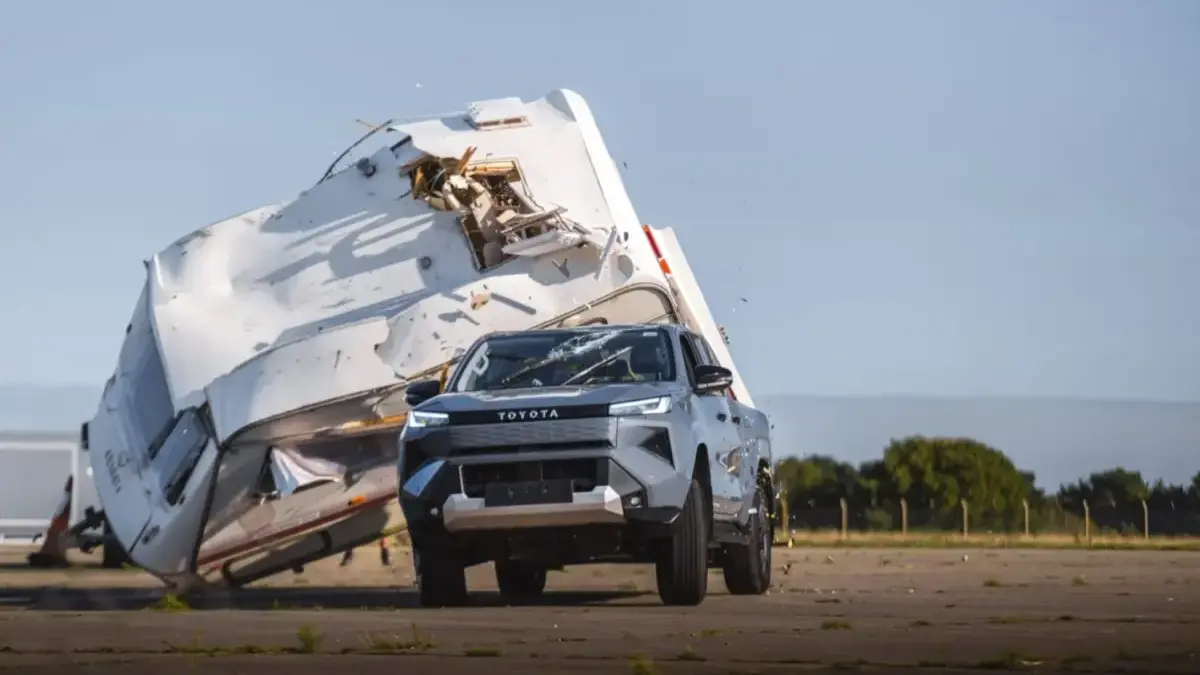
Under the watchful eyes of engineers and media spectators at the Bentwaters airfield in Suffolk, England, a 760-kilogram caravan was suspended nine meters in the air by a crane and dropped directly onto the roof of the electric pickup’s cabin.
Despite the heavy structural impact, which completely obliterated the caravan on collision and left the vehicle with severe cosmetic and structural roof damage, the Hilux BEV successfully turned back on and drove away under its own power.
By merging viral internet culture, nostalgic television heritage, and rigorous physical endurance testing, Toyota aims to ease consumer anxieties regarding the reliability and toughness of electric utility vehicles in harsh working environments.
Chronology of the Stunt
The path to recreating this iconic piece of automotive television was meticulously planned and executed through a series of distinct phases:
1. The Reddit Vote (Setting the Stage)
Rather than deciding on the method of destruction unilaterally, Toyota UK took a modern digital approach by consulting the public. The manufacturer turned to Reddit, posing a simple question to British online automotive communities: Should the new electric pickup face a crushing blow from a one-ton demolition ball, or should the company recreate the infamous caravan drop from the 2003 Top Gear archives? The second option won by a landslide, setting the parameters for the challenge.
2. The Setup at Bentwaters Airfield
The historic Bentwaters airfield in Suffolk, UK, was chosen as the testing ground due to its wide-open spaces and capacity to safely manage heavy-duty drop tests. Technicians positioned the Toyota Hilux BEV precisely within the drop zone, anchoring a standard caravan weighing 760 kilograms to a high-capacity industrial crane positioned roughly nine meters above the ground.
3. The Drop
With cameras rolling to capture every detail in ultra-high-definition, the release mechanism was triggered. The caravan plummeted from the September sky, picking up terminal velocity before slamming directly downward onto the cab and roof pillars of the Hilux BEV. The impact reduced the caravan to a chaotic heap of fiberglass, wood, and aluminum shards, while sending a massive shockwave through the pickup’s chassis.
4. The Post-Impact Assessment and Driveaway
Following the dust cloud’s dissipation, inspectors examined the vehicle. While the cabin structure sustained visible deformation and the roof caved inward, the critical drivetrain components and high-voltage battery housing underneath remained intact enough to function. To the amazement of onlookers, the driver climbed inside, turned the ignition sequence on, and maneuvered the battered electric pickup away from the debris field under its own power.
Supporting Data and Technical Specifications
To truly understand the weight of this achievement, one must examine the technological leap the Hilux has undergone, alongside the historical context of its predecessor.
The Historical Context: The 2003 Top Gear Benchmark
In 2003, Top Gear presenters Jeremy Clarkson and Andy Wilman subjected a mid-1980s diesel Toyota Hilux to a series of torturous trials that birthed the legend of the "indestructible truck." That vehicle was:
- Subjected to a tidal immersion in the Bristol Channel.
- Pummeled with a wrecking ball.
- Dropped from a collapsing residential tower block that was intentionally demolished with the truck parked on top.
After every single catastrophe—including being buried in rubble—the old diesel engine was coaxed back to life with basic hand tools (primarily a wrench, WD-40, and a hammer). That specific unit was later mounted on a plinth in the Top Gear studio as a permanent testament to engineering supremacy.
The Modern Challenger: Toyota Hilux BEV Specifications
Replicating this stunt with a modern BEV introduces entirely different physics and vulnerabilities. Unlike a simple mechanical diesel engine, an electric vehicle relies on sensitive electronics, high-voltage wiring harnesses, and a large, heavy lithium-ion battery pack integrated into the floorpan.
- Powertrain: Dual-motor setup providing electronic four-wheel drive (AWD).
- Total Power Output: Approximately 196 horsepower (146 kW).
- Battery Capacity: 59.2 kWh high-voltage lithium-ion pack.
- Estimated Range: Around 250 kilometers on a single charge under standard homologation cycles (varying by market and utility configuration).
- Global Pedigree: Over 27 million units of the Hilux family sold worldwide across decades of production.
The presence of a high-voltage battery directly beneath the cabin adds a layer of safety complexity. If structural intrusion breaches a modern EV battery pack, the risk of thermal runaway or catastrophic electrical failure is extraordinarily high. Toyota’s success in preserving the vehicle’s functional integrity speaks volumes about modern chassis reinforcement and structural load distribution in commercial electric vehicles.
Official Responses and Strategic Implications
Toyota’s leadership has framed this stunt not merely as a piece of entertaining PR, but as a crucial pillar in their broader electrification strategy.
Overcoming "EV Fragility" Anxieties
Commercial buyers—such as construction firms, agricultural workers, utility providers, and emergency services—have historically been skeptical of battery-electric vehicles. The prevailing industry perception has long been that EVs are "fragile computers on wheels" unsuited for the brutal, punishing environments where traditional diesel work trucks thrive.
By demonstrating that the electric Hilux can take a nine-meter caravan drop to the head and keep rolling, Toyota is directly neutralizing this psychological barrier. The message to fleet managers is unambiguous: switching to zero-emissions does not mean sacrificing rugged utility.
Maintaining Brand Heritage in a Zero-Emission Era
For decades, the Hilux has served as the backbone of Toyota’s reputation for indestructible build quality. As global regulations force legacy automakers to phase out internal combustion engines, brands face the existential risk of losing their core brand identity.
By tying the new BEV variant directly to its most famous historical stunts, Toyota is successfully transferring the "indestructible" halo from the diesel era into the electric era.
Implications for the Market and Future Tests
The timing of this stunt aligns with the commercial rollout of the Hilux BEV across various international markets, including Spain and the broader European theater. As the vehicle hits showrooms to compete alongside traditional diesel variants and hybrid alternatives, consumer curiosity is at an all-time high.
However, the story does not end at the Bentwaters airfield. Recognizing the viral potential and the marketing value of the exercise, Toyota has officially handed the battered, caravan-scarred Hilux BEV directly over to the Top Gear team to subject it to further, undisclosed rounds of torture.
Industry analysts are watching closely to see what additional trials the vehicle will face. Will it endure extreme thermal tests, deep-water wading, or further structural demolition? Regardless of what comes next, Toyota has achieved its primary goal: the world now knows that under the skin of the modern electric Hilux beats the exact same unbreakable heart that made its predecessor a global legend.


Leave a Reply