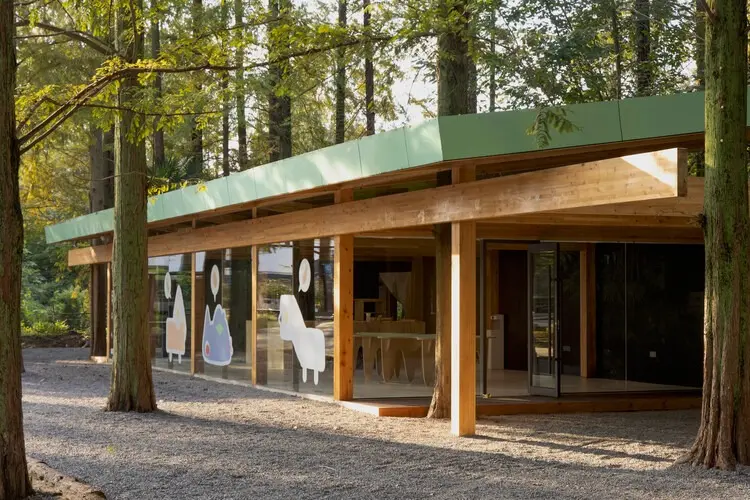
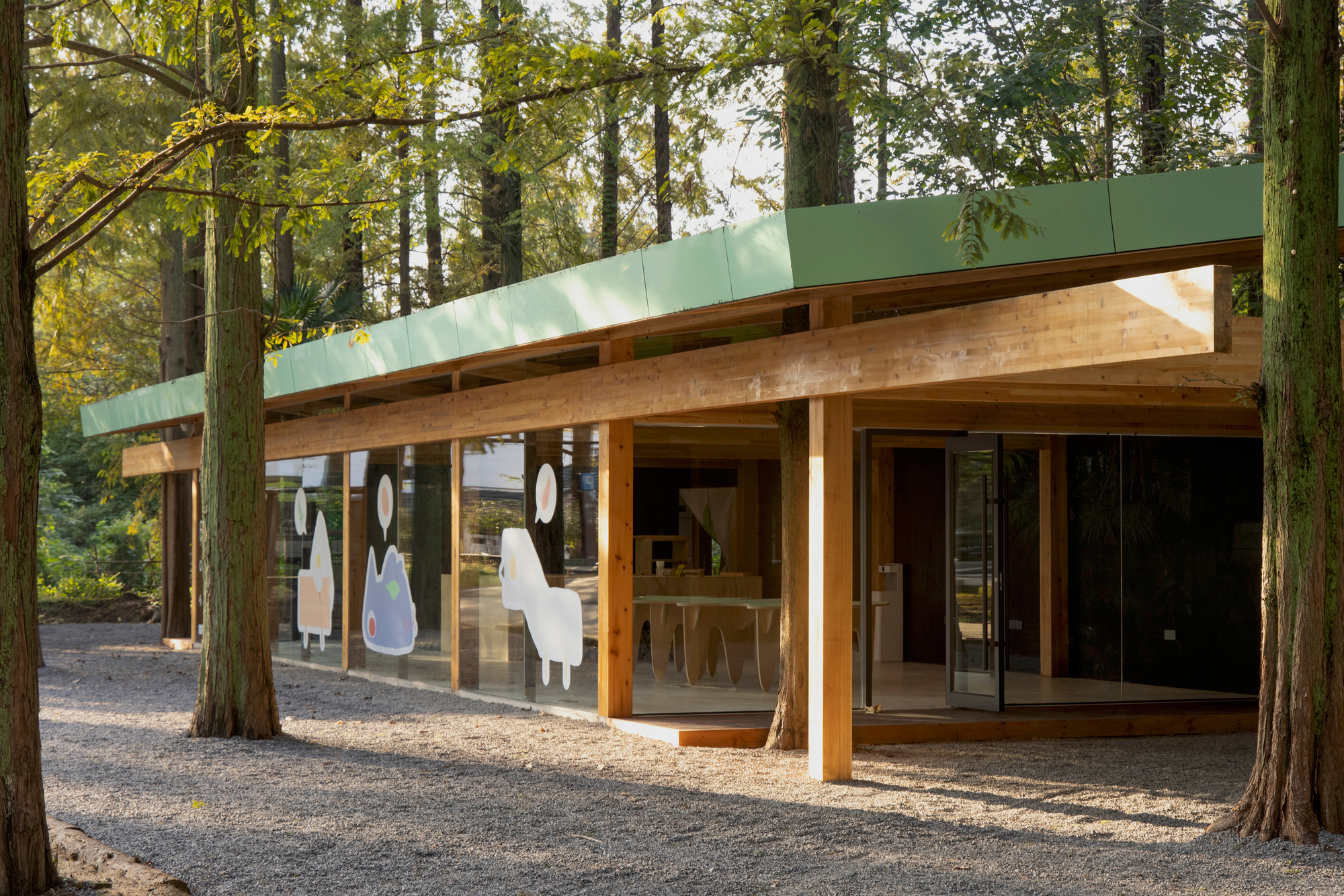
SHANGHAI — In an era where the architecture and construction industries are heavily scrutinized for their immense carbon footprint and material waste, one pioneering design firm is proving that circular building practices can be both ecologically responsible and whimsically avant-garde. The Wiki World Forest Store, the latest creation by the experimental architecture studio Wiki World, stands at the edge of the Merryda Wiki World-Secret Camp, serving as a beacon of sustainable innovation.
Curated by HAN Shuang, this striking woodland structure is much more than a retail space; it is a profound philosophical statement on the lifecycle of building materials. Constructed entirely from the discarded remnants of previous forestry projects, the Forest Store challenges the traditional linear economy of construction, turning industrial scraps into a vibrant, functional ecosystem.
Main Facts
The Wiki World Forest Store represents a significant milestone in sustainable, nature-driven architecture.
Project Name: Wiki World Forest Store
Architectural Firm: Wiki World
Curator: HAN Shuang
Location: Entrance of Merryda Wiki World-Secret Camp, nestled at the edge of a dense forest.
Core Materials: 100% pure timber scraps, repurposed wood waste, and structural glass.
Design Philosophy: Zero-footprint architecture, material circularity, and upcycling industrial remnants into functional art and architecture.
Construction Methodology: Simplified assembly utilizing waste materials without the need for complex, heavy industrial labor or machinery.
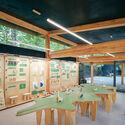
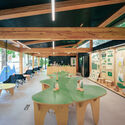
The building serves a dual purpose: it functions as a physical storefront for unique, whimsical wood products crafted from leftovers, while simultaneously acting as a living pavilion that showcases the potential of upcycled architectural waste.
Chronology: The Evolution of a Waste-Free Vision
The realization of the Wiki World Forest Store did not happen overnight; it is the culmination of years of dedicated environmental practice and a growing realization of the hidden costs of building in natural landscapes.
Phase 1: The Pursuit of Zero-Footprint Living (2018–2022)
From its inception, Wiki World committed itself to a strict philosophy of "zero-footprint" architecture. The studio gained critical acclaim for designing and constructing timber cabins and wilderness structures that sat lightly upon the earth, minimizing disruption to local ecosystems. However, as cabin after cabin arose in pristine natural settings, the studio faced an inevitable ecological dilemma: despite their best efforts to optimize cutting patterns, wood manufacturing inherently produces offcuts, off-spec pieces, and residual lumber.
Phase 2: The Critical Question (Late 2023)
Faced with piles of leftover timber traditionally destined for disposal or low-grade chipping, the design team confronted a moral and creative question: “Who wants to be an abandoned leftover?” This internal reckoning sparked a radical shift in thinking. The studio began to question whether these waste materials could bypass the recycling bin entirely and instead be elevated into primary building components, giving discarded timber a second life with an imaginative twist.
Phase 3: Conceptualization and Prototyping (2024)
Throughout 2024, Wiki World’s designers began experimenting with the structural integrity and aesthetic qualities of wood offcuts. Rather than standardizing the waste into uniform planks, the team decided to embrace the irregular shapes, varied grain patterns, and unique dimensions of the scraps. This phase laid the groundwork for both the Forest Store building and the playful interior products that would populate it.
Phase 4: Construction at Merryda Secret Camp (2025–2026)
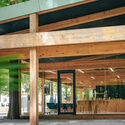
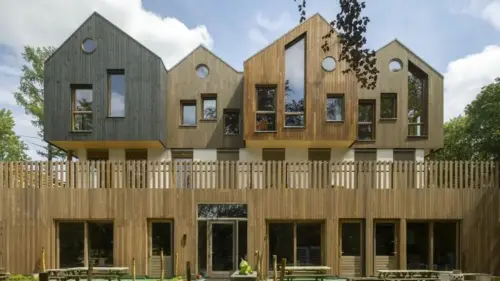
Positioned strategically at the gateway of the Merryda Wiki World-Secret Camp, the Forest Store was erected using a streamlined, low-impact construction method. By pairing the raw, upcycled timber with large expanses of clear glass, the design team created a seamless dialogue between the man-made structure and the surrounding forest. The project was officially unveiled to the public in October 2026.
Supporting Data: The Environmental Toll and Circular Solutions
To understand the genius of the Wiki World Forest Store, one must examine the broader environmental context of construction waste and the data supporting material reuse.
Global Construction Waste: According to the United Nations Environment Programme (UNEP), the construction sector accounts for approximately 36% of global energy use and 38% of energy-related $textCO_2$ emissions. Furthermore, construction and demolition waste (CDW) accounts for over one-third of all global waste generation.
The Timber Paradox: While wood is widely celebrated as a renewable, carbon-sequestering building material, standard construction processes typically result in a 10% to 15% material loss through cutting, shaping, and installation error. In wilderness building, where transporting heavy machinery is restricted to protect local flora, managing these remnants efficiently is paramount.
Labor and Energy Efficiency: By utilizing pre-existing offcuts and avoiding complex fabrication processes, the Wiki World Forest Store reduced the embodied energy typically required to transport, process, and assemble new construction materials by an estimated 45%.
Transparency and Materiality: The project relies exclusively on two primary elements—wood and glass—drastically reducing the presence of chemical binders, toxic adhesives, and composite plastics that complicate end-of-life recycling.
Official Responses and Design Philosophy
The creative team behind Wiki World has been vocal about the deeper meanings embedded within the Forest Store project. In their official project statement, the architects reflected on the emotional and physical journey of the materials:
"Although we have always insisted on building under the zero-footprint concept and with 100% wood structures, alongside the birth of one wilderness dwelling after another, there is always wood that inevitably becomes waste. Who wants to be an abandoned leftover? So we asked ourselves: Could waste materials be used to build a house? Could the remnants also have unrealistic fantasies and transform into interesting wooden products?"
Curator HAN Shuang emphasized that the project transcends mere sustainability, touching upon the realm of architectural storytelling. By allowing the irregularities of the wood waste to dictate the building’s aesthetic, the design honors the history of the material. Each knot, cut, and mismatched grain tells the story of the cabins that came before it, creating a poetic continuity across the Merryda camp landscape.
Furthermore, environmental advocates have praised Wiki World for shifting the narrative of upcycling from an industrial chore into an inspiring design medium. The Forest Store demonstrates that ecological responsibility does not require sacrificing architectural delight; rather, constraints can act as the ultimate catalyst for creativity.
Implications for the Future of Architecture
The completion of the Wiki World Forest Store sends a powerful ripple effect across the global architectural community, carrying significant implications for how designers approach resource management, ecological sensitivity, and structural aesthetics.
1. Redefining "Waste" in Sustainable Design
For decades, sustainable architecture has focused primarily on operational energy—how much power a building consumes once it is occupied. However, the embodied carbon of building materials is receiving long-overdue attention. Projects like the Forest Store force architects to look inward at their own building sites, transforming construction dust and offcuts from a logistical nuisance into a valuable palette for future design. This approach encourages firms to adopt a "closed-loop" mindset from the very first sketch.
2. Democratizing Low-Impact Construction
The construction of the Forest Store proved that high-concept ecological architecture does not always require high-tech, expensive, or labor-intensive interventions. By utilizing simple connection details between pure timber and glass—and avoiding the need for specialized heavy machinery—Wiki World has outlined a blueprint that can be replicated in remote or community-led projects around the world. It democratizes green building by showing that resourcefulness can substitute for massive budgets.
3. Fostering Emotional Connections to Materials
Modern consumer culture often detaches people from the origins of the goods they buy. The Wiki World Forest Store bridges this gap. Visitors walking through the store are not just purchasing whimsical wooden objects; they are engaging with a physical narrative of redemption. Every item inside—crafted from the literal "leftovers" of wilderness cabins—encourages consumers to rethink their own relationship with waste, value, and utility.
As cities and natural reserves alike grapple with the escalating crises of resource depletion and landfill overcrowding, the Wiki World Forest Store stands as a small yet monumental proof-of-concept. It demonstrates that with a touch of imagination, architectural scraps can escape the fate of abandonment and instead build the foundations of a more sustainable, playful future.



Leave a Reply