

By Christian Pérez
Specialized Science and History Contributor
Published: August 2, 2026
Main Facts
For decades, a thick shroud of sedimentary rock concealed a remarkable secret within the fossil collections of an Oregon museum. Initially excavated in the late 1980s from public lands managed by the United States Bureau of Land Management (BLM)—just a stone’s throw from the John Day Fossil Beds National Monument—the specimen was misidentified. Paleontologists of the era suspected the heavy gypsum jacket contained the remains of an oreodont: an extinct group of herbivorous mammals distantly related to modern camels, pigs, and sheep.
No one could have guessed that this subterranean vault of stone actually safeguarded one of the most complete and pristine canine skeletons ever discovered in North America.
A groundbreaking study published in the Journal of Paleontology has shattered previous assumptions, revealing that the fossil belongs to Mesocyon coryphaeus, an ancient canid that roamed the Earth between 31 and 29 million years ago during the Oligocene epoch. For nearly a century and a half, science knew Mesocyon coryphaeus exclusively through isolated skull fragments.

Now, for the first time, researchers have reconstructed its entire postcranial skeleton—every bone from the neck down. The revelation forces evolutionary biologists to discard a long-held dogma: the belief that the earliest members of the family Canidae rapidly evolved into hyper-specialized, long-distance endurance runners akin to modern wolves, foxes, and coyotes. Instead, this prehistoric relative relied on stealth, exhibiting an anatomy engineered for ambush predation rather than high-speed pursuits across open plains.
Chronology
To understand the magnitude of this discovery, science must retrace a deep evolutionary timeline that spans tens of millions of years, tracking both the natural history of the animal and the painstaking journey of the fossil itself.
- ~40 Million Years Ago: The earliest true canids emerge in the heavily forested, humid ecosystems of North America, setting the stage for a diverse radiation of carnivorous mammals.
- 31–29 Million Years Ago (The Oligocene Epoch): Mesocyon coryphaeus inhabits the mosaic landscapes of the American West. As global temperatures cool and dense forests transition into broken woodlands and shrublands, this species thrives as a compact, adaptable carnivore.
- Late 1980s: Paleontological field crews unearth the fossil encrusted in a massive block of matrix near the John Day basin in Oregon. Misidentified as an oreodont, the specimen enters museum storage, protected within its plaster jacket.
- The 1990s–2010s: Preparators slowly chip away at the rock over the course of three decades. The skull is liberated first and placed on public exhibition, while the delicate, interconnected skeleton beneath remains largely unstudied.
- Recent Years: Advanced osteological analysis and full preparation of the postcranial remains reveal the true identity of the specimen—not an oreodont, but the most complete Mesocyon skeleton ever found.
- August 2, 2026: The formal scientific description is published in the Journal of Paleontology, redefining our understanding of early canine locomotion and behavior.
Supporting Data and Anatomical Revelations
The core of the new study relies on the remarkably preserved postcranial skeleton. Unlike previous discoveries that offered only a glimpse into the animal’s cranial architecture, this specimen provides a holistic view of an organism designed for a very specific ecological niche.
The Anatomy of an Ambush Predator
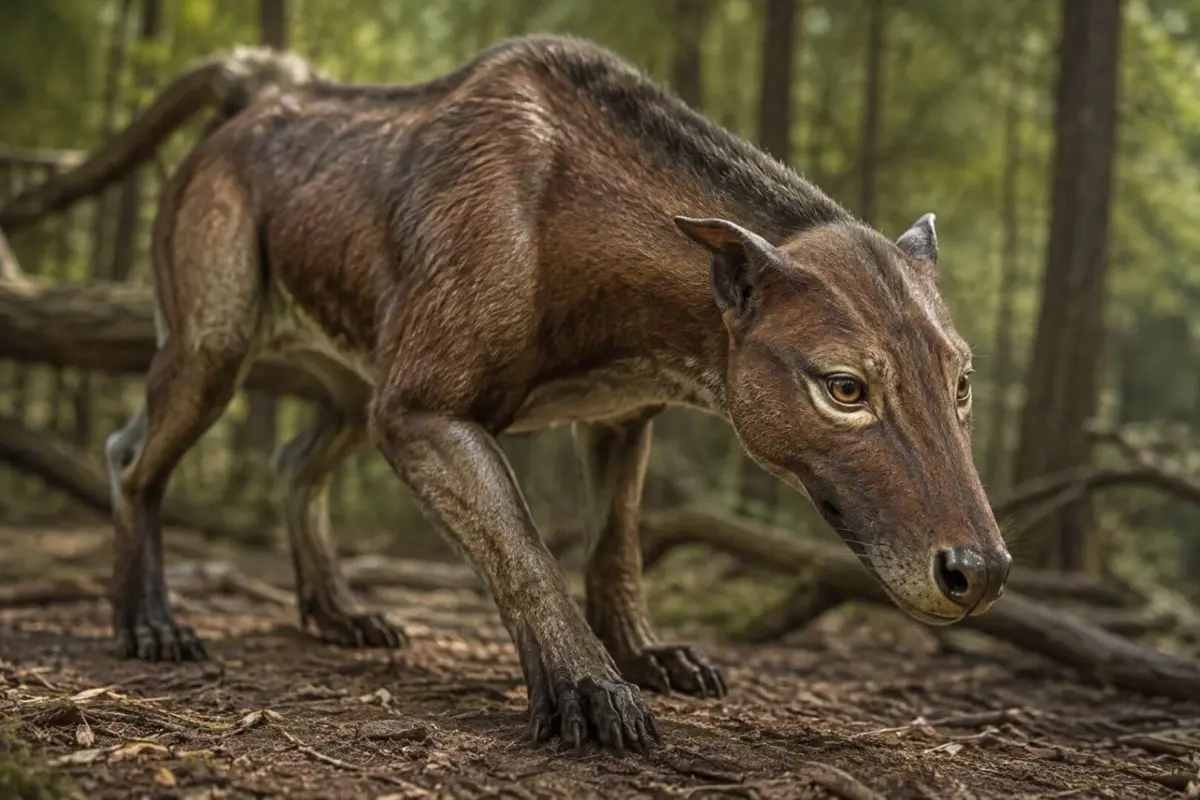
Weighing roughly the same as a modern coyote, Mesocyon coryphaeus possessed a skeleton that bore little functional resemblance to its modern lightweight counterparts. Its limbs were notably shorter and far more robust, anchored by heavy, dense bones.

While modern dogs exhibit a digitigrade posture—walking almost exclusively on their toes, which maximizes stride length and energy efficiency during long chases—Mesocyon retained a more conservative, intermediate stance. It could bear weight across a broader portion of the foot, sacrificing blistering speed for stability and traction on uneven terrain.
Furthermore, analysis of the elbow and tarsal joints revealed a high degree of rotational mobility in the forearms. A modern wolf or African wild dog has rigid, highly specialized forelimbs locked into a parasagittal (front-to-back) plane to prevent lateral movement and reduce injury during high-speed runs. Mesocyon, by contrast, possessed an elbow structure that allowed for forearm rotation—a primitive trait inherited from ancestral carnivorans. This flexibility was incompatible with marathon running, but it provided a distinct advantage when grappling with struggling prey or navigating cluttered, densely vegetated environments.
The Preservation
The recovery of this specific specimen required hundreds of hours of meticulous preparation by laboratory technicians. The resulting fossil portfolio includes:
- An intact skull articulated seamlessly with its lower jaw.
- An almost complete, unbroken vertebral column.
- Fully articulated forelimbs and hindlimbs, preserving delicate paw and hand bones rarely found in the fossil record.
- The preservation of a baculum (os penis), which definitively identified the specimen as an adult male.
Official Responses and Expert Perspectives
The rarity and completeness of the Oregon specimen have drawn widespread acclaim from the paleontological community, highlighting how a single fossil can upend established evolutionary paradigms.

Researchers involved in the study emphasize that the traditional narrative of dog evolution—viewing every extinct canid as an incremental step toward the modern wolf—is overly simplistic. "This fossil offers an unprecedented, crystal-clear window into what the earliest dogs were truly like," note the study’s authors. "It bridges a massive chasmic void in our understanding of early canid evolution, proving that nature experimented with a wide array of body plans before settling on the cursorial design we see today."
Park paleontologists and regional curators who managed the site where the fossil was unearthed underscore the importance of long-term curation and federal land protection policies. Without the initial preservation of the site by agencies like the BLM and the National Park Service, specimens of this scientific caliber would be lost to erosion or commercial exploitation before science has the tools to properly analyze them.
Evolutionary Implications
The discovery of the complete Mesocyon skeleton forces science to re-evaluate the ecological pressures that shaped the dog family (Canidae).
Shifting Niches in an Oligocene World
During the Eocene, North American canids operated within closed, wet canopies. As the Oligocene brought cooler and drier conditions, open spaces expanded, but riparian zones and brushlands remained common. Mesocyon capitalized on these transitional habitats.

Rather than running down fleet-footed herbivores over miles of open grassland, Mesocyon coryphaeus utilized a hunting style reminiscent of modern mustelids (such as martens or large weasels) or felids. It likely utilized low-slung vegetation, fallen logs, and uneven topography to stalk and ambush prey. Its diet would have consisted of small ungulates, ground-dwelling rodents, and hypertragulids—tiny, deer-like ruminants that abounded in North American forests at the time.
An Evolutionary Dead End
It is critical to note that Mesocyon coryphaeus is not a direct ancestor of our domestic dogs, nor is it on the direct lineage leading to modern wolves and foxes. Instead, Mesocyon represents an entirely extinct branch of the canid family tree—a specialized evolutionary experiment that proved exceptionally successful for millions of years before ultimately perishing without descendants.
Today, all living canids belong to a single surviving subfamily (Caninae). The disappearance of lineages like Mesocyon serves as a stark reminder that the modern diversity of life represents only a fraction of the anatomical and behavioral experiments conducted by evolution over deep time.
Ultimately, the revelation from Oregon reframes our emotional and scientific bond with our canine companions. When we look at a modern dog sprinting across an open park, we are witnessing the polished product of a long, narrow evolutionary pathway. But the fossil record whispers of a time when the "dogs" of the world were powerful, flexible ambush hunters—masters of a shadowy, ancient forest floor that vanished millions of years ago.




Leave a Reply