

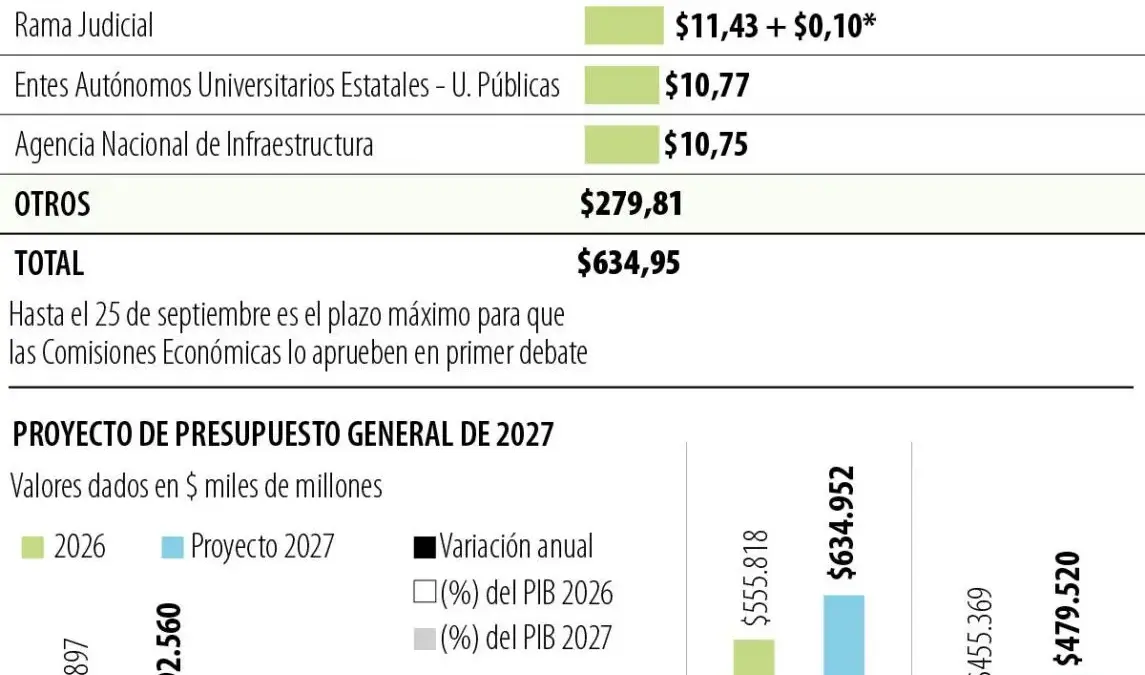
BOGOTÁ — As the legislative clock ticks down toward crucial constitutional deadlines, the Economic Commissions of the Senate and the House of Representatives are locked in intense, marathon negotiations over the final architecture of Colombia’s National General Budget (PGN) for 2027. While the macro-level fiscal aggregate—set at a staggering $634.9 trillion pesos—has already cleared initial hurdles, the allocation of these massive funds has triggered a fierce political and institutional tug-of-war.
Behind closed doors and across heated committee rooms, coordinators and congressional rapporteurs have hammered out significant adjustments to the initial proposal submitted by the Ministry of Finance. These modifications reveal a budget under severe pressure, forced to perform delicate balancing acts between soaring healthcare demands, institutional obligations, security requirements, and the looming shadow of fiscal rules.
With significant spending cuts targeted at heavyweights like the Ministry of Finance, the Special Jurisdiction for Peace (JEP), and key transport agencies—coupled with a contentious alternative proposal pushed by the opposition—the debate over the 2027 PGN has transformed into a referendum on the nation’s economic priorities.
Main Facts
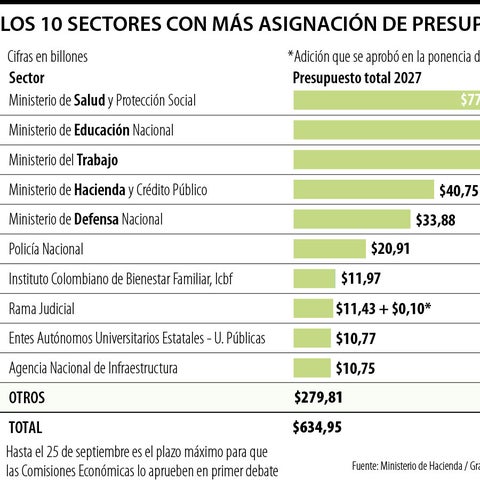
The ongoing legislative battle surrounding the 2027 PGN centers on a finalized overall spending envelope of $634.9 trillion pesos. However, the internal distribution of these resources has shifted dramatically following concertation agreements between congressional rapporteurs and the executive branch.
The core developments defining the current legislative landscape include:
- Targeted Budgetary Reductions: The revised ponencia under discussion implements notable funding cuts across several critical sectors. The Ministry of Finance faces a $2 trillion peso reduction. Concurrently, the Special Jurisdiction for Peace (JEP) takes a $170,000 million peso haircut, the National Police sees a $17,000 million reduction, the Civil Aeronautics Administration (Aeronáutica Civil) drops by $15,000 million, and the National Department of Planning (DNP) is trimmed by $13,000 million.
- The Healthcare Lifeline: The massive $2 trillion extraction from the Ministry of Finance’s initial allocation is not vanishing; it is being aggressively redirected toward the Ministry of Health. This transfer aims to address deep structural deficits in the health sector, driven largely by necessary adjustments to the Unit of Payment per Capitulation (UPC).
- Strategic Additions: While some entities face tightening belts, others secured funding bumps. The Judicial Branch received an additional $100,000 million pesos, the Ministry of Sport (Ministerio del Deporte) gained $99,106 million, and the Ministry of Defense secured an extra $17,000 million.
- The Opposition’s Counter-Proposal: Discontented with the macroeconomic assumptions and debt strategies of the ruling administration, the opposition bloc—spearheaded by the Pacto Histórico—has tabled an alternative budget proposal. Their plan shrinks the total envelope by $36 trillion (landing at $598.6 trillion) while demanding $32 trillion in contingent resources and activating fiscal rule escape clauses.
Chronology of the Legislative Process
The trajectory of the 2027 PGN has been marked by high urgency, tight institutional deadlines, and complex negotiations between the executive branch and various legislative coalitions.
- Early September 2026: The Ministry of Finance formally delivers the initial PGN proposal to Congress, establishing the macro-level spending target at $634.9 trillion pesos and igniting the preliminary review process within the bicameral Economic Commissions.
- Mid-September 2026: Warnings from industrial leaders and health sector stakeholders—including statements from ANDI President Bruce Mac Master regarding the precarious financial health of EPS providers and the urgent need for a 12% to 13% UPC adjustment—inject a sense of crisis into the fiscal debates.
- September 23, 2026: Negotiations between coordinators and rapporteurs yield a revised ponencia. This updated text introduces the multi-trillion-peso reallocation from the Ministry of Finance to Health, alongside adjustments to the JEP, Police, and transport sectors. Meanwhile, the Pacto Histórico coalition formally presents its alternative $598.6 trillion budget.
- September 25, 2026: This serves as the absolute statutory deadline for the Joint Economic Commissions of the Senate and House to approve the budget ponencia. Failure to reach consensus within this window risks severely delaying the broader legislative schedule.
- Late September to Mid-October 2026: Once cleared by the Economic Commissions, the PGN project will advance to the full plenaries of both the House of Representatives and the Senate. In these forums, the bill will undergo separate, highly scrutinized debates and floor votes.
- October 20, 2026: The constitutional deadline for Congress to fully debate, vote on, and approve the 2027 National General Budget project into law.
Supporting Data and Financial Metrics
To fully understand the gravity of the 2027 PGN debate, one must examine the underlying figures driving both the government’s strategy and the intense pushback from industry and opposition leaders.
The Reallocation Ledger (Key Cuts and Additions)
- Ministry of Finance: -$2,000,000 million pesos (reallocated primarily to healthcare).
- Special Jurisdiction for Peace (JEP): -$170,000 million pesos.
- National Police: -$17,000 million pesos.
- Civil Aeronautics (Aeronáutica Civil): -$15,000 million pesos.
- National Department of Planning (DNP): -$13,000 million pesos.
- Judicial Branch: +$100,000 million pesos.
- Ministry of Sport: +$99,106 million pesos.
- Ministry of Defense: +$17,000 million pesos.
Healthcare System Pressures
The financial strain on Colombia’s healthcare infrastructure serves as the primary catalyst for the massive $2 trillion shift in the budget. According to analyses cited by ANDI President Bruce Mac Master, the operational realities of the health system demanded radical fiscal intervention:
- The National Association of Industrialists (ANDI) estimated that the UPC (Unit of Payment per Capitulation) needed to increase by at least 15.6% heading into recent cycles just to stabilize current operations.
- Projections for institutional loss ratios (siniestralidad) hovered at an unsustainable 105.9%, generating a staggering operational deficit of $10.2 trillion pesos.
- This meant that for every $100 pesos received by Health Promotion Entities (EPS), approximately $106 pesos were expended strictly on patient care, leaving administrative costs entirely exposed and creating an acute financing crisis that the 2027 PGN is now desperately attempting to mitigate.
The Macroeconomic Debate and Debt Exposure
The fiscal architecture proposed by the government relies heavily on debt management and public credit lines. Key figures highlighted by dissenting lawmakers include:
- Projected Public Debt Needs: Projections indicate the nation will require upwards of $155 trillion in public debt servicing and acquisition for the upcoming fiscal year.
- Fiscal Rule Parameters: The alternative budget proposal pushed by the opposition actively triggers the escape clause of the Fiscal Rule—approved by CONFIS for the 2025–2027 window—while ostensibly vowing to respect the net debt anchor of 55% and the gross debt ceiling of 71%.
Official Responses and Stakeholder Perspectives
The compromises struck within the congressional committees have satisfied few entirely, drawing sharp critiques, pragmatic defenses, and ideological warnings from key political and economic actors.
The Industrial Sector: Warning of Structural Deficits
Bruce Mac Master, president of the National Association of Industrialists (ANDI), has been a vocal participant in framing the economic reality behind the budget adjustments. Highlighting the historical context of healthcare financing, Mac Master stressed that the Ministry of Finance’s revisions are symptomatic of deeper, systemic miscalculations in past funding cycles.
"The calculations made in previous years help to understand why the Ministry is reviewing its financing," Mac Master noted, pointing out that operational deficits and high loss ratios have backed the healthcare system into a corner that minor budgetary tweaks can no longer ignore.
The Opposition Perspective: A Dangerous Reliance on Debt
On the legislative front, the opposition—led vigorously by the Pacto Histórico bloc—has raised alarm bells regarding the administration’s strategy of lowering certain corporate and wealth tax burdens while aggressively expanding public debt.
Representative Jorge Hernán Bastidas (Pacto Histórico, Cauca) launched a scathing critique of the executive’s fiscal roadmap during the committee debates:
"The government proposes to reduce current revenues by cutting income and wealth taxes while increasing debt—a grave error," Bastidas asserted. "We will need $155 trillion in public debt next year (…) internal credit resources are being augmented and we will lean on the financial sector, but they will return new debt to us relative to what will flow out of the PGN; it will be a small and marginal amortization."
This sentiment underpins the opposition’s alternative $598.6 trillion proposal, which seeks to rein in what they view as an over-leveraged fiscal strategy that risks long-term macroeconomic stability.
Implications for Colombia’s Economic and Institutional Future
As the bicameral Economic Commissions barrel toward their September 25 deadline, the repercussions of the 2027 PGN debate extend far beyond the legislative chambers of Bogotá.
- Healthcare Sustainability: The emergency infusion of $2 trillion into the health sector—bolstered by expected UPC adjustments of 12% to 13%—will provide much-needed breathing room for an operational model pushed to the brink of insolvency. However, economists warn that without structural reforms to healthcare delivery and pricing, this budgetary patch will merely delay a recurring systemic crisis.
- Fiscal Discipline vs. Development Needs: The activation of the Fiscal Rule escape clause, combined with heavy reliance on internal credit markets and public debt issuance, highlights the razor-thin margins within which the Colombian state currently operates. Balancing the need for post-crisis regional reconstruction against strict debt ceilings (such as the 71% gross debt limit) will remain a tightrope walk for the Ministry of Finance.
- Institutional Tensions: The deliberate trimming of budgets for oversight, planning, and transitional justice entities—such as the JEP and the National Department of Planning—signals a prioritization of immediate liquidity over long-term institutional capacity. Critics argue that weakening agencies tasked with planning and accountability could carry severe governance costs in the medium term.
With the macro-amount locked at $634.9 trillion, the immediate battleground shifts entirely to sectoral allocations. As the debate moves from the joint committees to the high-stakes theater of the Senate and House plenaries ahead of the October 20 constitutional deadline, the final shape of Colombia’s 2027 fiscal year hangs delicately in the balance.



Leave a Reply