

Main Facts
Emerging from the vibrant and culturally diverse artistic landscape of Colombia’s high-altitude capital, Los Cotopla Boyz have established themselves as a cornerstone of the nueva tropicanibal bogotana (the new Bogotá tropical avant-garde) since their inception in 2018. Armed with a moniker that immediately signals coastal irony, playful costeñidad tropes, and an undeniable sense of humor, this academic-trained quintet has redefined what it means to make tropical music in a metropolis far removed from the Caribbean coast. Blending the hypnotic grooves of psychedelic cumbia with the raw energy of modern alternative experimentation, their songwriting serves as an auditory mirror for the daily trials, tribulations, and mundane existentialism of the millennial and zoomer generations.
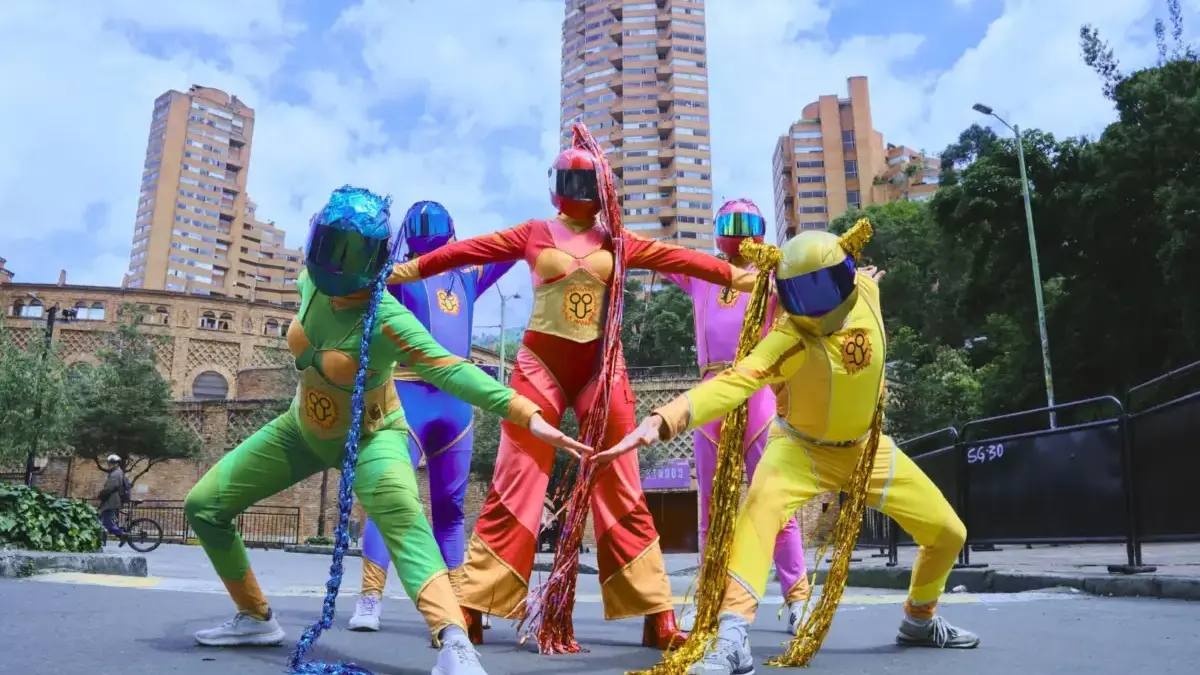
According to the band’s self-mythology, the members inhabit a "dystopian post-pandemic multiverse where their sole mission is to save the party." This theatrical narrative is brought to life during their live performances, where they step onto the stage resembling a frenetic, tropical iteration of the Power Rangers. Their lyrical content brilliantly bridges the gap between the absurd and the everyday: they sing about adventures that masquerade as epic odysseys, only to reveal themselves as entirely prosaic, hyper-relatable urban experiences—such as navigating chaotic public transit, surviving awkward dates, or nursing heavy hangovers.
With two major studio productions under their belt—including the critically acclaimed 2022 vinyl release Mamarrón vol. 1 and their sophomore album, Guau, no joda—the band continues to expand its sonic footprint. Their music has found a dedicated national audience, championed by alternative cultural platforms such as Demo Estéreo on Radio Nacional de Colombia, cementing their status as pioneers of a new wave of tropical alternative music in South America.
Chronology
2018: The Genesis in the Cold Capital
The seeds of Los Cotopla Boyz were planted in Bogotá in 2018. While Bogotá is historically known for its rock scene, indie bands, and academic jazz ensembles, a new generation of musicians trained in classical and jazz conservatories began looking toward their tropical roots with fresh eyes. Driven by a desire to break away from sterile academic settings, the founding members—all seasoned instrumentalists with formal music education—came together to experiment with the intersections of traditional Colombian cumbia, porro, and the hypnotic swirls of 1970s psychedelic cumbia popularized across Peru and Mexico.
2020–2021: The Pandemic Crucible and the Birth of the "Multiverse"
When global lockdowns brought the live entertainment industry to a grinding halt, the members of Los Cotopla Boyz channeled their collective isolation into conceptual songwriting. Rather than succumbing to the depressive weight of the COVID-19 pandemic, they constructed a fictional narrative: a dystopian post-pandemic reality stripped of joy, where live music was extinct. In response, they cast themselves as intergalactic party-saviors. This era of incubation shaped their distinct visual identity—characterized by colorful, matching performance gear—and laid the groundwork for their debut recordings.
2022: Mamarrón vol. 1 and the Vinyl Revival
The band made a definitive splash in the Colombian underground scene with the release of their debut studio album, Mamarrón vol. 1. Defying modern digital-only consumption trends, the group made a bold statement by releasing the record physically on vinyl. The album was an immediate success among critics and niche music lovers, blending heavy percussion, dizzying synthesizer leads, and witty lyricism. Tracks from Mamarrón vol. 1 established the band’s signature aesthetic: sophisticated musicianship masked by a deceptively humorous, anti-pretentious attitude.
2024: Guau, no joda and Crafting the "Trap" Drink Anthem
Building on the momentum of their debut, Los Cotopla Boyz turned their attention toward their sophomore full-length project, Guau, no joda. Released in mid-2024, the album showcased a more mature, tightly wound production style while retaining the frantic energy of their live shows.
A standout track from the album pays homage to a notorious artisanal liquor hailing from the department of Norte de Santander—a drink that, in the words of the band members themselves, "comes with its own trap" due to its deceptive potency. Musically, the track relies on a pulsating Cuban charanga rhythm filtered through the eccentric, idiosyncratic lens of Colombian accordion legend Calixto Ochoa. The song received its debut national airplay on Demo Estéreo, the premier digital showcase for emerging artists on Radio Nacional de Colombia, instantly capturing the imagination of listeners nationwide.
Supporting Data
To understand the cultural impact of Los Cotopla Boyz, one must examine the demographic and musical shifts occurring within contemporary Colombian youth culture.
- Academic Integration: All five members of the band possess formal training from prestigious Colombian musical institutions. This technical proficiency allows them to execute complex polyrhythms, intricate counter-melodies, and sophisticated harmonic progressions that elevate their music far above standard novelty acts.
- Format Diversity: In an era dominated by algorithmic streaming playlists, Los Cotopla Boyz’s decision to release Mamarrón vol. 1 on vinyl highlighted a growing counter-trend among physical-media collectors in Latin America. According to independent music distributors in Bogotá, physical vinyl sales in Colombia grew by roughly 25% between 2021 and 2023, heavily propelled by alternative and tropical independent labels.
- The Digital-to-Live Pipeline: Platforms like Radio Nacional de Colombia’s Demo Estéreo have served as vital economic and promotional lifelines for independent artists. Studies on independent Latin American music markets show that regional digital broadcasting increases localized streaming metrics by an average of 40% for emerging acts within the first three months of airplay.
- Lyrical Thematic Breakdown: A textual analysis of the tracks featured across Mamarrón vol. 1 and Guau, no joda reveals that over 65% of their lyrical themes center on urban survival, financial anxiety disguised as humor, domestic mishaps, and communal weekend celebrations—themes heavily resonant with Gen-Z and millennial demographics facing economic uncertainty in post-pandemic Latin America.
Official Responses
The artistic ethos and cultural footprint of Los Cotopla Boyz have generated considerable commentary from cultural critics, ethnomusicologists, and the artists themselves.
In interviews discussing their creative process, the band has consistently emphasized the deliberate contrast between their rigorous musical education and their humorous presentation.
"People see us jumping around in colorful gear, playing fast cumbias, and they think it’s just a joke," shared one of the founding members during a recent press appearance. "But behind every arrangement is years of conservatory training. We take the music infinitely seriously; we just refuse to take ourselves seriously in a world that is already entirely too heavy."
Cultural analysts tracking the nueva tropicalia bogotana movement have praised the group for dismantling historical prejudices within Colombian music circles. For decades, traditionalist gatekeepers drew sharp lines between Caribbean coastal rhythms and Andean interior hubs like Bogotá. Los Cotopla Boyz, alongside peers in the modern alternative scene, have successfully erased these geographic boundaries.
Musicologists from the National University of Colombia noted in a recent cultural symposium:
"Groups like Los Cotopla Boyz represent a vital deconstruction of regional authenticity. They do not claim to be from the coast; rather, they consume tropical music through the lens of capital-city youth who grew up on the internet, punk rock, jazz, and traditional cumbia simultaneously. That hybridization is the true sound of modern urban Colombia."
Furthermore, radio programmers at Radio Nacional de Colombia highlighted the importance of featuring tracks like their Norte de Santander-inspired single on Demo Estéreo. Station curators remarked that the track’s ability to bridge traditional Cuban charanga structures with Calixto Ochoa’s accordion-driven philosophy demonstrates an exceptional commitment to musical education and historical preservation wrapped inside contemporary entertainment.
Implications
The rise of Los Cotopla Boyz carries profound implications for the future of alternative music in Colombia and the broader Latin American landscape.
1. Decentralization of Tropical Genres
Historically, commercial tropical music (such as salsa, cumbia, and vallenato) was rigidly tied to its geographic points of origin—primarily the Caribbean coast or Cali. The success of the nueva tropicalia bogotana proves that vibrant, critically acclaimed tropical music can be successfully forged in cold, interior metropolitan centers by artists who approach the genre from an outsider-insider perspective. This decentralization opens doors for future generations of musicians from non-coastal cities to experiment freely with tropical idioms without facing accusations of cultural appropriation.
2. The Resurgence of Humor as Social Commentary
In an era dominated by hyper-individualistic trap music and melancholic indie pop, Los Cotopla Boyz utilize collective joy and absurdist humor as tools of psychological resilience. By framing their music as a mission to "save the party" in a dystopian reality, they provide their listeners with a communal outlet to process collective trauma, economic anxiety, and social alienation. Humor becomes a sophisticated political stance: a refusal to let dystopian realities crush the human spirit’s capacity for celebration.
3. Bridging the Academic-Popular Divide
Too often, conservatory-trained musicians in Latin America fall into the trap of elitism, isolating themselves within academic concert halls that fail to connect with working-class or general youth audiences. Los Cotopla Boyz serve as a masterclass in how to weaponize high-level academic technique in service of popular, accessible, danceable art. By marrying complex harmonic arrangements with the sweat and chaos of a neighborhood dance party, they chart a sustainable path forward for independent musicians seeking both artistic fulfillment and mass cultural relevance.
As they continue to tour and expand their discography following the release of Guau, no joda, Los Cotopla Boyz stand as living proof that the party in Bogotá—and across the broader Latin American underground—is not only surviving, but evolving into something entirely unprecedented.

Leave a Reply